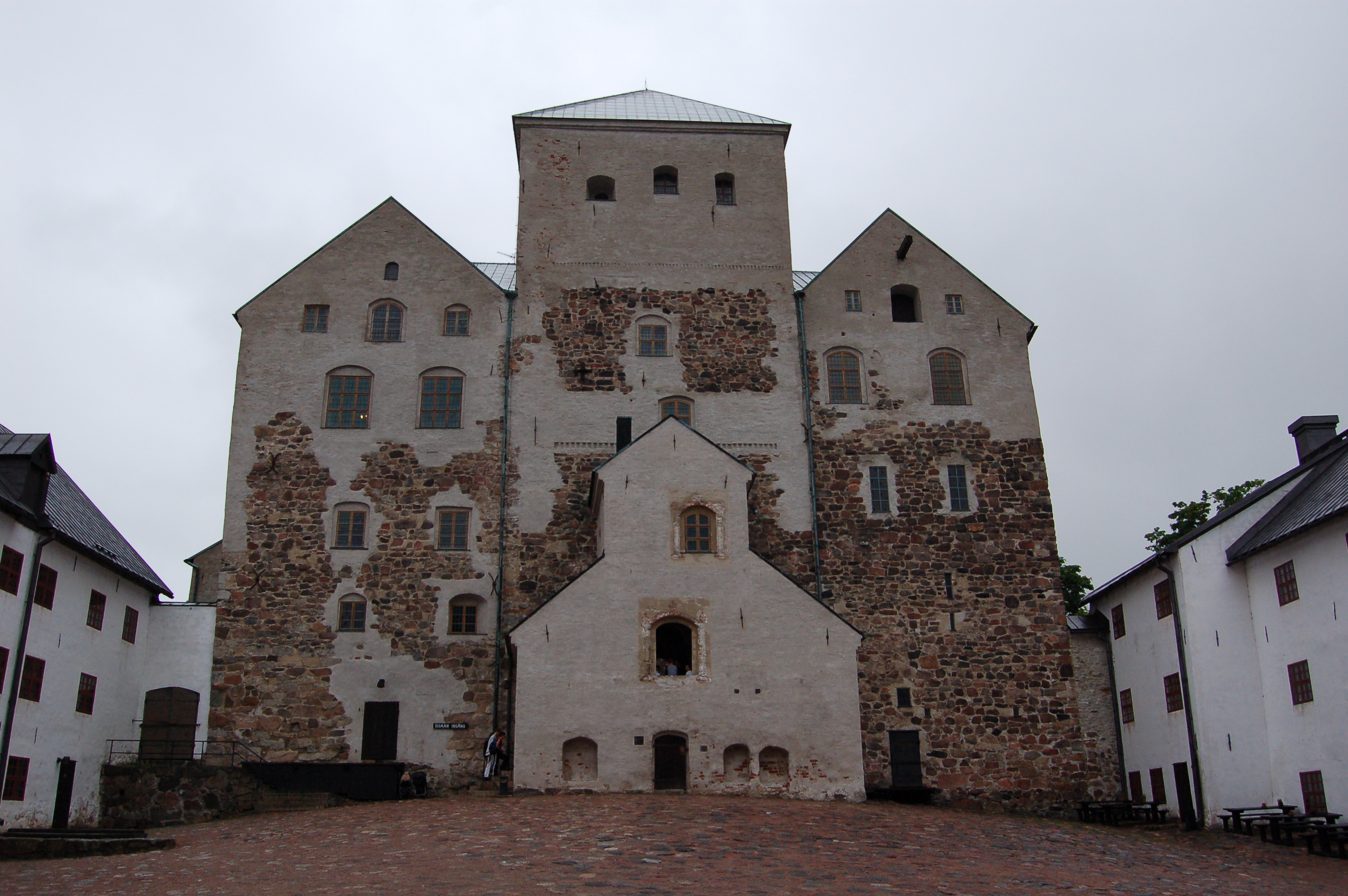
Turku Castle
For a few years in the late 1390s, pirates operated freely from the halls of Turku Castle. The Victual Brothers, privateers turned raiders who terrorized Baltic shipping, had been invited in by the castle's own commander during a complicated web of political intrigue. They looted the cathedral across town. This is the kind of history that accumulates when a building has stood for seven hundred years at the crossroads of empires. The massive stone fortress on the banks of the Aura River began as a Swedish military outpost around 1280, became the administrative heart of Finland for centuries, housed a deposed queen as prisoner, survived devastating fires, served as a grain warehouse, held criminals in its dungeons, took Soviet bombs during World War II, and today welcomes over 100,000 visitors annually as Finland's most popular museum.
The Swedish Century
Swedish soldiers built the first fortifications here in a land they called Osterland, the eastern country. For the next five hundred years, Finland would be part of the Swedish realm, and Turku Castle would be its administrative center. The fort's walls grew thick, reaching six meters at the base. Living quarters rose behind the battlements. By the 15th century, a proper medieval keep stood on what had been essentially an island, surrounded by a moat connecting to the Aura River. The castle watched over the most important trading center in Finland, controlling commerce and collecting taxes for distant Swedish kings. It changed hands during power struggles within Sweden and the broader Kalmar Union, enduring sieges and witnessing battles fought just beyond its walls.
A Duke's Renaissance
The castle reached its peak in the mid-16th century under Duke John of Finland and his wife Catherine Jagellon, a Polish princess. Gustav Vasa had placed his son in charge of Finnish administration, and John transformed the military fortress into something approaching a Renaissance court. New towers rose at the southeast corner. The Duke and Duchess constructed an entirely new Renaissance floor with a King's Hall and Queen's Hall, bringing courtly refinement to the Baltic frontier. This was the castle's golden age, but it would not last. Political winds shifted, and from 1573 to 1577, the deposed Swedish Queen Karin Mansdotter was held prisoner within these same elegant walls.
Fire, Abandonment, and Reinvention
In 1614, a great fire swept through the castle while King Gustav II Adolf was visiting. The wooden structures of the old section burned almost completely, and afterward the main keep was largely abandoned, reduced to storage space. The Renaissance bailey continued to function as an administrative center through the turbulent 18th century, including the period of Russian occupation known as the Greater Wrath. The castle's new purpose became darker: from the 18th century until the end of the 19th, it served as a prison. During the Finnish War of 1808-1809, the Russian Navy took control before eventually returning it to Finnish regional authorities under the Grand Duchy.
Rebirth as Museum
The Turku Historical Museum gained control of the castle in 1881, beginning a long journey toward restoration. When Finland declared independence in 1917, the young republic inherited this ancient Swedish fortress as its own. Renovation work began before World War II but was interrupted by the Winter War in 1939 and the Continuation War that followed. Soviet incendiary bombardment damaged the castle again, echoing the fires of centuries past. Work resumed after peace came, and the full restoration was finally completed in 1987, over a hundred years after the museum first took possession. The City of Turku assumed responsibility in 1993, and today the old banquet halls host events while a church serves the local congregation.
Stone Witness to History
Walk through the castle today and you pass through layers of Finnish history made physical. The medieval keep with its massive walls recalls the Swedish crusaders who first built here. The Renaissance chambers remember a Polish princess and a Finnish duke who tried to create something beautiful at the edge of the known world. The prison cells recall darker centuries when the grand halls had been abandoned and the castle served merely to confine. The restoration work itself tells a story of national identity, of a young country choosing to preserve its complicated past. The castle stands where it has always stood, on the banks of the Aura River, watching ships pass as they have for seven centuries.
From the Air
Located at 60.44°N, 22.23°E on the western bank of the Aura River in Turku, Finland. The castle sits near the river's mouth where it meets the Baltic Sea. Its distinctive medieval silhouette with square towers is clearly visible when approaching from the water. The nearby Forum Marinum maritime museum and the museum ship Sigyn are within sight. Turku Airport (EFTU) lies approximately 8 km north. The castle grounds include a public park, and the structure's gray stone walls contrast with the surrounding modern city.