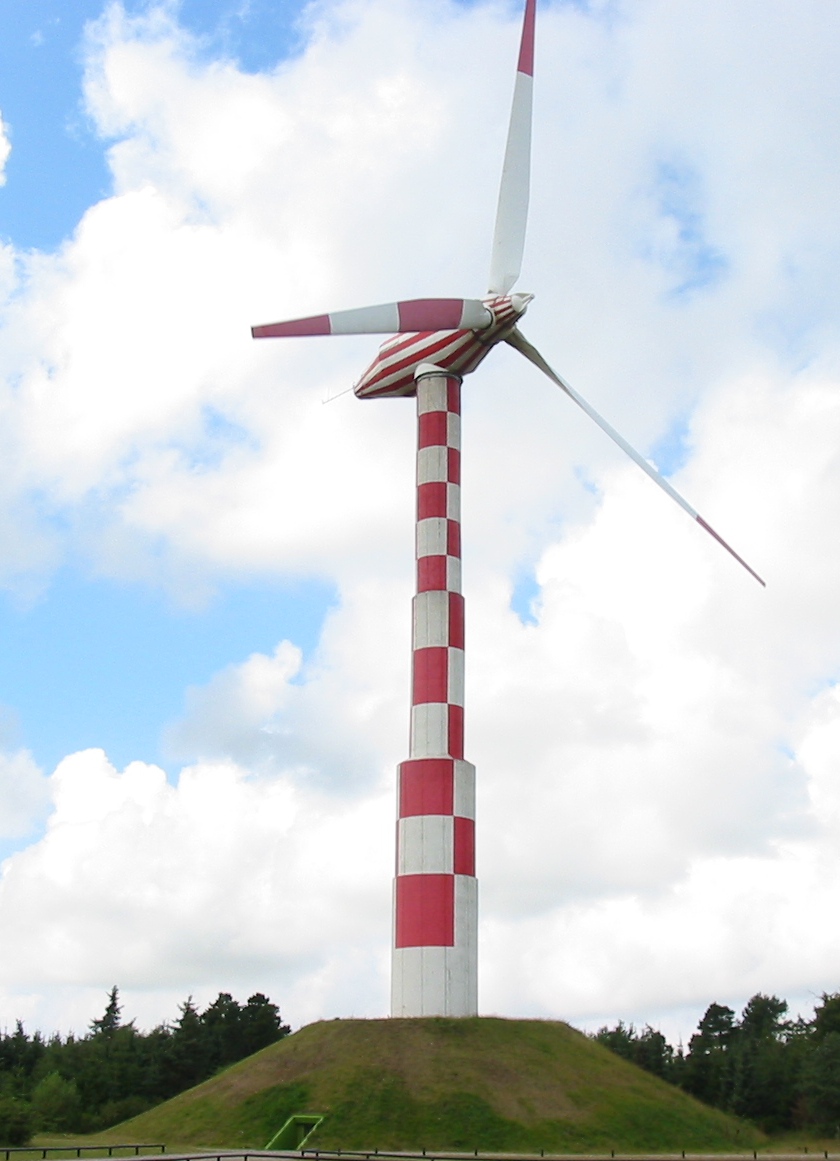
Tvindkraft Wind Turbine
In the flat farmland of West Jutland, near the small town of Ulfborg, a 54-meter concrete tower rises above the Danish countryside with three fiberglass blades turning in the North Sea wind. It looks modest by the standards of modern wind farms, where turbines routinely stand three times taller. But the Tvindkraft wind turbine -- Tvindmollen, the Tvind Mill -- is not a relic. It still generates electricity. And when it first began feeding power to the grid in 1978, it was the tallest wind turbine in the world, a record it held until around 2000. More importantly, it helped prove that wind energy could work at scale, setting off a chain of research and development that made Denmark a global leader in the industry.
A School Project Like No Other
Tvindkraft was not built by engineers working for a power company. It was built by the school cooperative Tvind -- teachers and students who decided that if they wanted to understand renewable energy, they should build a turbine themselves. The tower and cone are iron-reinforced concrete; the pinnacle is rolled steel; the blades are fiberglass. The project drew on outside expertise where it was needed: researchers from Riso DTU, Denmark's national laboratory for sustainable energy, calculated the aerodynamics of the blades. But the construction was carried out by the school community. The result was a 2-megawatt turbine that, improbably, catalyzed serious institutional research into wind energy. Riso DTU continued the aerodynamics work that the Tvind project had initiated, and the lessons learned fed directly into Denmark's emerging wind power industry.
Running at Half Speed
From the beginning, the turbine operated at roughly half its rated capacity, producing about 1 megawatt rather than 2. This was not a failure -- it was physics making itself heard. During test runs, the builders discovered that the turbine needed to spin faster than it could safely manage. History later confirmed what the test run revealed: 1 megawatt is precisely the power that blades of 27-meter span can generate. The slower speed also uncovered a resonance problem. At 27 revolutions per minute, the blades hit the tower's natural oscillating frequency, a dangerous condition that could shake the structure apart. The rotor speed was therefore limited to a maximum of 21 revolutions per minute. These constraints, which might have seemed like setbacks, turned out to be gifts. The lower operating speed reduced mechanical stress and extended the turbine's life far beyond what anyone expected.
Forty-Seven Years and Counting
In its first years, the local power grid could absorb only 400 kilowatts of Tvindkraft's output, even though the turbine was already producing a full megawatt. The excess energy was routed to a 500-kilowatt immersion boiler that heated water for the school's central heating system -- an elegant solution that kept nothing wasted. By July 2007, the turbine had logged 117,540 operating hours, completed 100 million revolutions, and produced 16 gigawatt-hours of electricity. The mill still runs today with all its original components except the blades and blade bearings, which have been replaced. In an industry where turbines are typically designed for 20- to 25-year lifespans, Tvindkraft has operated for nearly half a century.
The Spark That Lit an Industry
Tvindkraft's significance extends well beyond its own output. Denmark's modern wind energy sector -- which today supplies a substantial share of the country's electricity -- traces part of its origin story to this school cooperative's audacious project. The turbine demonstrated that large-scale wind generation was technically feasible at a time when the concept was still treated with skepticism by utilities and governments. The aerodynamics research it prompted at Riso DTU became foundational work for the Danish wind industry. Standing in the fields near Ulfborg, the Tvindkraft turbine is easy to overlook. It is dwarfed by the offshore giants that now dot the Danish coastline. But every one of those modern turbines owes something to the teachers and students who poured concrete, shaped fiberglass, and proved that the wind could be harnessed not just in theory but in practice, reliably, for decades.
From the Air
Coordinates: 56.26N, 8.28E. The turbine is located near Ulfborg in West Jutland, Denmark, and is visible as a solitary structure in flat agricultural terrain. At 54 meters, it is shorter than modern turbines but distinctive in its concrete construction. Nearest airport: Karup Airport (EKKA) to the east, Esbjerg Airport (EKEB) to the south. The flat Jutland landscape makes it easy to spot from low altitude. Look for the Tvind school complex nearby.