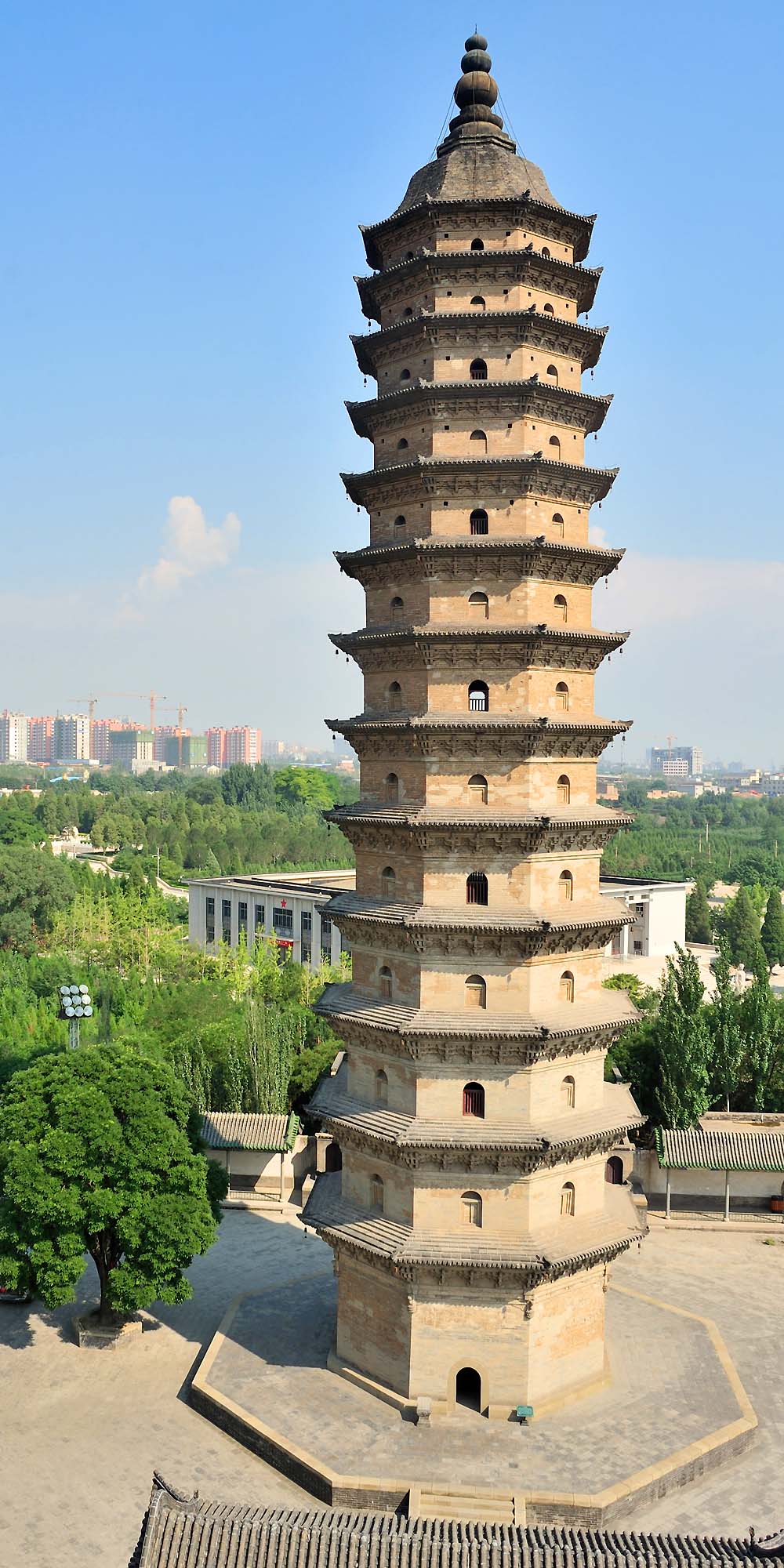
Twin Pagoda Temple
They lean toward each other like old friends sharing a confidence. The twin pagodas of Yongzuo Temple in Taiyuan, Shanxi province, are the tallest matching pair in China, and for most of the twentieth century, one of them was slowly falling. By the time engineers intervened in 1995, the East Pagoda had drifted 2.87 meters from its center of gravity, a structural tilt accumulated over nearly four hundred years. The correction worked. Both pagodas still stand, their octagonal silhouettes defining Taiyuan's skyline as they have since the late Ming dynasty.
Built by a Monk Named Fodeng
The East Pagoda was completed first, in 1597. The West Pagoda followed fifteen years later, in 1612. Overseeing the construction of both was Fodeng, a high-ranking Buddhist monk whose name means "Buddha's Lamp." The gap between the two construction dates is visible in subtle differences between the structures, though both follow the same octagonal plan. The West Pagoda reaches 54.78 meters, slightly taller than the East at 53.3 meters. Both taper floor by floor, each successive level smaller than the one below, creating the distinctive tiered profile that makes pagodas one of the most recognizable forms in East Asian architecture.
Emerald Eaves and Copper Gourds
The details reward close attention. The West Pagoda's eaves are painted with emerald green glaze, a color that shifts in tone depending on the angle of sunlight and the season. At the lowest floor, the circumference measures 4.16 meters, expanding slightly at the East Pagoda to 4.36 meters. Crowning the East Pagoda are three magic gourds, known as bao hulu, the upper two fashioned from copper. In Chinese Buddhist symbolism, gourds represent blessings and the containment of evil spirits. After four centuries of exposure to Shanxi's hot summers and cold winters, these copper forms have developed the green-blue patina that marks aged metal.
A Forest of Stone Steles
The temple grounds shelter approximately 260 stone steles, calligraphic inscriptions carved into stone that serve as some of China's most durable historical records. Many of these steles were relocated to Yongzuo Temple from other temples in the Taiyuan area that were destroyed over the centuries, making the compound a kind of archive in stone. Among the peony trees that dot the grounds, one specimen dates to the Ming dynasty itself, its roots contemporary with the pagodas it grows beside. Each spring, when the peonies bloom, the temple becomes a gathering place for residents of Taiyuan who come as much for the flowers as for the history.
Saving the Leaning Tower
By the twentieth century, the East Pagoda's lean had become alarming. Centuries of settling, combined with the geological instability that affects much of the Loess Plateau region, had shifted the structure 2.87 meters off its vertical axis. In 1995, a team of engineers undertook a correction project, carefully removing earth from beneath the foundation to allow the pagoda to settle back toward plumb. The method echoes techniques used to stabilize other famous leaning structures around the world, including the Leaning Tower of Pisa. The project succeeded, and the East Pagoda now stands close to its original alignment, its tilt reduced to a fraction of what it had been.
From the Air
Located at 37.85N, 112.59E on the eastern edge of Taiyuan, Shanxi province. The twin pagodas are among the tallest structures in the historic city and may be visible from low altitude. Nearest major airport: Taiyuan Wusu International (ZBYN), approximately 12 km south. Recommended viewing altitude: 2,000-4,000 feet for best visibility of the pagoda silhouettes against the city.