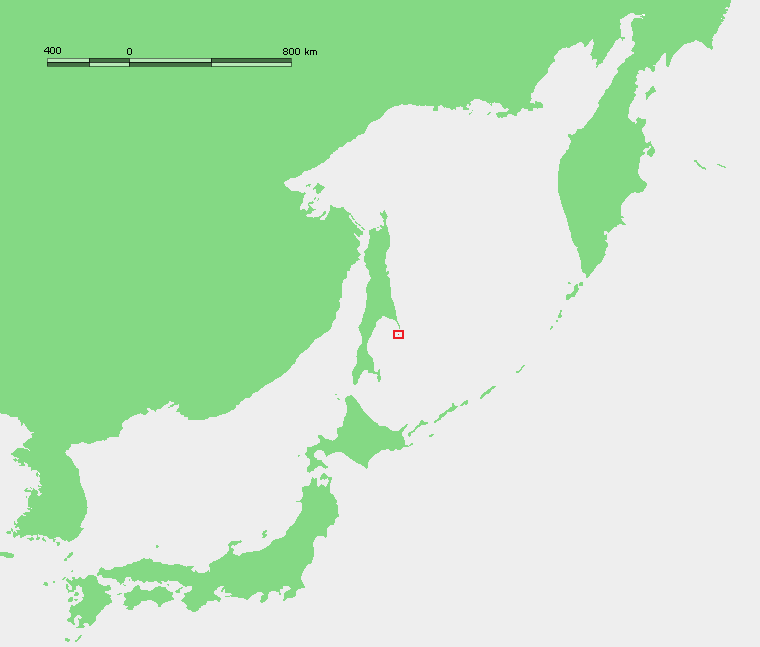
Tyuleny Island (Sea of Okhotsk)
Every language that has named this island has called it the same thing. The Ainu knew it as Atoyamoshiri -- the island of net fishing -- and also by a name meaning the island of adult fur seals. The Dutch explorer Maarten Gerritszoon Vries charted it in 1643 as Robben Island: seal island. The Russians, arriving later, called it Tyuleniy -- seal island again. When a place earns the same name from every culture that encounters it, the naming says less about the people than about what they found. Tyuleny Island is, above all else, a place where seals have gathered since before humans had words for it.
A Sliver in the Okhotsk
The numbers alone make Tyuleny seem implausible. The island is less than 700 meters long and between 40 and 90 meters wide -- a total area of 0.053 square kilometers, smaller than most parking lots. It consists of an 18-meter-high rock with cliffs and a plateau on top, flanked by sandy spits extending from both ends. There is no fresh water. The surrounding reefs make approach treacherous. In the geological past, Tyuleny was connected to Cape Patience on Sakhalin Island's eastern shore, about 12 kilometers to the northeast. Tectonic processes and coastal erosion severed the connection, leaving this fragment of Late Cretaceous sedimentary rock adrift in the Sea of Okhotsk, slowly shrinking as waves, weather, and the aggressive organic residue of its enormous seabird colony eat away at its edges.
Wall-to-Wall Life
What Tyuleny lacks in size, it compensates for in biological density. The island hosts one of the largest reproductive rookeries of northern fur seals in the Northwest Pacific. Steller sea lions breed alongside them, and spotted seals haul out on the beaches between the larger pinnipeds. Above the seal colonies, the numbers become staggering: more than 145,000 common guillemots breed on the plateau and cliffs, packed at densities of up to 20 nesting plots per square meter. Black-legged kittiwakes, slaty-backed gulls, tufted puffins, rhinoceros auklets, crested auklets, parakeet auklets, ancient murrelets, and northern fulmars compete for whatever space remains. In all, 143 bird species have been observed on this tiny island, 12 of them confirmed breeders. Biologists have noted that several passerine species found here belong to subspecies native to Kamchatka rather than nearby Sakhalin -- a biogeographic puzzle suggesting wind-borne arrivals from far across the sea.
The Killing Yards
Humans came to Tyuleny for the seals and stayed for the profit. Adam Johann von Krusenstern visited during his circumnavigation in 1805, and by the late nineteenth century the island had acquired the infrastructure of industrial slaughter: houses for hunters and military personnel, small factories for skinning fur seals and salting pelts, and a fenced yard-field for the killing itself. The scale of the harvest prompted one of the earliest international conservation agreements: the North Pacific Fur Seal Convention of 1911, which restricted commercial sealing across the region. A second treaty, the Interim Convention on the Conservation of North Pacific Fur Seal, followed in 1957. Even so, commercial hunting on Tyuleny continued until 2008, when the last official harvest took place.
Viruses from the Ticks
Tyuleny's fame in scientific circles extends beyond seals and seabirds. The island is the type locality for several arboviruses isolated from Ixodes uriae ticks that infest the seabird colony. These include Tyuleniy virus, Sakhalin virus, Paramushir virus, Zaliv Terpeniya virus, and several others named for locations across the Russian Far East. The ticks feed on the guillemots and other colonial seabirds, and the dense aggregation of hosts on such a small area creates ideal conditions for viral transmission. The island functions as a natural laboratory for studying how pathogens circulate within and between wildlife populations -- a research interest that has only grown more urgent in an era of emerging zoonotic diseases.
Ruins and Resilience
The abandoned factories and dilapidated structures from the sealing era still stand on Tyuleny, slowly collapsing under the combined assault of salt air, seabird guano, and neglect. They contribute a significant amount of anthropogenic debris to an island otherwise untouched by development. From the air, Tyuleny appears as a pale scratch on the dark surface of the Okhotsk -- impossibly small, impossibly crowded with life. The seals have reclaimed the beaches. The guillemots carpet the plateau so densely that the rock beneath is invisible. In every meaningful sense, this island belongs to the animals that gave it every name it has ever had.
From the Air
Located at 48.50N, 144.63E in the Sea of Okhotsk, approximately 12 km southwest of Cape Patience on Sakhalin Island's eastern coast. The island is extremely small (700m x 40-90m) and may be difficult to spot from high altitude, but its white coloration from guano and the surrounding dark water create contrast. Look for it off the eastern bulge of Sakhalin near the Gulf of Patience. Nearest airport: Yuzhno-Sakhalinsk (UHSS), approximately 200 km to the south.