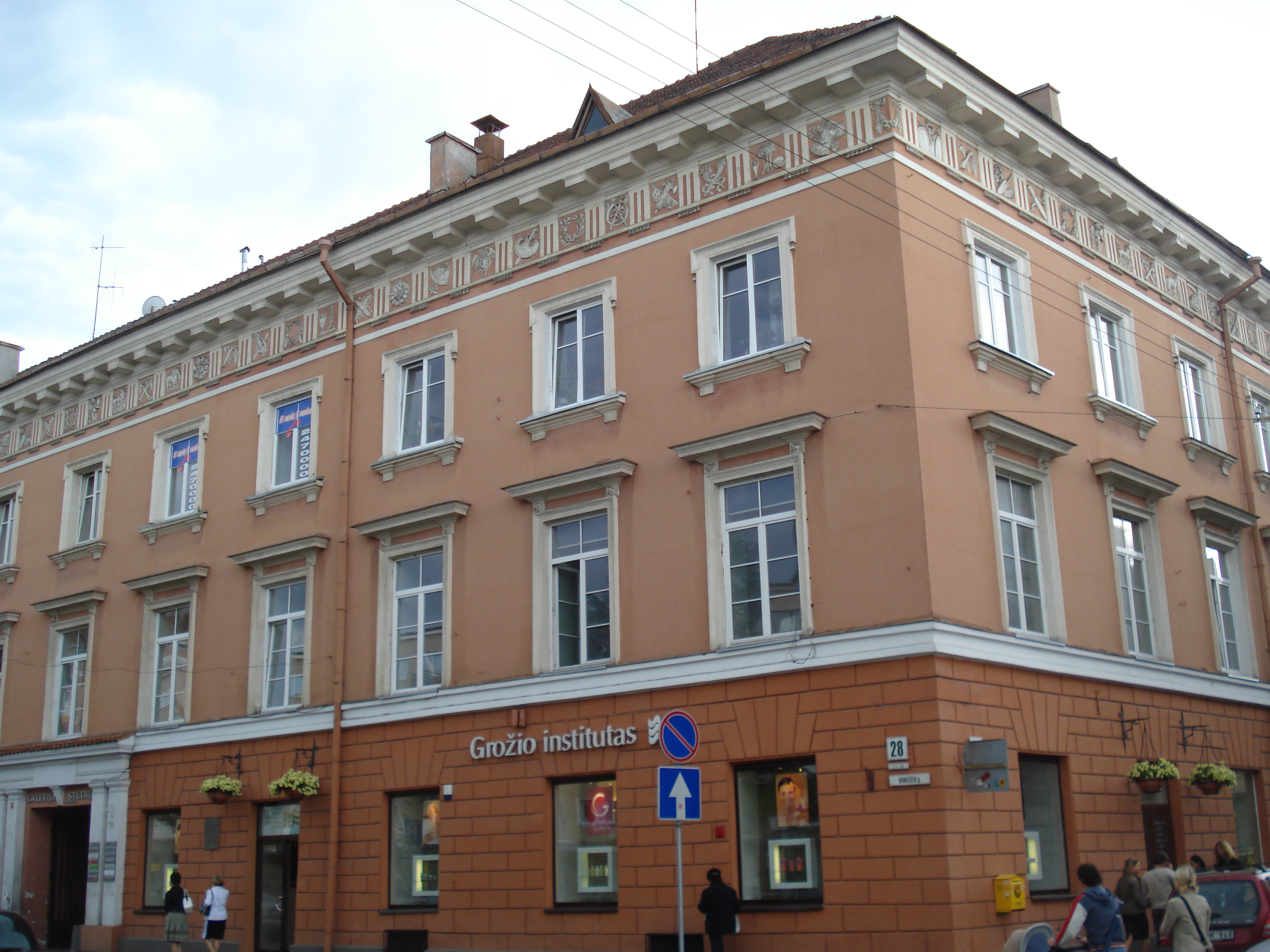
Tyzenhauz Palace
Antoni Tyzenhauz had a problem common to brilliant men in 18th-century Lithuania: he could not stop building. As treasurer of Lithuania, starost of Grodno, and the close friend who managed King Stanisław August Poniatowski's royal estates, he ran an industrialization program in the Grodno region that might have transformed the Grand Duchy if it had worked. It mostly did not. By 1777 he was bankrupt and dismissed from court. By 1785 he was dead. But around 1765 he had bought a parcel in central Vilnius, atop a long-vanished International Gothic building, and in the early 1770s he commissioned a classical-style palace there - probably from the Venetian architect Giuseppe de Sacco. The palace outlived him by two and a half centuries. He gave it his name, and the name stuck.
Layered by Owners
Few buildings in Vilnius have been reworked as often. After Tyzenhauz's death, General Fitinhof's widow bought the palace in 1789 and ordered a refurbishment the next year, almost certainly carried out by Martin Knakfuss - the German-born architect and Jesuit Academy professor who shaped much of late-18th-century Vilnius. New simplistic facades went up, and the so-called Silver Hall was built. After his work, the palace contained 30 halls and 16 smaller rooms, making it one of the largest aristocratic residences in Lithuania. In 1807, Mikołaj Szulc led another refurbishment, modernizing the interior and adding a new staircase. By the 19th century the building had begun a long slide: subdivided into shops, doors and windows punched through the ground floor, the luxurious finishes peeling away under commercial use.
The Hotel and the Wars
In the early 20th century, E. Bortkiewicz bought the palace and rebuilt the second floor. After Wilno became part of Poland in 1922, the upper floors were converted into the Hotel Sokołowskiego, named for its owner. German bombs damaged the building during the 1939 Polish Defensive War. Five years later, during Operation Ostra Brama in July 1944 - the Polish Home Army's attempt to liberate the city ahead of the advancing Soviets - the palace took further hits. Only the cellars, ground floor, and outer walls survived. Unlike many of its neighbors on Vokiečių Street, which were demolished entirely, the palace was rebuilt in 1945. In 1957 Algimantas Umbrasas led a complete reconstruction, this time to serve Soviet needs: small apartments carved into the carcass, addressing the housing shortage caused by the city's wartime destruction. A fourth floor was added on the courtyard side, invisible from the street.
Trapezoid with a Gothic Cellar
The palace today reads more like a city block than a single building. Its plan is a trapezoid; three floors face Vokiečių Street, four face the courtyard, and the courtyard itself is fully enclosed, accessible through gates on each adjacent street. Beneath all of it sits a two-level Gothic cellar - the bones of that 1579 building Tyzenhauz inherited - currently unused. Look up from the street side and you find the most interesting flourish: bas-relief sculptures arrayed beneath the tall attic, a quiet Baroque punctuation surviving above more than two centuries of rebuilds. The rooms along the street side are arranged in two parallel lines, with windows opening on both the street and the courtyard, a layout that brings light deep into a building wedged tight against its neighbors.
After Independence
When Lithuania regained independence in 1990, Vilnius Old Town transformed almost overnight from a place of forgotten Soviet flats into prime real estate. Of the 40 apartments carved out of the palace, most have since been sold and converted to offices or shops. The address - Vokiečių 28, also Trakų 17, on a corner where two streets meet - puts the building near the lively bars and restaurants of the German Quarter. Most passersby have no idea who Tyzenhauz was, or that the cellar beneath their feet is older than the United States. The palace simply absorbs them all - shoppers, tenants, the occasional historian - the way it has absorbed every century since the 1700s.
From the Air
Tyzenhauz Palace stands at 54.6802 degrees north, 25.2823 degrees east, in Vilnius Old Town on the corner of Vokiečių and Trakų Streets, approximately 400 meters southwest of Vilnius Cathedral. From cruising altitude the building is one cell in the dense Old Town fabric; the area is best identified by the Cathedral and Gediminas Tower complex just to the northeast. Vilnius International Airport (EYVI) lies about 6 km south.