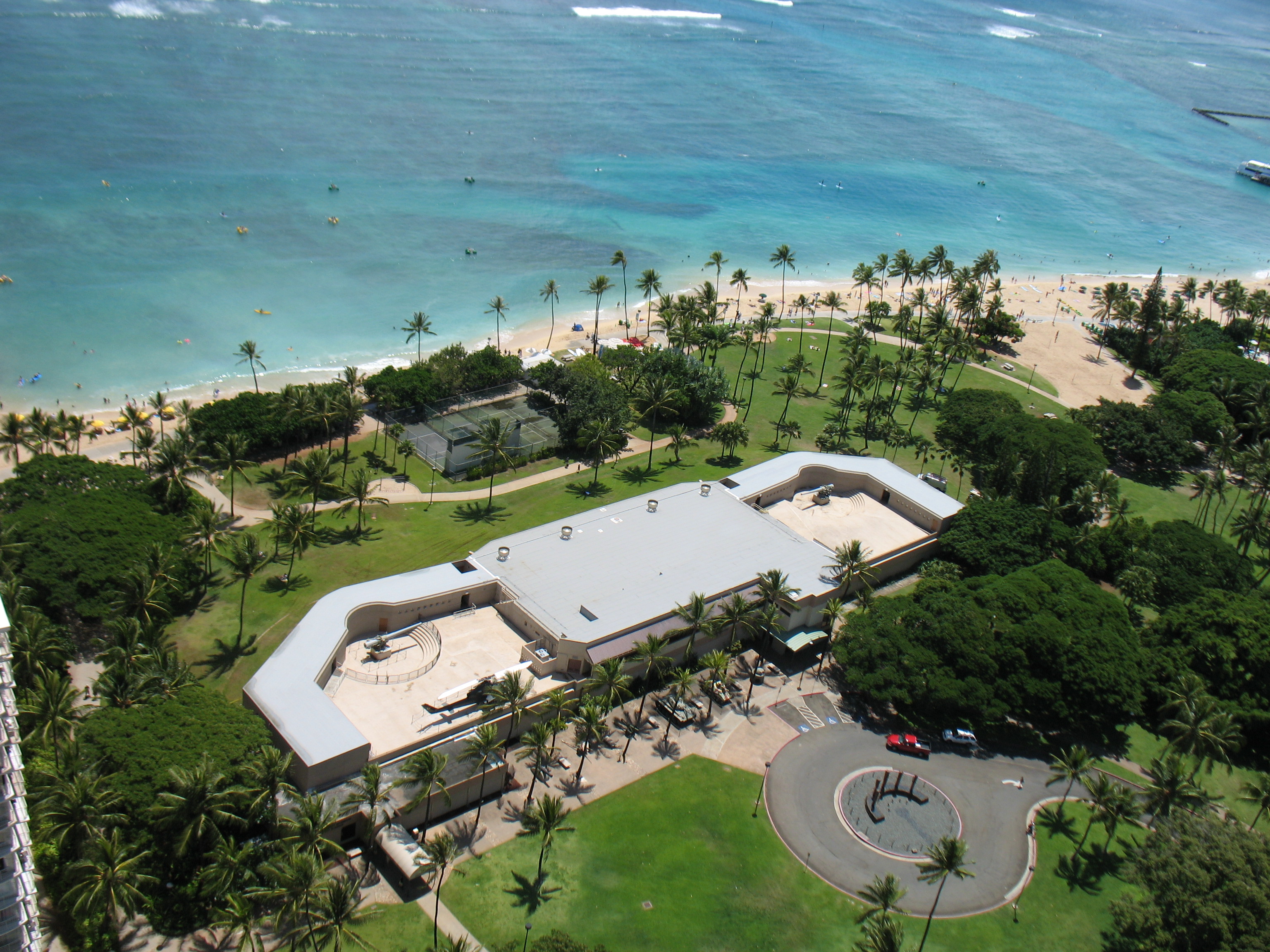
U.S. Army Museum of Hawaii
Walk a hundred yards from the sunbathers on Waikiki Beach and you will find a concrete bunker built to withstand a naval bombardment. Battery Randolph, completed in 1911 as part of Oahu's coastal defense network, once mounted a pair of fourteen-inch guns capable of hurling shells miles out to sea. The guns are gone now, scrapped after World War II, but the battery itself proved so massively overbuilt that when the Army tried to demolish it, the project was abandoned as impractical. Instead, in 1976, the indestructible structure became the U.S. Army Museum of Hawaii, a free public museum sitting in one of the most expensive real estate corridors on Earth.
A Fortress That Refused to Fall
Battery Randolph was part of what military planners called the Ring of Steel, a system of coastal fortifications ringing Oahu that was designed to repel a naval assault on Pearl Harbor and Honolulu. The battery's walls are reinforced concrete several feet thick, engineered to absorb direct hits from battleship-caliber guns. Its original fourteen-inch main guns could rotate to cover wide arcs of the ocean approaches to the south shore. The irony, of course, is that when the attack finally came in December 1941, it arrived by air, not by sea, rendering the Ring of Steel largely irrelevant. After the war, the big guns were removed and the battery sat empty on the Fort DeRussy Military Reservation, surrounded by the resort hotels and shopping arcades of modern Waikiki. When demolition crews attempted to tear it down, they discovered that the same engineering designed to survive enemy shells also defeated wrecking balls. The Army made the pragmatic choice: if you cannot destroy it, make it a museum.
From Ancient Warriors to the Pacific Theater
The museum's exhibits trace a long arc, beginning with the military traditions of pre-contact Hawaii, where warfare was governed by kapu and conducted with weapons of wood, stone, and shark teeth. From there, the collection moves through the upheavals of the nineteenth century, the annexation era, and into the twentieth-century conflicts that turned Hawaii into the most important military staging area in the Pacific. Two armored vehicles anchor the World War II collection: a U.S. M24 Chaffee light tank and a captured Japanese Type 95 Ha-Go, both veterans of the Pacific campaign. An AH-1 Cobra attack helicopter represents the Vietnam era. Indoors, small arms displays and personal artifacts bring the scale of industrial warfare down to the human level. The Gallery of Heroes honors recipients of the Medal of Honor, the Distinguished Service Cross, the Navy Cross, and the Air Force Cross, putting names and faces to the abstract language of valor that military citations employ.
Waikiki's Hidden Military Landscape
Fort DeRussy, the military reservation surrounding the museum, is itself a piece of hidden history. Established in 1909, the fort once occupied a much larger footprint along the Waikiki shoreline. Today its boundaries have shrunk, but the reservation still includes the Hale Koa Hotel, a military resort serving active-duty personnel and veterans, and the museum shares its campus with the Regional Visitor Center of the U.S. Army Corps of Engineers Pacific Division. The Corps center showcases engineering projects across Hawaii and the wider Pacific, from harbor construction to flood control. Walking from the beach through the museum's doors, visitors cross an invisible border from civilian tourism into the military infrastructure that has shaped Hawaii since the early 1900s. The museum sits at 2131 Kalia Road, adjacent to the Hale Koa, with free admission and no security screening, a deliberate choice to make the military's story accessible to the millions of tourists who pass within a few blocks each year without realizing that Waikiki was once a garrison as much as a resort.
Guns from a Battleship, Lessons from a Century
The fourteen-inch guns that once gave Battery Randolph its purpose were cut up for scrap after 1945, but the museum has mounted two replacement pieces to give visitors a sense of the battery's original function. These seven-inch naval guns were salvaged from the USS New Hampshire, a pre-dreadnought battleship commissioned in 1908. They are smaller than the originals but still imposing, their barrels angled over the palm trees toward a horizon that no longer needs defending. The juxtaposition is the museum's quiet argument: that the history of warfare in the Pacific is not abstract but physical, embedded in the concrete and steel of this very building, in the tanks parked outside, in the helicopter suspended overhead. Hawaii's military story is not confined to Pearl Harbor and the Arizona Memorial. It lives in the coastal batteries, the fortified ridgelines, the training grounds that shaped soldiers for campaigns from Guadalcanal to Korea to Vietnam. Battery Randolph, too tough to tear down and too important to forget, holds that story in its walls.
From the Air
Located at 21.2815N, 157.835W on the Waikiki shoreline of Oahu, within the Fort DeRussy Military Reservation. The low concrete battery structure sits among taller resort buildings but is identifiable by its squat, bunker-like profile and the military vehicles displayed outside. Diamond Head crater is 1.5 miles to the southeast. Daniel K. Inouye International Airport (PHNL) is approximately 7 miles northwest. The museum is adjacent to the Hale Koa Hotel, a large white military resort building. Best viewed at 1,000-2,000 feet AGL from over the Ala Wai Canal or the offshore waters of Waikiki.