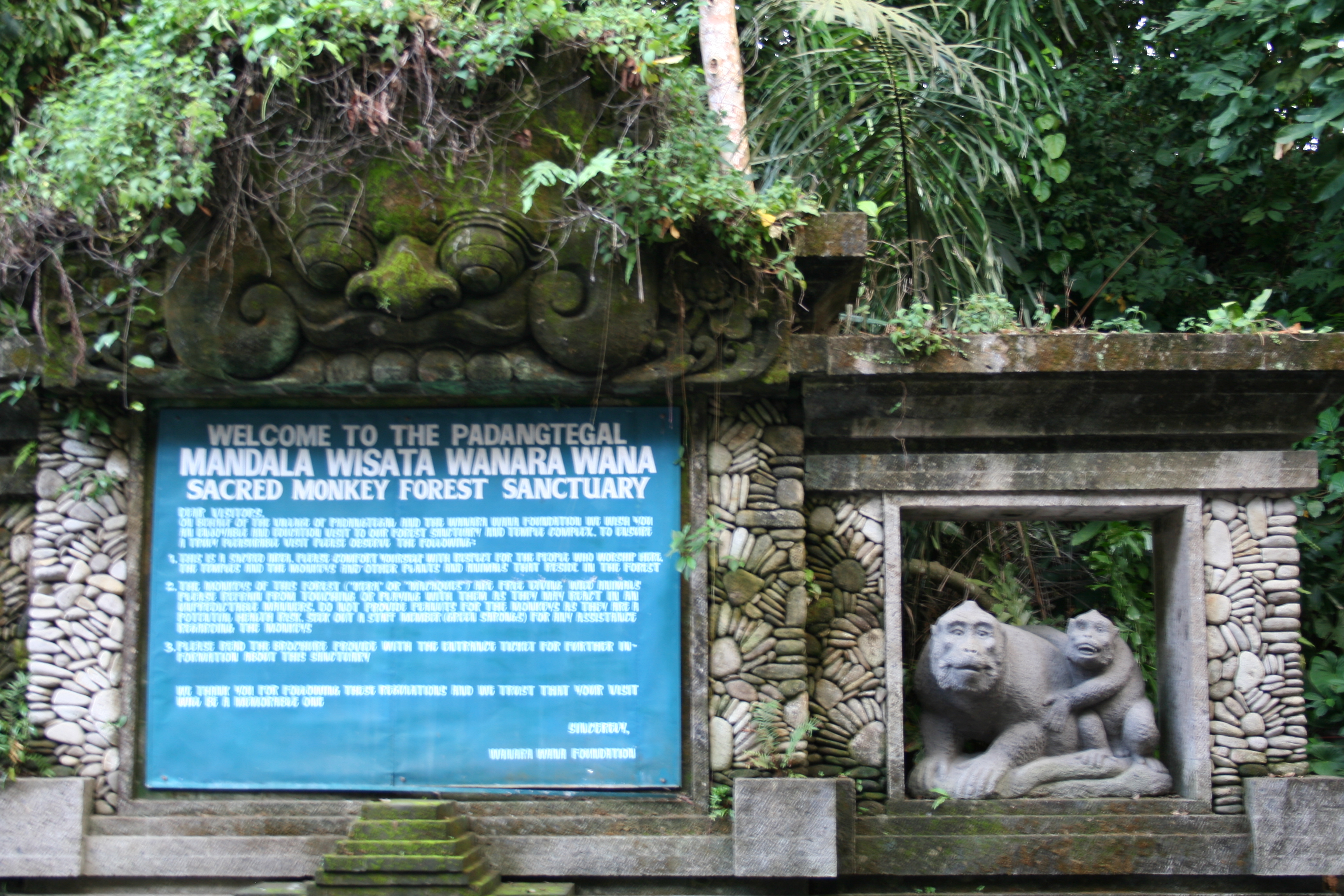
The Sacred Troop of Padangtegal
They will take your sunglasses. They will unzip your bag. They will sit on your head, rifle through your pockets, and stare you down with the unblinking confidence of a creature that has lived alongside humans for seven centuries and learned exactly what it can get away with. The long-tailed macaques of Ubud's Sacred Monkey Forest are not tame -- the sanctuary's own safety guidelines make that clear -- but they are deeply habituated to people, and the result is one of the most intimate encounters with wild primates anywhere in the world. Over 1,260 of them share this 12.5-hectare patch of forest in the heart of Ubud, their social dramas unfolding among moss-covered stone carvings and banyan roots that have been swallowing temple walls since the 14th century.
Three Temples in the Trees
The forest's official name -- Mandala Suci Wenara Wana, the Sacred Monkey Forest Sanctuary -- reflects its primary identity as a religious site, not a zoo. Three Hindu temples stand within the grounds, all believed to have been constructed around 1350, during the rule of the Pejeng dynasty at the dawn of the Gelgel era. Pura Dalem Agung Padangtegal, the "Great Temple of Death," occupies the southwestern corner and is dedicated to Shiva in his role as recycler and transformer. Pura Beji, a purification temple, sits near a natural spring. Pura Prajapati, the funeral temple, stands beside the cremation grounds where village ceremonies still take place. For the community of Padangtegal, the forest is not a park with temples in it. It is a temple complex with a forest around it.
Tri Hita Karana: The Three Harmonies
The sanctuary's conservation philosophy is rooted in the Balinese Hindu principle of tri hita karana -- literally, "three causes of well-being." The concept prescribes harmonious relationships in three directions: between humans and God, between humans and the natural environment, and among humans themselves. This is not decorative theology. It shapes operational decisions, from the way the forest's 115 documented tree species are maintained to how the macaques are fed and studied. Park staff provide sweet potatoes three times daily as the monkeys' primary food source, supplemented by papaya leaf, maize, cucumber, and coconut. The feeding schedule is calibrated not just for nutrition but for the social stability of the troop -- hungry macaques are aggressive macaques, and aggression disrupts the harmony that tri hita karana demands.
What the Monkeys Teach
The forest has become a natural laboratory for primatologists studying how long-tailed macaques (Macaca fascicularis) negotiate life alongside humans. Researchers from the Balinese Macaque Ethnoprimatology Field Project and other institutions have conducted studies here on mating strategies, dominance relationships, migration patterns, and habitat use. One area of particular interest is the grooming network: macaques groom each other not merely for hygiene but to build and maintain social alliances, and the patterns of who grooms whom reveal the invisible power structures within the troop. More recent research has examined gastrointestinal parasite infections in relation to social network centrality -- essentially asking whether the most socially connected monkeys are also the most exposed to disease. The forest's combination of high primate density and constant human contact makes it a uniquely valuable site for understanding synanthropy, the process by which wild species adapt to human-dominated environments.
Roots Swallowing Stone
Beyond the monkeys and the temples, the forest itself is extraordinary. Giant banyan trees send aerial roots down through stone carvings and over moss-covered walls, creating a landscape where architecture and botany have merged into something neither could produce alone. The canopy is dense enough to drop the temperature several degrees below the streets of Ubud just a few hundred meters away, and the filtered light gives the stone sculptures -- dragons, demons, guardian figures -- an atmosphere that shifts between playful and genuinely eerie depending on the hour. The grounds include a public hall, an open stage, and a gallery, but the forest floor is the real exhibition space. Walking the paths, you pass through zones where the monkeys ignore you entirely, zones where they watch you with calculating interest, and zones where they approach with an outstretched hand and an expression that says they have done this before. The village of Padangtegal views the forest as a spiritual, economic, educational, and conservation center all at once. It is all of those things. It is also, unmistakably, the monkeys' home.
From the Air
Located at 8.519°S, 115.258°E in the village of Padangtegal, at the southern edge of Ubud in central Bali. The 12.5-hectare forest canopy is visible as a dense green patch amid Ubud's development. Ngurah Rai International Airport (WADD) lies approximately 18 nm to the south. The forest sits in the river valley corridor that defines Ubud's geography, flanked by terraced rice paddies visible from altitude.