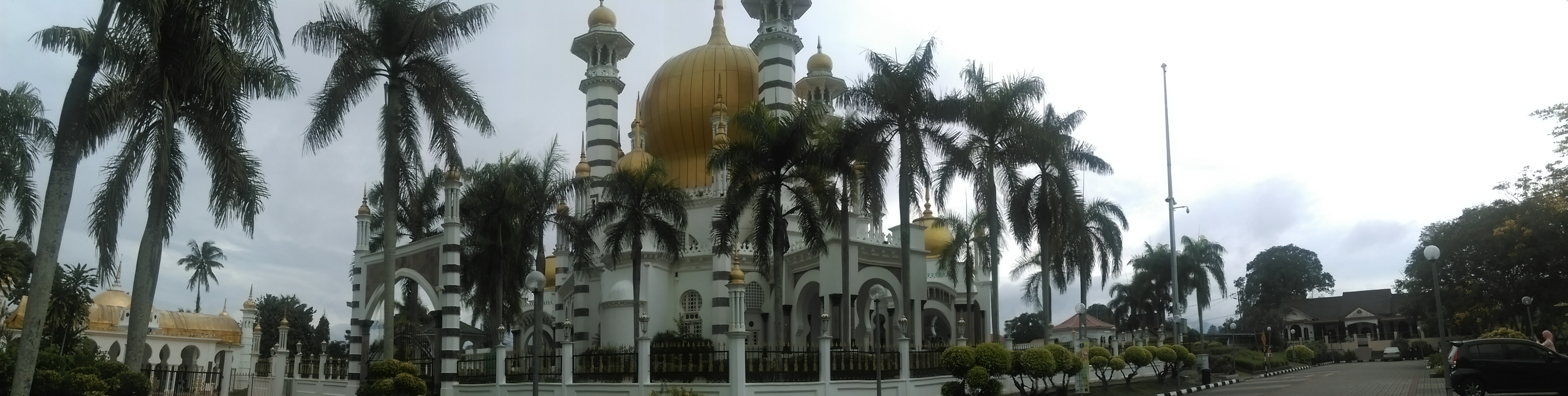
Ubudiah Mosque
Two elephants nearly killed this mosque before it was born. During construction in 1913, a pair belonging to Sultan Idris Shah I and the nobleman Raja Chulan broke loose, fought each other across the building site on Bukit Chandan hill, and trampled the imported Italian marble tiles. It was a setback both expensive and absurd, the kind of mishap that might have doomed a lesser project. But the Ubudiah Mosque in Kuala Kangsar, Perak, was built on gratitude -- a sultan's thanksgiving for surviving a serious illness -- and gratitude, it turned out, was harder to derail than marble was to replace.
A Sultan's Vow on Bukit Chandan
Sultan Idris Shah I, the 28th Sultan of Perak, had been gravely ill. When he recovered, he commissioned a mosque as an act of devotion, choosing a site on Bukit Chandan beside the Perak royal mausoleum in Kuala Kangsar, the seat of Perak's royal house. The groundbreaking ceremony took place on 26 September 1913, and the design fell to Arthur Benison Hubback, the same British architect who shaped the Ipoh railway station and the Kuala Lumpur railway station. Hubback worked across styles -- Neo-Moorish, Indo-Saracenic, Mughal Revival -- and for Ubudiah he drew on all of them, centering the design around a golden dome that would become the building's signature. The sultan would never see it finished. He died during the years of construction, and it was his successor, Sultan Abdul Jalil, who formally opened the completed mosque.
Elephants, War, and Carrara Marble
The elephant incident was only the first interruption. After the damaged marble was cleared and fresh tiles ordered -- Carrara marble, shipped from Italy -- the outbreak of World War I in 1914 disrupted supply lines across Europe and Southeast Asia. Materials grew scarce. Costs climbed. Construction slowed to a crawl. That the mosque was completed at all by late 1917 is a testament to sustained royal will; the final cost reached 24,000 Straits dollars, roughly RM 200,000 at the time, a considerable sum for a building described officially as small. Yet the word "small" misleads. The mosque's proportions feel intimate rather than cramped, its dome commanding without overwhelming the hilltop. The choice of scale was deliberate: this was not a congregational mosque for masses but a royal statement of faith, built to be exquisite rather than enormous.
Hubback's Golden Crown
Hubback's design unifies several architectural traditions without letting any single one dominate. The golden dome, visible for miles across the Perak River valley, borrows from Mughal precedents. Minarets flank the structure in a form familiar from Ottoman and Indo-Saracenic mosques across the British Empire. The interior dome, painted and detailed with geometric patterns, catches light that filters through arched windows. At night, illumination transforms the exterior into a glowing silhouette against Bukit Chandan. The mosque sits within a landscape of royal significance: the Makam Al-Ghufran, Perak's royal mausoleum, lies nearby, and the royal palaces of Kuala Kangsar occupy the surrounding hills. Hubback designed several of Malaysia's most recognizable colonial-era buildings, but the Ubudiah Mosque may be his most harmonious -- a building where the architect's eclecticism served the site rather than competing with it.
Pride of Perak
The mosque was renovated in 2003, but its essential character has changed little since 1917. It remains a working Sunni mosque, welcoming worshippers for daily prayers while also drawing visitors who come to photograph the dome against the tropical sky. For the people of Perak, the Ubudiah Mosque is more than architecture; it is a symbol of state identity, appearing in tourism materials and local pride in equal measure. Its story -- a sultan's gratitude, an architect's ambition, elephants and war, completion against the odds -- reads like a parable about persistence. Kuala Kangsar itself remains the royal town of Perak, quieter and more ceremonial than the state capital of Ipoh thirty kilometers to the south, and the mosque is its centerpiece. From the hilltop, the golden dome catches the sun and holds it, a beacon that has marked this bend of the Perak River for more than a century.
From the Air
Located at 4.764N, 100.951E atop Bukit Chandan hill in Kuala Kangsar, Perak. The mosque's golden dome is a highly visible landmark from the air, particularly when catching direct sunlight. Situated along the Perak River, the town is flanked by lush tropical hills. Nearest airport is Sultan Azlan Shah Airport (WMKI/IPH) in Ipoh, approximately 30 km southeast. At 1,500-2,500 feet AGL, the dome and adjacent royal mausoleum are clearly distinguishable on the hilltop above the river.