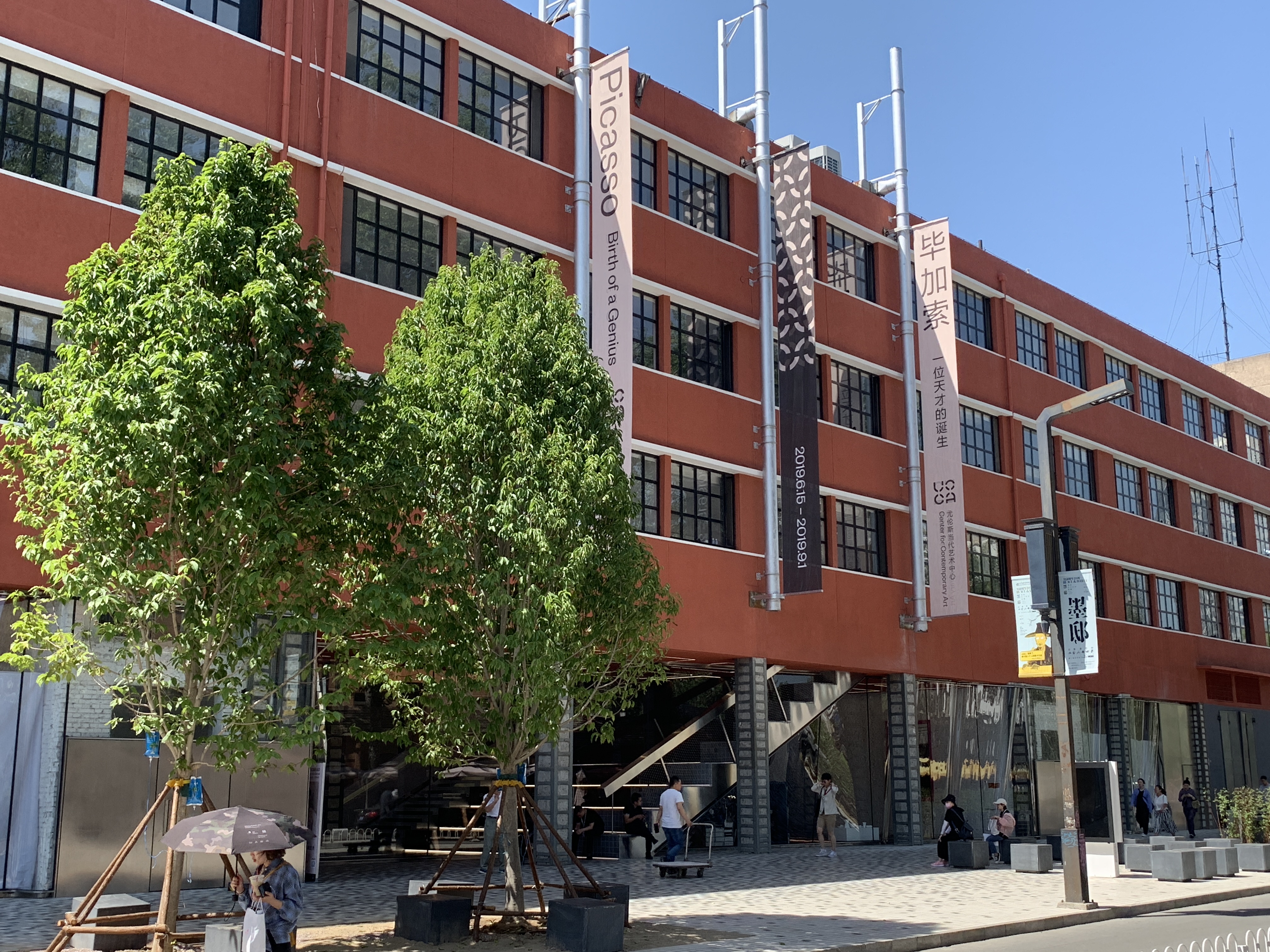
UCCA Center for Contemporary Art
The building was designed to make weapons. Factory 798, part of a sprawling electronics and munitions complex in northeastern Beijing, was drawn up by architects from the Dessau Design Institute -- the postwar institutional successor to the Bauhaus -- and opened in 1957 as part of China's military-industrial expansion. Half a century later, the factory's soaring vaulted ceilings and raw industrial surfaces house something its designers never imagined: one of China's most important contemporary art institutions, welcoming over a million visitors a year to exhibitions that push against the boundaries of what art can say in a country where speech is carefully monitored.
From Munitions to Museums
UCCA opened in November 2007 at the heart of what had become Beijing's 798 Art District, a cluster of decommissioned factories colonized by artists and galleries beginning in the early 2000s. The original Ullens Center for Contemporary Art was founded by Belgian collectors and occupied 8,000 square meters of Factory 798, including a Great Hall of 1,800 square meters, a 150-seat auditorium, and multiple exhibition spaces. In 2007, architects Jean-Michel Wilmotte and Qingyun Ma renovated the interiors while preserving traces of the industrial past -- exposed ductwork, concrete walls, the ghost lines of former machinery. In 2018, the Dutch firm OMA redesigned the entrance and exhibition halls again, adding a cafe and modernizing the visitor experience.
Reinvention at the Crossroads
UCCA underwent a major restructuring in 2017, when a group of China-based investors separated the institution's commercial and nonprofit functions. The result was the UCCA Group: a foundation that organizes exhibitions, research, and public programming, alongside an enterprise arm focused on retail and education. Director Philip Tinari, who co-curated the Guggenheim's landmark 2017 exhibition "Art and China after 1989: Theater of the World," has positioned UCCA as a bridge between Chinese and international art worlds. The institution has presented more than 200 exhibitions and attracted more than ten million visitors since opening, featuring artists ranging from Robert Rauschenberg and William Kentridge to Chinese contemporaries like Zeng Fanzhi and Cao Fei.
The Censorship Question
Operating a contemporary art institution in China means navigating constraints that Western museums rarely face. In 2014, artist Ai Weiwei accused UCCA of self-censorship when curators omitted his name from a newsletter announcing an exhibition in memory of curator Hans van Dijk. Ai had contributed three works, including the first piece he ever showed in Europe, but withdrew them during the opening in protest. The incident highlighted the tensions inherent in institutional art in China, where the line between prudent diplomacy and complicity with censorship is perpetually debated. The Guggenheim's "Theater of the World" exhibition, co-curated by Tinari, faced its own controversies when three works were pulled from the New York showing over animal welfare concerns.
Art Beyond the Factory Walls
UCCA has expanded beyond its Beijing flagship. In 2018, UCCA Dune opened in Beidaihe, a seaside resort town roughly 300 kilometers from Beijing on the Bohai Sea coast. Designed by OPEN Architecture, the museum is integrated into the sand dunes of the beach, its cave-like galleries emphasizing the relationship between nature, humanity, and art. A third location, UCCA Edge, opened in Shanghai's Jing'an District in 2021, overlooking Suzhou Creek. The expansion from a single factory space to a three-site museum network tracks the growth of contemporary art infrastructure across China -- and the determination to create spaces where art can challenge, provoke, and occasionally unsettle in a culture that prefers consensus.
From the Air
Located at 39.99°N, 116.49°E in Beijing's 798 Art District, Chaoyang District. The former industrial complex is visible from altitude as a cluster of sawtooth-roofed factory buildings northeast of the city center. Beijing Capital International Airport (ZBAA/PEK) lies approximately 15 km to the northeast. Best viewed at 3,000-5,000 feet.