Udmurt Language
In 2012, a group of grandmothers from the Udmurt village of Buranovo stood on the Eurovision stage in Baku and sang in a language that most of Europe had never heard. The Buranovskiye Babushki finished second, and for a brief moment the world paid attention to Udmurt — a Permic language spoken by roughly 324,000 people in a Russian republic most outsiders would struggle to locate on a map. That number was once 550,000. The decline tells a story that the Eurovision performance, charming as it was, could only hint at.
Distant Cousins Across a Continent
Udmurt belongs to the Uralic language family, which means it shares ancestry with Finnish, Estonian, Hungarian, Mansi, and Khanty — languages scattered from the Baltic Sea to western Siberia. Within this family, Udmurt sits in the Permic branch alongside Komi and Komi-Permyak, its closest linguistic relatives. The three Permic languages share agglutinative structures, building words by stacking suffixes onto roots in long chains that can express in a single word what English requires an entire clause to say. Outsiders historically knew Udmurt by its Russian exonym, Votyak, a name the Udmurt people themselves never used. The language has absorbed vocabulary from its neighbors — primarily Tatar and Russian — but its grammar and core structure remain distinctly Uralic, a living thread connecting central Russia to a linguistic lineage that predates the Slavic migrations.
Five Extra Letters and Fifteen Cases
Udmurt is written in Cyrillic, but it needs five characters that Russian does not provide. The letters look familiar but carry sounds absent from Russian, subtle markers of a phonological system that operates by different rules. Unlike Finnish and Hungarian, Udmurt does not distinguish between long and short vowels and lacks vowel harmony, making it something of an outlier even among its Uralic relatives. Its grammar compensates with complexity elsewhere: Udmurt has fifteen grammatical cases, eight governing abstract relationships like possession and instrumentality, and seven describing spatial ones — where something is, where it is going, and where it came from. The language makes no distinction between genders in nouns or pronouns. Perhaps most intriguingly, Udmurt preserves a feature called clusivity in its first-person plural pronoun: one form of "we" includes the listener, another excludes them. Younger speakers, influenced by Russian, increasingly use only the exclusive form, collapsing a distinction that older generations considered essential.
Three Dialects and a Fading Continuum
Udmurt divides into three dialect groups. Northern Udmurt runs along the Cheptsa River. Southern Udmurt, predictably, occupies the southern reaches of Udmurtia, where Tatar influence has introduced more loanwords into everyday speech. Besermyan, spoken by the Turkified Besermyan people, stands most sharply apart, distinguishing only six vowel phonemes where standard Udmurt recognizes seven. Between north and south, a continuum of intermediate dialects blurs the boundaries, and literary Udmurt draws from both poles. The differences are not dramatic — speakers from different regions can understand one another — but they trace the history of contact and isolation across the Udmurt-speaking territory. Subtle morphological markers reveal which direction you are heading: the accusative ending shifts from one form to another as you move from north to south.
A Language Fighting for Its Future
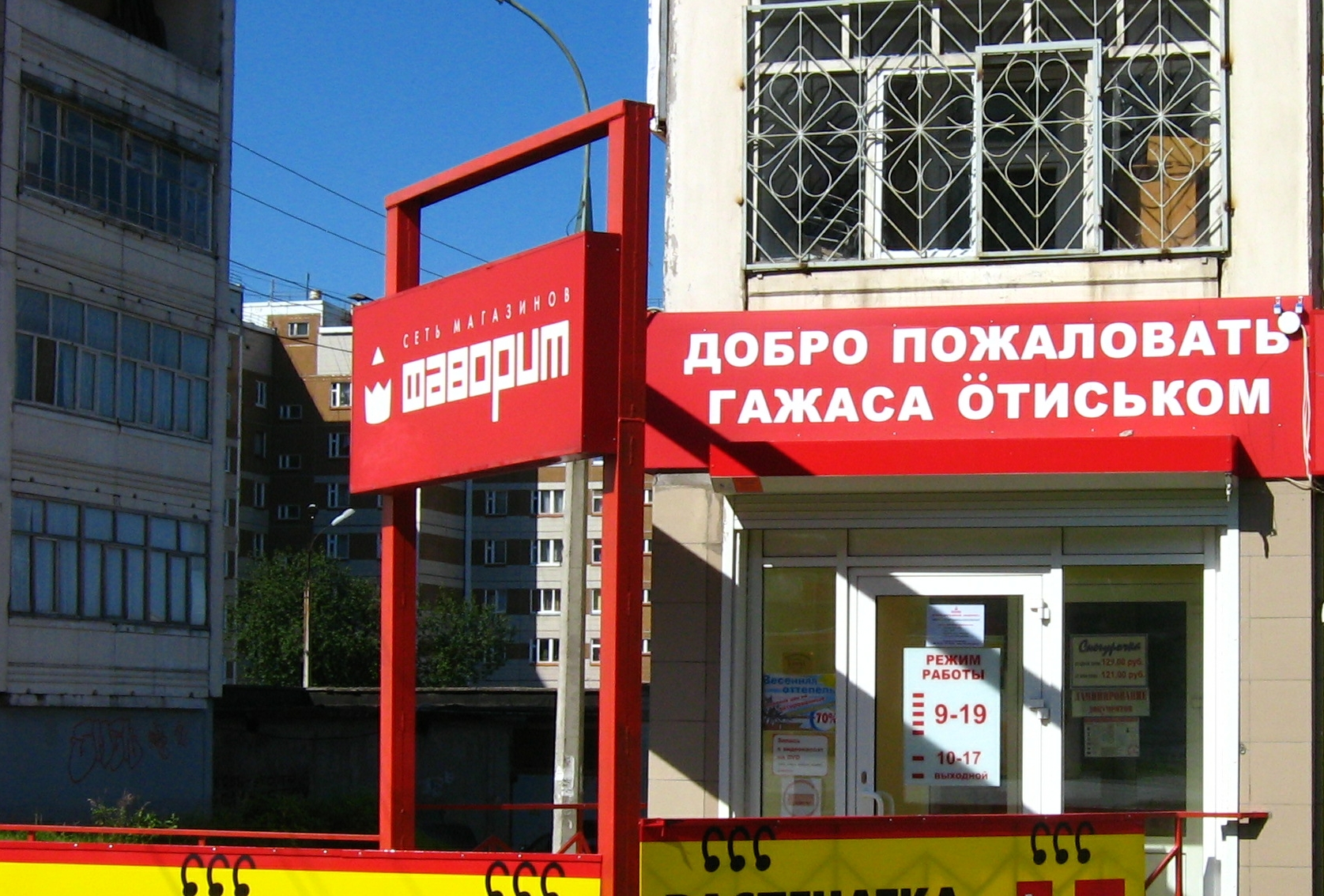
The numbers are stark. In the 1989 Soviet census, Ethnologue estimated 550,000 native Udmurt speakers out of an ethnic population of 750,000. By the 2010 Russian census, speakers had fallen to approximately 324,000 out of 554,000 ethnic Udmurts — a decline of roughly 41 percent in just two decades. Udmurt is co-official with Russian in the Republic of Udmurtia, but legal status and daily vitality are different things. Bus stops in the capital city of Izhevsk carry signs in both languages. Government documents are available in Udmurt. Yet the gravitational pull of Russian in education, media, and professional life steadily draws younger speakers away. The Bible was first completely translated into Udmurt in 2013. Films have been produced in the language — including the romantic comedy Berry-Strawberry, a joint Polish-Udmurt production, and the 2013 film Puzkar, meaning "nest." These cultural artifacts represent both achievement and urgency: a language rich enough to sustain literature and cinema, yet classified as definitely endangered.
From the Air
Udmurt is centered on the Republic of Udmurtia in central Russia, with its capital Izhevsk at approximately 56.63°N, 52.13°E. The nearest major airport is Izhevsk (USII). The Udmurt-speaking region spans from the Cheptsa River in the north to the Tatar-influenced south, covering a forested landscape between the Volga and the Urals. From the air, the region appears as rolling forest and agricultural land with scattered mid-sized cities. Bus signs in Izhevsk display both Russian and Udmurt text.