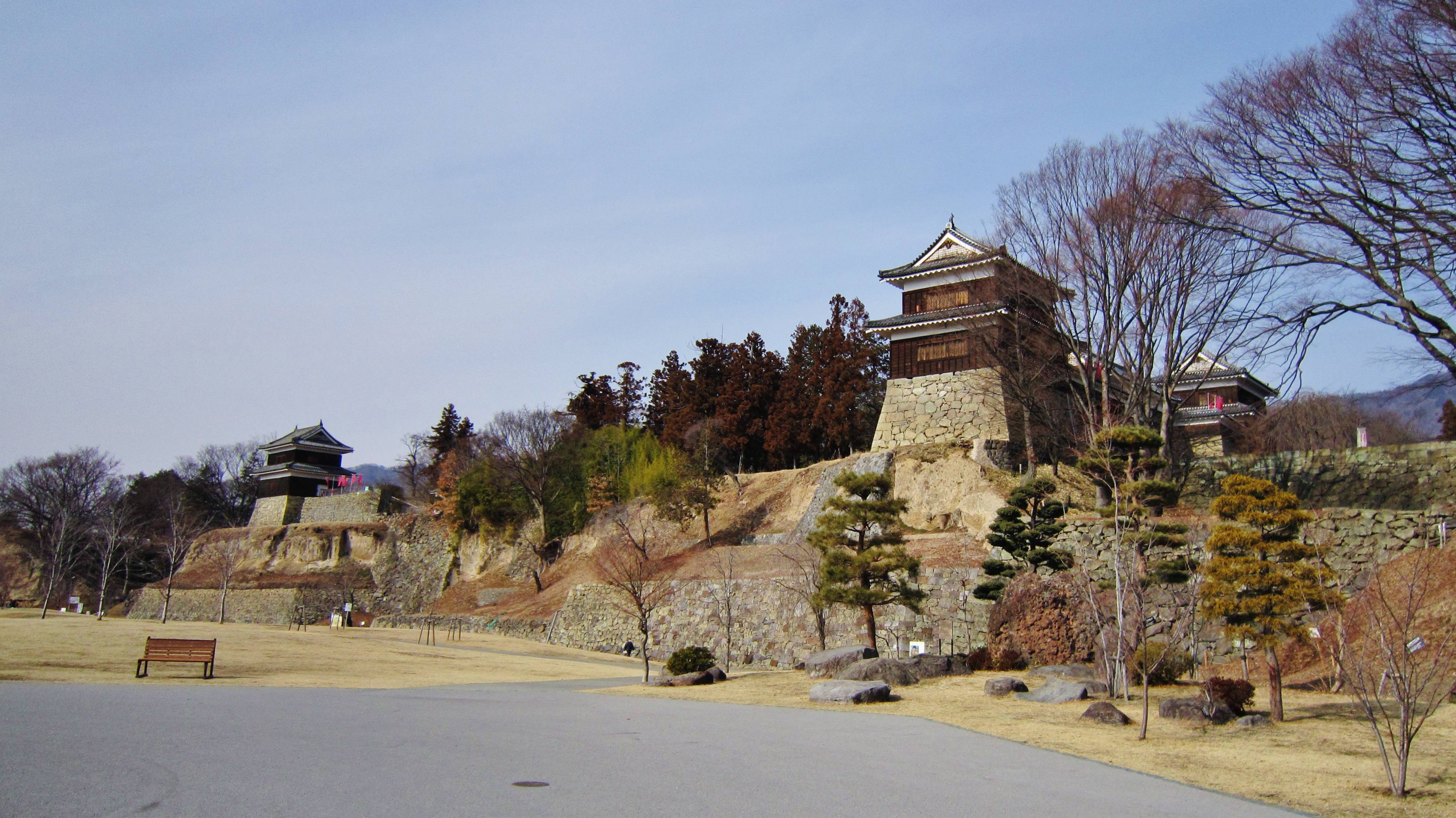
Ueda Castle
Twice, the Tokugawa came to Ueda Castle with overwhelming force. Twice, the Sanada sent them home bloodied and embarrassed. The small hilltop fortress in northern Nagano Prefecture is not Japan's grandest castle -- it never even had a main tower -- but its story of defiance against impossible odds has made the Sanada clan folk heroes for over four centuries. Designated a National Historic Site in 1934, Ueda Castle sits on a bluff above a branch of the Chikuma River, its stone walls and surviving turrets carrying the weight of one of the Sengoku period's most remarkable military legacies.
Survivors by Instinct
The Sanada clan were survivors in the most literal sense. A minor warlord family in the service of the Takeda clan, they watched their patrons fall to the combined forces of Oda Nobunaga and Tokugawa Ieyasu, and then did what they did best: adapted. In the chaotic power vacuum that followed, the Sanada switched allegiances with bewildering speed -- from the Uesugi to the Hojo, from Oda Nobunaga to Toyotomi Hideyoshi -- always calculating which alliance would best preserve their territory and independence. It was Sanada Masayuki who began constructing Ueda Castle in 1583 on Tokugawa Ieyasu's orders. Two years later, he moved his main base from the family's older Sanada-shi Yakata to this new stronghold on the Nagano plain. The castle would soon prove its worth against the very man who commissioned it.
The First Humiliation
In 1585, Tokugawa Ieyasu sent his forces to take Ueda Castle. The details of the Battle at Kami River remain a source of pride in the region: Sanada Masayuki, vastly outnumbered, used the terrain and the castle's defenses to devastating effect. The Chikuma River served as a natural moat along the castle's southern flank, while a layered system of baileys -- the central Hon-Maru with its seven two-story yagura, the surrounding Ni-no-Maru with its earthen ramparts, and the outer San-no-Maru -- created a defense in depth that the Tokugawa forces could not crack. Masayuki's reputation soared. A minor lord had bested the most powerful warlord in eastern Japan, and the story spread across the country like wildfire.
A Family Divided
The politics of the era made loyalty a family-splitting proposition. Under Toyotomi Hideyoshi's authority, the Sanada were compelled to pledge fealty to Tokugawa Ieyasu. The arrangement was cemented through marriage: Masayuki's eldest son, Sanada Nobuyuki, wed Komatsuhime, an adopted daughter of Ieyasu himself. Meanwhile, his younger son, Sanada Yukimura -- who would become one of Japan's most legendary warriors -- married Chikurin-in, an adopted daughter of Hideyoshi. When Hideyoshi died and Japan fractured again, the family broke along exactly those lines. Nobuyuki sided with the Tokugawa. Masayuki and Yukimura threw in with the pro-Toyotomi coalition under Ishida Mitsunari. Father and son on one side, brother against brother -- the Sanada hedged their bets to ensure the family name would survive no matter who won.
The Siege That Changed Sekigahara
In 1600, the Tokugawa returned to Ueda with an army led by Tokugawa Hidetada, Ieyasu's son and heir. Hidetada was marching to the Battle of Sekigahara -- the engagement that would determine the fate of Japan -- when he was ordered to reduce Ueda Castle along the way. It should have been a brief detour. Instead, Masayuki and Yukimura turned it into a siege that the Tokugawa could neither win nor abandon gracefully. Once again outnumbered, the Sanada inflicted severe casualties and bled time from Hidetada's schedule. The delay became so costly that Hidetada was forced to break off the siege entirely. His army arrived at Sekigahara too late to contribute to the battle. The Tokugawa won Sekigahara anyway, but Hidetada's failure at Ueda became a lasting embarrassment. The castle that was never meant to matter had very nearly altered the outcome of Japan's most consequential battle.
Stone Walls and Cherry Blossoms
Today Ueda Castle is a ten-minute walk from Ueda Station on the Nagano Shinkansen. The castle grounds have become a public park where stone ramparts and reconstructed turrets stand among cherry trees that draw crowds each spring. The South Yagura and the Otemon gate offer a sense of the castle's original scale, while the Sanada Shrine within the grounds honors the clan whose cunning and tenacity defined this place. Most of the Third Bailey's footprint is now occupied by Ueda High School -- students walking to class over ground where samurai once prepared for siege. The moats still trace their original lines, and the hilltop position still commands views across the Nagano plain to the mountains beyond. It remains, four centuries later, a monument to the idea that the outnumbered are not always the outmatched.
From the Air
Located at 36.40N, 138.24E on a hill above the Chikuma River in Ueda city, northern Nagano Prefecture. The castle grounds are visible as a park area with distinctive stone walls near the center of Ueda. The nearest major airport is Matsumoto Airport (RJAF), approximately 50 km to the southwest, though the area is also accessible via Shinshu-Matsumoto Airport. Ueda sits in a broad valley flanked by mountains on both sides. From altitude, look for the grid of Ueda city along the Chikuma River, with the castle park on the northeastern edge of the urban area. The Nagano Shinkansen line runs through the city.