Ueno Park: Battleground, Gift, and Cultural Heart of Tokyo
The temple of Kan'ei-ji was deliberately placed in the demon gate -- the unlucky northeast direction from Edo Castle -- to ward off evil spirits in 1625. Two centuries later, in 1868, that spiritual shield became a literal battleground when forces loyal to the Tokugawa shogunate clashed with imperial restoration armies in the Battle of Ueno, leaving most of the temple buildings in ruins. Five years after that, a Dutch doctor named Bauduin convinced the government that the scarred hilltop should become a public park rather than a medical school. The year was 1873, just one year after the founding of Yellowstone. Ueno Park became one of Japan's first public parks, and today it draws over ten million visitors annually -- making it the most popular city park in Japan.
From the Demon Gate to the Emperor's Gift
Kan'ei-ji once sprawled across this hilltop, a powerful temple positioned to protect Edo Castle from malevolent forces believed to enter from the northeast. The Battle of Ueno in 1868 devastated the complex, but three structures survived: a five-story pagoda dating to 1639, the Kiyomizu Kannondo of 1631, and the main gate, all now designated Important Cultural Properties of Japan. When the Meiji government debated what to do with the ruins, proposals ranged from a hospital to a medical school. Bauduin, a Dutch doctor working in Japan during the rapid modernization of the Meiji era, argued for a park instead. The government agreed, and in 1873 Ueno Park was established alongside Shiba, Asakusa, Asukayama, and Fukugawa Parks. Administration passed through several ministries before, in 1924, Emperor Taisho presented the park to the city of Tokyo to honor the marriage of Crown Prince Hirohito. Its official name became Ueno Onshi Koen -- Ueno Imperial Gift Park -- a name that endures today.
A Campus of Museums
The very Japanese words for 'museum' and 'art' were coined during the Meiji period to capture Western concepts encountered during the Iwakura Mission's visits to North America and Europe. Ueno Park became the proving ground for those new ideas. The Tokyo National Museum was founded in 1872, followed that same year by what is now the National Museum of Nature and Science. The National Museum of Western Art arrived in 1959, housed in a building designed by Le Corbusier to express his concept of the Museum of Unlimited Growth -- a spiral that could theoretically expand outward forever. The collection itself had a dramatic provenance: industrialist Matsukata Kojiro had left his art trove in storage in France, and it was returned by the French government only after the Treaty of San Francisco. The Tokyo Metropolitan Art Museum has stood here since 1926, and the Shitamachi Museum preserves the culture of the 'Low City.' The Tokyo Bunka Kaikan opened in 1961 as a venue for opera and ballet, celebrating the five hundredth anniversary of the founding of Edo.
Shrines, Flames, and Foxes
Between the museums, a different kind of history persists. Tokugawa Ieyasu is enshrined at Ueno Tosho-gu, dating to 1651. Nearby, a grey stone memorial holds a flame that has burned continuously since 1990 -- the Flame of Hiroshima and Nagasaki, combining fires lit in both cities shortly after the atomic bombings of August 1945. The memorial was initiated by Tatsuo Yamamoto from the town of Hoshino, and tens of thousands of people raised funds over a year to build the monument. The dedication stone pledges to keep the flame burning as a symbol of the movement to abolish nuclear weapons. Elsewhere in the park, Gojoten Jinja honors the scholar Sugawara no Michizane, while neighboring Hanazono Inari Jinja features red-bibbed Inari fox statues arranged in an atmospheric grotto. A Yayoi-period burial mound sits on a small hill near the park's center, placing human habitation of this spot at roughly two thousand years. After the Great Kanto earthquake of 1923, the statue of Saigo Takamori served as a message board for notices about missing persons.
Cherry Blossoms and the Lotus Pond
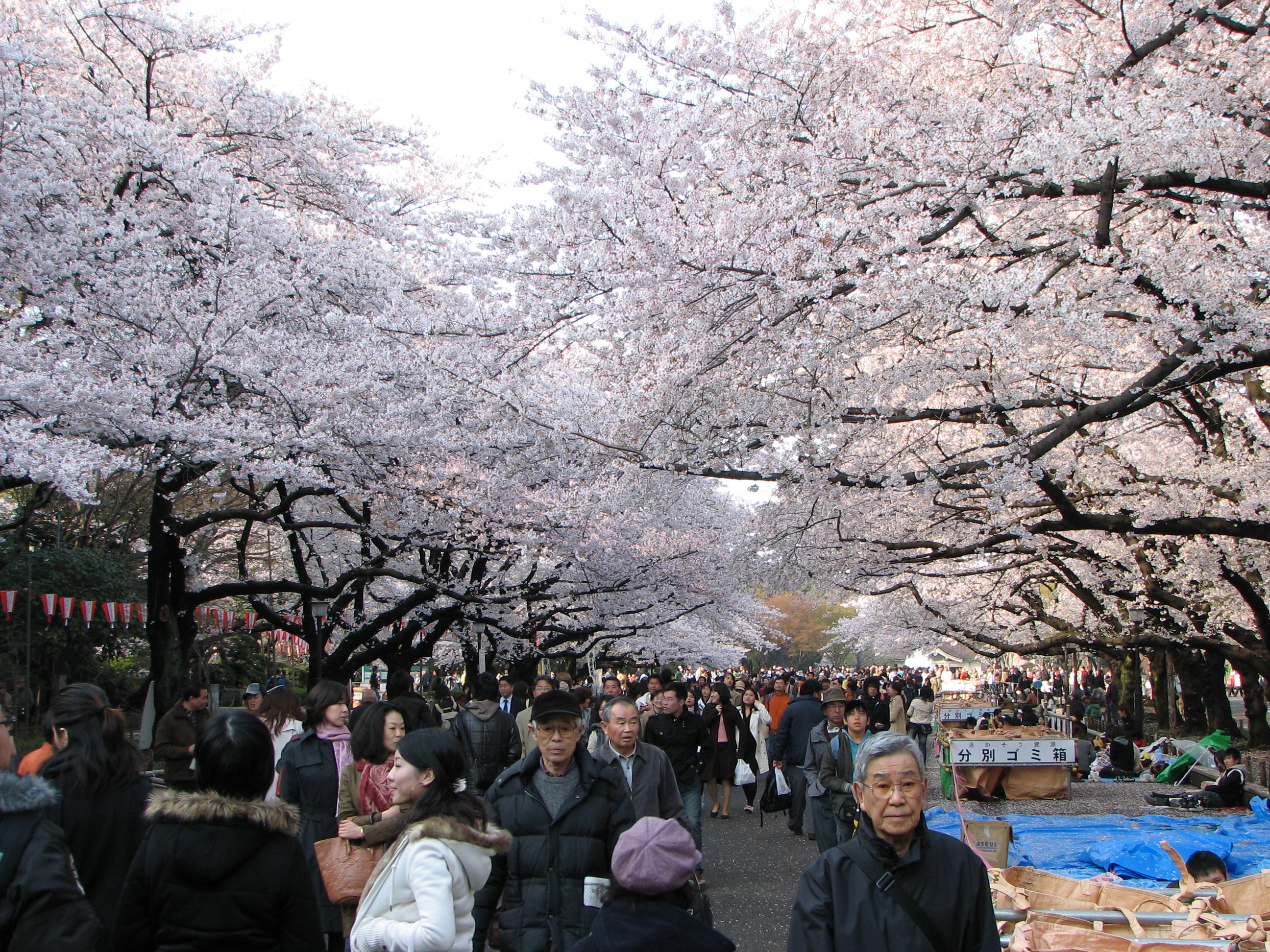
Each spring, Ueno Park becomes the epicenter of hanami -- cherry blossom viewing -- as hundreds of trees burst into bloom and visitors spread picnic blankets beneath the canopy of pale pink petals. The tradition draws enormous crowds, transforming the park's broad avenues into one of Tokyo's most celebrated seasonal spectacles. At the park's southern edge, Shinobazu Pond offers a different beauty. Its central island houses a shrine to Benzaiten, goddess of fortune, modeled on Chikubu Island in Lake Biwa. The lotus pond was restored in 1949, though much of it was accidentally drained again in 1968 during construction of a new subway line. The area around the pond was once filled with 'rendezvous teahouses,' the predecessors of modern love hotels. Today the pond blooms with lotus flowers in summer, and Ueno Zoo -- Japan's oldest, founded in 1882 -- borders its western shore. The park sits at the intersection of old and new Tokyo, a place where a Yayoi burial mound, a shogun's shrine, a Le Corbusier building, and a cherry blossom party can all exist within a ten-minute walk.
From the Air
Located at 35.712N, 139.771E in the Taito ward of central Tokyo. From altitude, Ueno Park is identifiable as a large green area adjacent to Ueno Station, with Shinobazu Pond visible as a distinctive body of water at its southwestern edge. The Tokyo National Museum complex is visible at the park's northern end. Best viewed at 3,000-5,000 feet AGL. Tokyo Haneda Airport (RJTT) lies approximately 12 nautical miles to the south. Narita International Airport (RJAA) is approximately 35 nautical miles to the east. The park sits along the Yamanote Line rail loop, and the dense urban grid of Taito ward surrounds it on all sides.