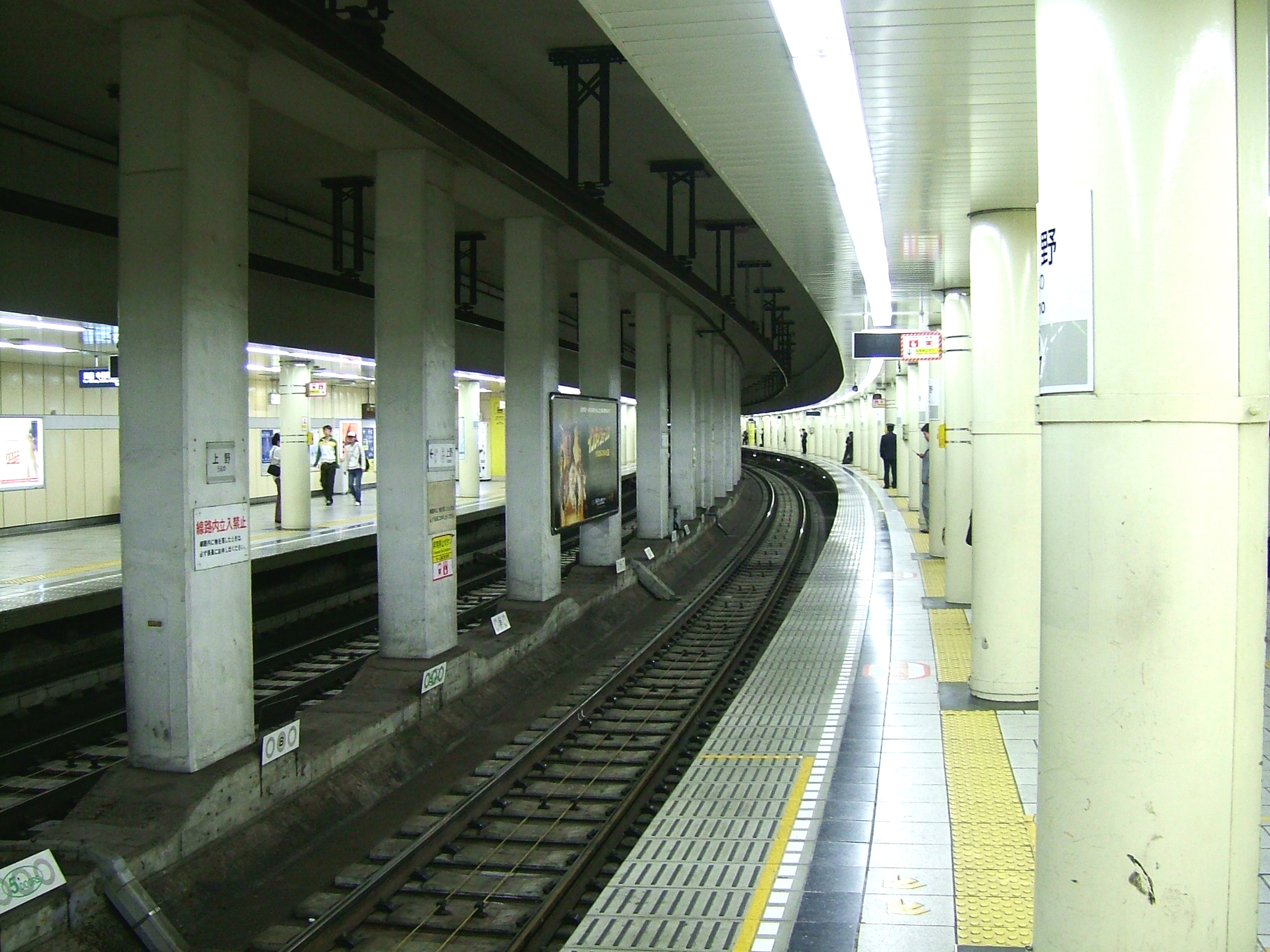
Ueno Station: Gateway to the North
When workers dug the foundations for Ueno Station's replacement building after the 1923 Great Kanto earthquake, they unearthed bones, swords, and lances from the Battle of Ueno, fought fifty-five years earlier on the hill just above. It was a fitting discovery for a station that has always been layered with arrivals and departures, memory and motion. Opened on July 28, 1883, Ueno Station was for generations the gateway between Tokyo and the north -- the place where migrant workers from Tohoku stepped off the train into the capital, where soldiers departed for war, and where poet Ishikawa Takuboku listened to the Tohoku dialect and wept with homesickness. A memorial plate with his poem remains in the station today.
The Northern Terminus
For most of its history, Ueno Station was where northern Japan met Tokyo. Long-distance trains from Tohoku, Akita, Yamagata, and Hokkaido terminated here, making the station the first and last impression of the capital for millions of travelers. The emotional weight of these arrivals and departures embedded Ueno Station deep into Japanese cultural consciousness. Ishikawa Takuboku's famous tanka poem captures the feeling: the sound of home in the voices at the station, the ache of distance. Ueno was not just a transportation hub but a threshold -- between rural and urban, between the old country and the modern city. The Tohoku Shinkansen reached Ueno in March 1985, extending south from Omiya. But when it extended further south to Tokyo Station in June 1991, the gravitational center of long-distance rail shifted. The Ueno-Tokyo Line, completed in 2015, connected conventional lines through to Shinagawa and beyond. Ueno remained a major station, but its reign as the exclusive northern gateway was over.
First Subway, War Orphans, Black Markets
In 1927, the Tokyo Underground Railway opened Japan's first subway line from Ueno Station to Asakusa Station, a short but revolutionary route that launched the underground network that now carries millions daily. The station's subterranean depths would serve a darker purpose during World War II and the years that followed, when war orphans found refuge in Ueno's tunnels and underground passages. The neighborhood in front of the station became a major center of black market activity in the postwar chaos. That same area evolved into Ameya-Yokocho -- a bustling open-air market street that still stretches beneath the elevated tracks, selling everything from fresh fish to sneakers. The transformation from black market to beloved shopping district mirrors the trajectory of postwar Japan itself.
Twenty-Two Tracks and Six Shinkansen Lines
Today Ueno Station is an intricate machine operating on multiple levels. The main level holds through tracks for the Yamanote Line and Keihin-Tohoku Line, the circular and radial arteries that keep Tokyo's commuters moving. Terminal tracks end inside the building, their dead-end platforms evoking the station's original role as a terminus. Below these, on a lower deck, additional terminal tracks serve regional routes. Further underground, two island platforms handle Shinkansen tracks 19 through 22, serving six bullet train lines: the Tohoku, Yamagata, Akita, Joetsu, Hokuriku, and Hokkaido Shinkansen. The Tokyo Metro Ginza and Hibiya Lines add another layer beneath. In fiscal year 2013, the combined station handled roughly 181,880 JR East passengers and 211,539 Tokyo Metro passengers daily -- nearly 400,000 people passing through a building whose foundations rest on the bones of the Battle of Ueno.
Literature and the Living Station
Ueno Station has generated its own literature. Beyond Takuboku's poem, Yu Miri's novel 'Tokyo Ueno Station,' which won the National Book Award for Translated Literature in 2020, centers on a homeless man haunting the park above the tracks, weaving together the lives of displaced laborers from Fukushima and the imperial family whose residence borders the park. The novel captures what the station has always been: a place where Japan's contradictions converge. In March 2020, the Park Exit was moved northward and the roadway in front was converted to a dead end, allowing pedestrians to walk directly from the station into Ueno Park without crossing traffic. It was a small change with large symbolic weight -- erasing one more barrier between the station and the cultural landscape above it, between transit and destination, between motion and rest. Ueno Station endures as both machine and monument, a place still layered with departures and arrivals, still echoing with the Tohoku accent Takuboku heard more than a century ago.
From the Air
Located at 35.713N, 139.777E in the Taito ward of central Tokyo, immediately east of Ueno Park. From altitude, the station's extensive track fan and covered platforms are visible as a linear complex running north-south, with the green expanse of Ueno Park directly to the west. The elevated Shinkansen tracks curve into underground platforms beneath the station. Best viewed at 3,000-5,000 feet AGL. Tokyo Haneda Airport (RJTT) lies approximately 12 nautical miles to the south. Narita International Airport (RJAA) is approximately 35 nautical miles to the east via the Keisei Line, which terminates at adjacent Keisei Ueno Station. The Yamanote Line loop is visible curving through the station area.