Uglich
The coat of arms of Uglich shows a young boy holding a knife. It is not a symbol anyone would choose for civic pride, but Uglich did not choose it -- history imposed it. On May 15, 1591, ten-year-old Tsarevich Dmitry Ivanovich, the last surviving son of Ivan the Terrible and the final scion of the Rurik dynasty, was found dead in the palace courtyard with his throat cut. The cathedral bell rang the alarm. What followed -- the investigation, the cover-up, the imposters, the foreign invasions -- reshaped Russia for decades. The town that witnessed it all still sits on a bend of the Volga, its name derived from the Russian word for corner, its identity forever tied to a death that may or may not have been murder.
Corner Field
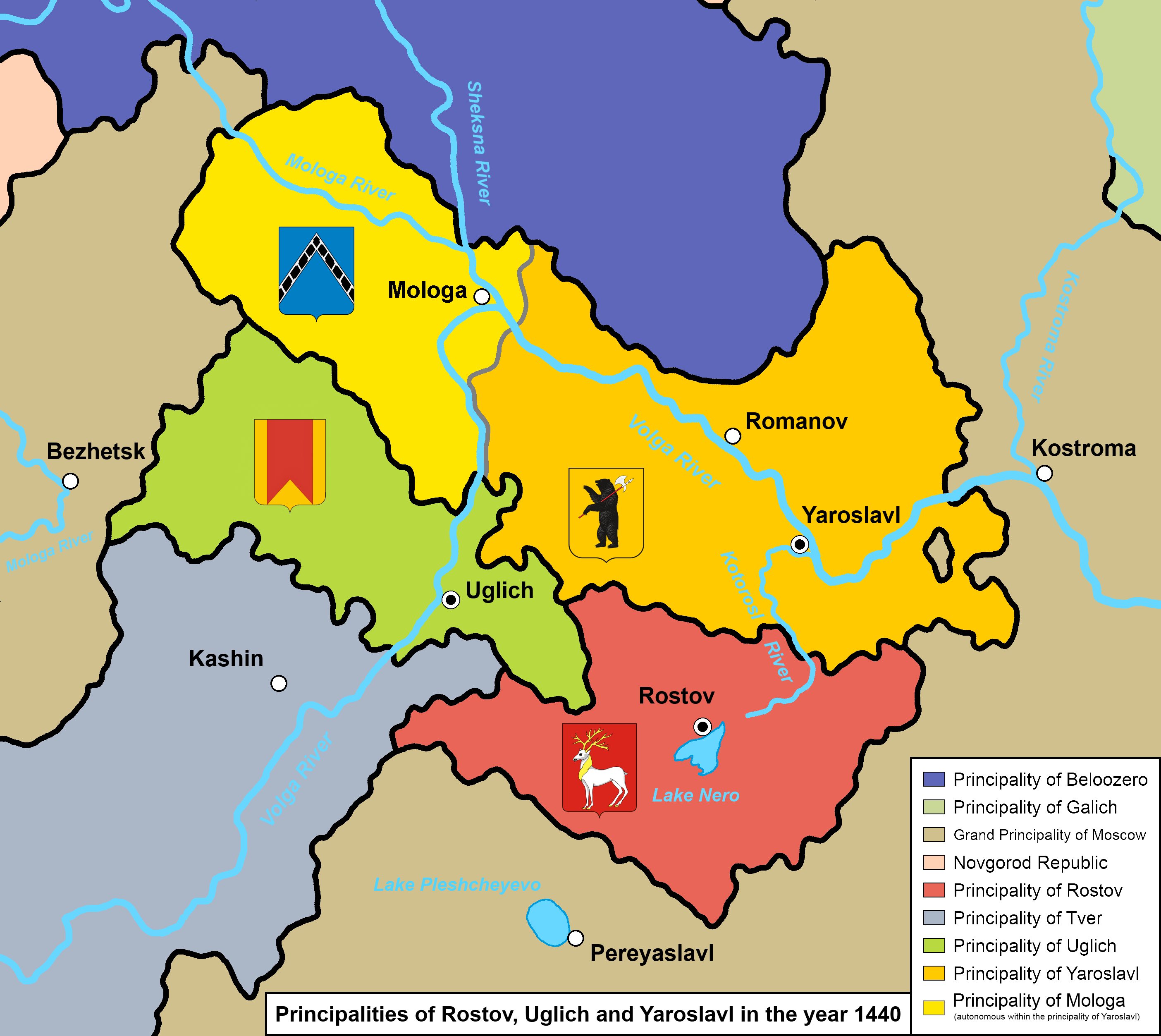
Uglich was first documented in 1148 as Ugliche Pole -- Corner Field -- a name that described the sharp bend in the Volga nearby. From 1218 to 1328 it served as the seat of a small princedom before the local rulers sold their rights to the Grand Prince of Moscow. As a border town, Uglich burned repeatedly in conflicts with Lithuanians, Tatars, and the rival princes of Tver. In 1462, Grand Duke Ivan III gave the town to his younger brother Andrey Bolshoy, who expanded it and built Uglich's first stone buildings. The red-brick princely palace he completed in 1481 still stands -- one of the oldest surviving secular buildings in Russia. During Ivan the Terrible's reign, the town's inhabitants contributed to the siege of Kazan in 1552 by building a wooden fortress that was floated down the Volga to the battlefield.
The Death That Broke a Dynasty
After Ivan the Terrible's death, his youngest son Dmitry was banished to Uglich in 1584, effectively exiled from Moscow under the watchful eye of Boris Godunov, the tsar's chief advisor. Suspicion fell on Godunov immediately when the boy was found dead. Official investigators ruled the death an accident -- an epileptic seizure during which the boy fell on a knife. Few believed it. The authorities punished the town for ringing the alarm bell: they cut out the bell's clapper, its "tongue," and exiled the bell itself to Siberia, as if metal could be guilty of treason. Because Dmitry was the last of the Rurik line, his death opened a vacuum that destabilized all of Russia. Pretenders claiming to be the miraculously surviving Dmitry appeared one after another -- False Dmitry I, False Dmitry II, False Dmitry III -- each backed by foreign powers eager to exploit the chaos.
Ashes and Pilgrimage
The period known as the Time of Troubles devastated Uglich along with much of Russia. Polish forces besieged the Alexeievsky and Uleima monasteries and burned them to the ground, killing everyone who had sought shelter inside. When the Romanov dynasty finally restored order, they moved quickly to canonize the murdered Tsarevich and designate Uglich as a place of pilgrimage. In 1692, the city built the Church of St. Demetrios on the Blood on the spot where Dmitry was thought to have died. Its crimson walls and blue domes are visible from the Volga, a landmark for travelers heading north on the river. The palace where the prince had lived was converted into a museum, and the image of the young Tsarevich with knife in hand became the town's official emblem.
Marvelous Ruins and Modern Currents
Uglich's architecture tells its layered story. The Assumption Church of the Alexeyevsky Monastery, built in 1628, earned the nickname "Marvelous" from ordinary people who saw it -- and that qualifier became part of its official name. The Resurrection Monastery presents its cathedral, refectory, belfry, and summer church all in a row, dating to the 1670s. Opposite stands the Church of the Nativity of St. John the Baptist, built by a merchant in 1689-90 to mark the spot where his son had drowned. In the 20th century, Stalin's industrialization reached Uglich in the form of a hydroelectric dam on the Volga. The resulting Uglich Reservoir flooded the town's outskirts, drowning the Intercession Monastery and other structures. A watch factory making Chaika timepieces operated for decades before closing. Today Uglich sits on Russia's Golden Ring tourist circuit, a small town with a violent past and architecture that ranges from medieval brick to Soviet concrete, all of it anchored by the bend in the river that gave the place its name.
From the Air
Located at 57.53°N, 38.33°E on the Volga River in Yaroslavl Oblast. The town is visible along the river bend with the distinctive red-and-blue Church of St. Demetrios on the Blood prominent on the riverbank. The Uglich Dam and reservoir are visible to the south. Best viewed at 3,000-8,000 feet. Nearest airports: Tunoshna (UUDL) near Yaroslavl approximately 100 km northeast, Moscow Sheremetyevo (UUEE) approximately 230 km southwest.