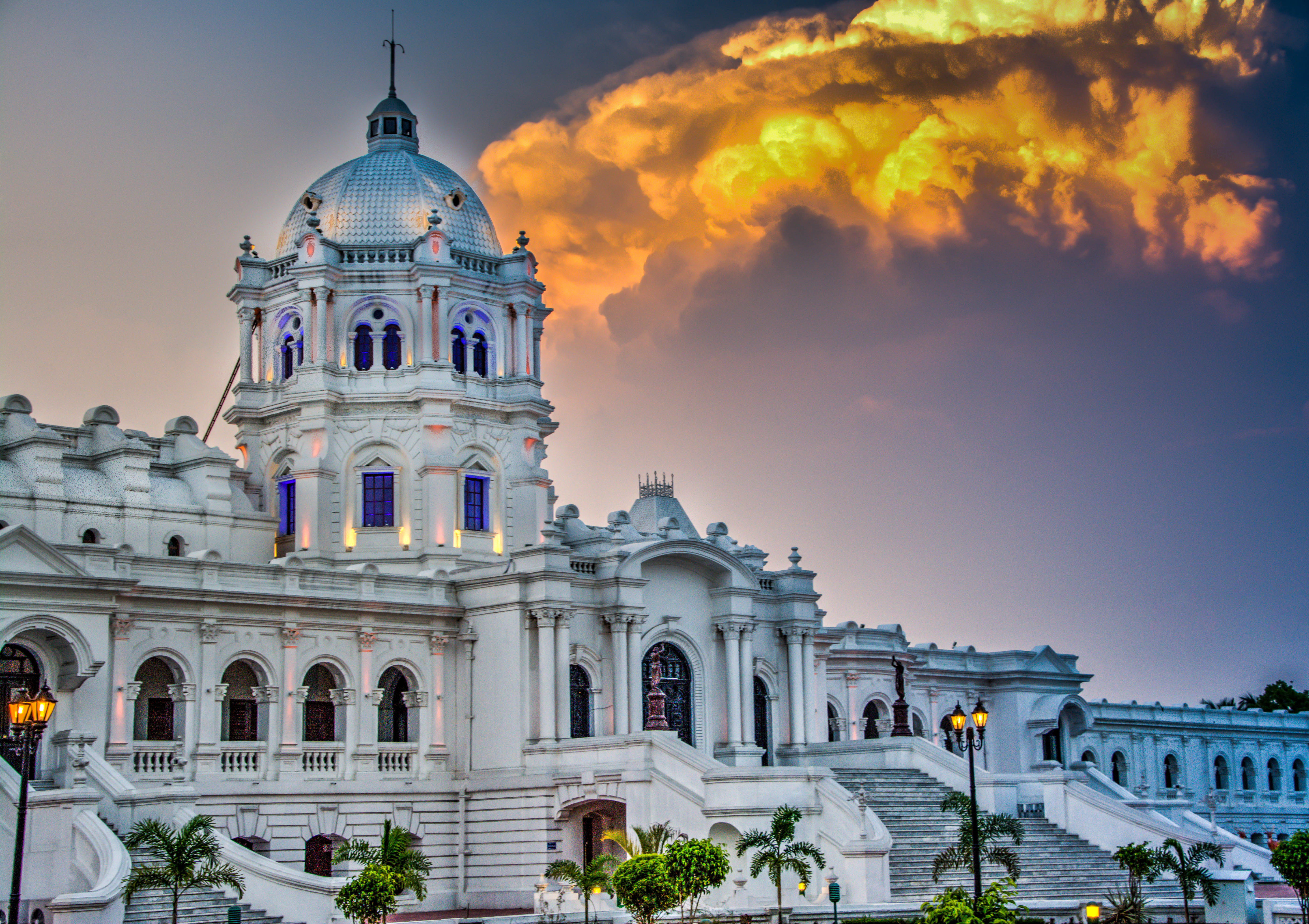
Ujjayanta Palace
Rabindranath Tagore gave it a name that means "radiant" -- Ujjayanta -- and for more than a century the palace has lived up to that word, though rarely in the way anyone expected. Built as a royal residence, it became a legislative assembly, then a museum. The 1897 Assam earthquake destroyed its predecessor. Political protests saved it from being renamed. Across all these transformations, the palace has stood at the center of Agartala, reflecting whatever Tripura needed it to be at a given moment in its turbulent, shape-shifting history.
A Kingdom Rebuilds in Stone
The original Ujjayanta Palace was constructed in 1862, ten kilometers from Agartala. It did not survive long. The 1897 Assam earthquake -- one of the most powerful seismic events ever recorded, estimated at magnitude 8.0 -- devastated the structure. Maharaja Radha Kishore Manikya, determined to rebuild on grander terms, commissioned Sir Alexander Martin of the Martin and Burn Company to design a new palace in the heart of the city itself. Between 1899 and 1901, the new Ujjayanta Palace rose in the Indo-Saracenic style, blending Mughal arches with European neoclassical proportions. It became the principal residence of the Manikya dynasty and remained so until Tripura merged with the Dominion of India in October 1949, ending centuries of princely rule.
The Poet's Gift
Rabindranath Tagore, the Nobel laureate who would become the first non-European to win the prize for literature, visited the Manikya court and christened the palace "Ujjayanta." The name stuck -- so thoroughly that when the government of Tripura purchased the building from the royal family in 1972-73 for 2.5 million rupees and later attempted to rename it the "Tripura State Museum," the public refused. The Indigenous Nationalist Party of Twipra protested directly to India's vice-president. Pradyot Bikram Manikya Deb Barma, the pretender to the throne, spoke out as well. The government relented, keeping Tagore's name and erecting a statue of Maharaja Radha Kishore Manikya on the grounds instead. A poet's word, it turned out, carried more authority than a government decree.
Twenty-Two Galleries of Memory
Inaugurated as a museum on 25 September 2013 by Vice-President Mohammad Hamid Ansari, Ujjayanta Palace now houses northeast India's largest museum, with twenty-two display galleries spread across its seismically retrofitted interior. The collection is staggering in its range: 79 stone sculptures, 141 terracotta plaques, 774 coins in gold, silver, and copper, 10 copper plate inscriptions, 39 bronze images, 102 textile items, 58 oil paintings, and 197 ornaments. The most distinctive pieces come from Pilak, an archaeological site in southern Tripura that yielded sculptures blending Hindu and Buddhist iconography from the 9th to 13th centuries -- bronze figures of Avalokitesvara alongside Vishnu, evidence of a period when these traditions coexisted in Tripura's hills.
Temples at the Gate
Several Hindu temples occupy plots adjacent to the palace grounds, dedicated to Lakshmi Narayan, Uma-Maheshwari, Kali, and Jagannath. Their presence is a reminder that Ujjayanta was always more than an administrative center -- it was a sacred landscape where political power and religious devotion intertwined. The Manikya dynasty traced its legitimacy through both martial prowess and temple patronage, and the placement of these shrines beside the royal residence was deliberate. Walking the grounds today, visitors move between the museum's secular galleries and these living temples where incense still burns and prayers are still offered, experiencing the layered texture of a site where devotion and governance have never been fully separable.
Resilience Written in Architecture
The palace's 2013 conversion required seismic retrofitting -- an apt metaphor for a building that has been structurally and symbolically reinforced at every stage of its existence. Further restorations followed in 2023. Through it all, the Indo-Saracenic facade remains, its domes and columns evoking an era when Indian and European architectural traditions were being deliberately fused. Ujjayanta Palace stands in Agartala not as a relic of a vanished monarchy but as a working institution, open to the public, its galleries showcasing the tribal cultures and artistic traditions of a region that most Indians, let alone most visitors from abroad, know only as a name on a map. The name Tagore gave it still fits: radiant, defiant, resilient.
From the Air
Located at 23.837N, 91.282E in central Agartala, the capital of Tripura state. The palace compound with its domes and adjacent temple spires is visible among the city's lower buildings. Best viewed below 2,500 feet. Nearest airport: Maharaja Bir Bikram Airport (VEAT), approximately 12 km northwest. The surrounding terrain is flat river plain with low hills to the east. Visibility is generally good October-March; monsoon months bring heavy cloud cover.