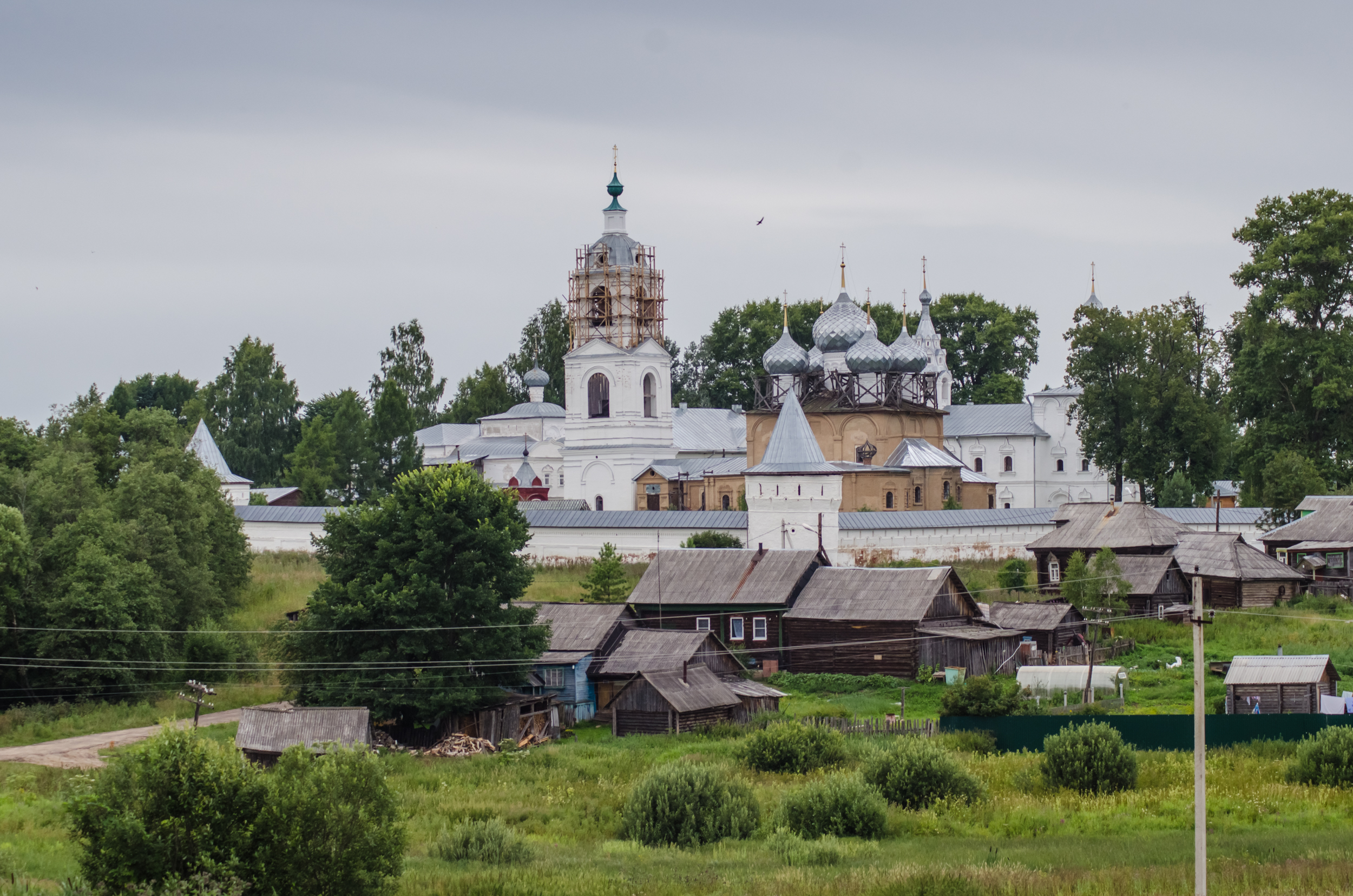
Uleima Monastery
Sometime in the early 15th century, a monk from Rostov walked into the forests near Uglich carrying an icon of St. Nicholas that had traveled a remarkable distance. The icon came from Bari, the Italian port city where the relics of St. Nicholas himself are kept. The monk established a monastery on the banks of the Uleima River, a tributary of the Yukhot, and the icon became its founding treasure. Six centuries later, the Uleima Monastery of St. Nicholas still stands in those woods -- seldom visited, its walls scarred by war, its community transformed from monks to nuns. It is the only sizable monastery in Russia still controlled by the Old Believers.
A Fortress on the Pilgrim Road
The monastery's location was strategic as well as spiritual. It sat on the highway between Rostov and Uglich, making it both a pilgrim waystation and a military target. The ruling Princes of Uglich patronized the monastery, and it grew into a substantial fortified complex. During the Time of Troubles -- the chaotic period of foreign invasion and civil war that followed the extinction of the Rurik dynasty -- the monastery was attacked three times: in 1609, 1612, and 1619. The most devastating assault came from the forces of Jan Sapieha. Several thousand monks and peasants had taken refuge behind the monastery walls, and they defended the complex with everything they had. When the main church collapsed in flames, many of the defenders died inside it.
Rebuilding in Stone
What stands today at Uleima is largely a product of the 17th and early 18th centuries -- the patient reconstruction that followed the devastation of the Time of Troubles. The five-domed katholikon was rebuilt in stages from the 1620s through the 1670s, its onion domes rising above the forest canopy. The refectory church of the Presentation followed in 1695. The encircling walls, watchtowers, and a gate church were completed around 1710, giving the monastery the fortified profile it still carries. When Peter the Great acquired a portion of St. Nicholas's relics from Italy, his relatives from the Naryshkin family presented them to the Uleima monks -- a gift that reinforced the monastery's connection to its founding icon from Bari and kept pilgrims coming along the road between Uglich and Rostov.
Silence and Survival
The Soviet government closed the monastery in 1930. For the next six decades, the buildings that had withstood Polish armies and Lithuanian raiders were handed over to an underfunded local orphanage. Without maintenance, the structures began to crumble. Some restoration work was carried out in the 1960s, but the monastery remained a shell of its former self until 1992, when religious use resumed. The Old-Rite Church -- the branch of Russian Orthodoxy that split from the mainstream in the 17th century over liturgical reforms -- took control of the complex. By 1998, citing a shortage of monks willing to join, they converted it into a nunnery. The transformation was fitting in its way: a community that had always stood apart, that had survived by sheer stubbornness, found its home in a building with the same qualities.
Lost in the Woods
The Uleima Monastery is seldom visited. It lacks the fame of the Trinity Lavra in Sergiyev Posad or the dramatic setting of the Monastery of Sts Boris and Gleb near Rostov. Travelers who make the journey find a walled medieval compound in a forest clearing beside a quiet river, its five domes visible above the trees. The walls carry the memory of three sieges. The katholikon holds the echoes of monks who died defending it. The icon from Bari -- the one that a Rostov monk carried through these woods six hundred years ago -- established a thread connecting this remote corner of Russia to the Mediterranean, a thread that the Old Believers maintain in their own stubborn, particular way.
From the Air
Located at 57.44°N, 38.41°E in the forests near Uglich, Yaroslavl Oblast. The walled monastery complex is visible from low altitude as a compact fortified compound with five domes amid dense woodland near the Uleima River. Best viewed at 2,000-4,000 feet. Nearest significant airport: Tunoshna (UUDL) near Yaroslavl, approximately 100 km northeast. Moscow airports UUEE and UUDD are approximately 250 km southwest.