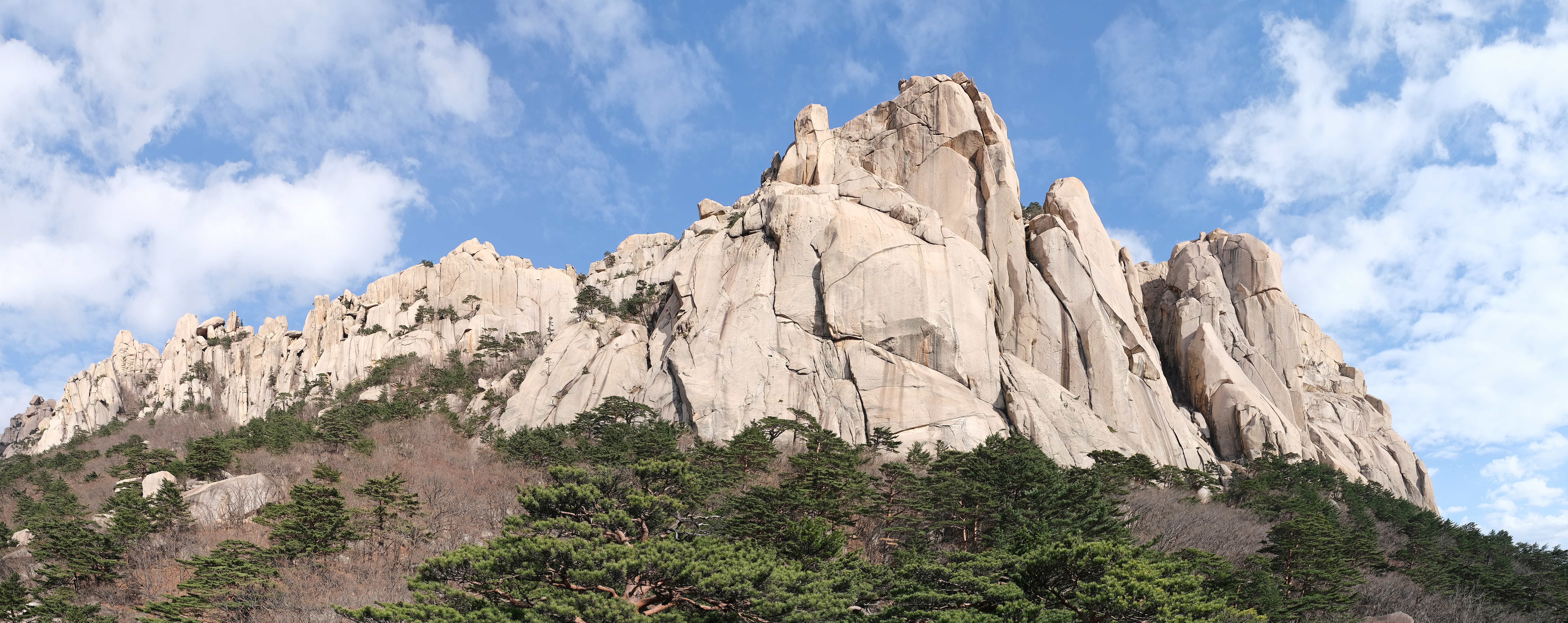
Ulsanbawi
Eight hundred and eighty-eight steps. That is the count, according to locals who have bothered to tally them, from the trailhead in Seoraksan National Park to the base of Ulsanbawi -- six granite peaks rising 873 meters above sea level, their vertical cliffs forming a natural wall four kilometers in circumference. The formation is Mesozoic granite, harder and less fractured than the surrounding rock, which is why it still stands while millennia of differential erosion have carved away everything softer. But Koreans do not talk about Ulsanbawi in geological terms. They tell its story instead.
A Rock Too Proud to Go Home
The tale has been passed down orally through Buddhist communities in Gangwon Province for centuries. When the god of mountains set about constructing Mount Kumgang -- the legendary twelve-thousand-peaked mountain to the north -- he summoned the grandest rocks from across the peninsula. A massive rock from the southern city of Ulsan heaved itself upward and lumbered north to answer the call. But it was too big and too slow. By the time it reached the Seorak area, a messenger intercepted it: Mount Kumgang had all the peaks it needed. The rock was devastated. It had traveled too far to simply go back in shame. The messenger, taking pity, suggested that Seoraksan was hardly inferior to Ulsan as a place to live. So the rock lay down to sleep one evening in these mountains, found them beautiful, and decided to stay forever. The lake nearby, the story goes, formed from its tears of frustration. Hence the name: Ulsan-bawi, the rock from Ulsan.
The Clever Child Monk
A second tale serves as a sequel, set thousands of years later during the Joseon Dynasty. A temple stood beneath Ulsanbawi, and one day the reeve of Ulsan decided to claim the rock as his city's property. He demanded the temple pay a tax for sitting beneath it -- or be shut down. The monks grew desperate. The new chief monk fasted for days, searching for a solution, until a child monk spoke up with a plan. The boy told the reeve that the temple did not want Ulsanbawi at all; in fact, it was a burden. If the reeve wanted it, he should pay them instead -- or move it back to Ulsan. The reeve, confident the monks could never tie the rock for transport, agreed to the challenge: bind it with a burnt rope, and we will haul it away. The child had his monks braid a rope, soak it in salt water, wrap it around Ulsanbawi, and then set it alight. Days later, the salt-stiffened fibers looked exactly like burnt rope but held firm. The reeve climbed up, tested it, and surrendered. The temple never paid again.
Verses Carved by Centuries
Ulsanbawi has drawn writers since at least the fifteenth century. The Joseon-era poet Ju Sebung composed verses about it in the early 1500s. Yu Gyeong Si, a government official active in the late seventeenth century, described it in his travel writings as a folding screen around a brick wall, wondering who could have cut it so perfectly. In 1746, the scholar Lee Myung Hwan walked the eastern coast between Mount Kumgang and Mount Seorak, recording what he saw: 'High and high peaks that looks like tied up jasper.' The travel writer Yu Mong In, whose posthumous works were published in 1832, described the wind howling through Ulsanbawi's holes so fiercely that it seemed a thousand soldiers were advancing with spears. These were not casual tourists. Joseon scholars undertook pilgrimages to notable peaks as acts of both spiritual and literary devotion, and Ulsanbawi earned a place in that canon alongside far larger mountains.
Wobble Stone and Bronze Buddha
The climb to Ulsanbawi passes two landmarks that capture the mountain's dual nature -- playful and sacred. Heundeulbawi, the Rocking Rock, sits about five meters tall atop a larger boulder near the trail. Despite its apparent precariousness, it is immovable. Thousands of visitors lean against it every year, and with effort you can feel it shift slightly, but no one has ever pushed it off. The physics are simple -- its center of gravity sits directly above its contact point -- but the experience feels like a riddle the mountain poses. Further along the trail stands Sinheungsa, one of Korea's oldest Buddhist temple complexes, tracing its origins to 652 CE. In 1997, a 14.6-meter bronze statue called the Unification Great Buddha was erected at its entrance, facing north toward the divided border. The statue took a decade to create. In this landscape of granite that has endured since the Mesozoic, the temple has burned and been rebuilt at least twice, and the Buddha gazes toward a reunification that has not yet come.
From the Air
Ulsanbawi (38.20N, 128.47E) is a distinctive six-peaked granite formation within Seoraksan National Park, visible from altitude as a vertical rock wall on the eastern flanks of South Korea's Taebaek range. The coastal city of Sokcho lies immediately to the east. Yangyang International Airport (RKNY) is the nearest field, approximately 30 km south. The rock's 200m vertical faces and folding-screen profile are identifiable even from high altitude in clear conditions.