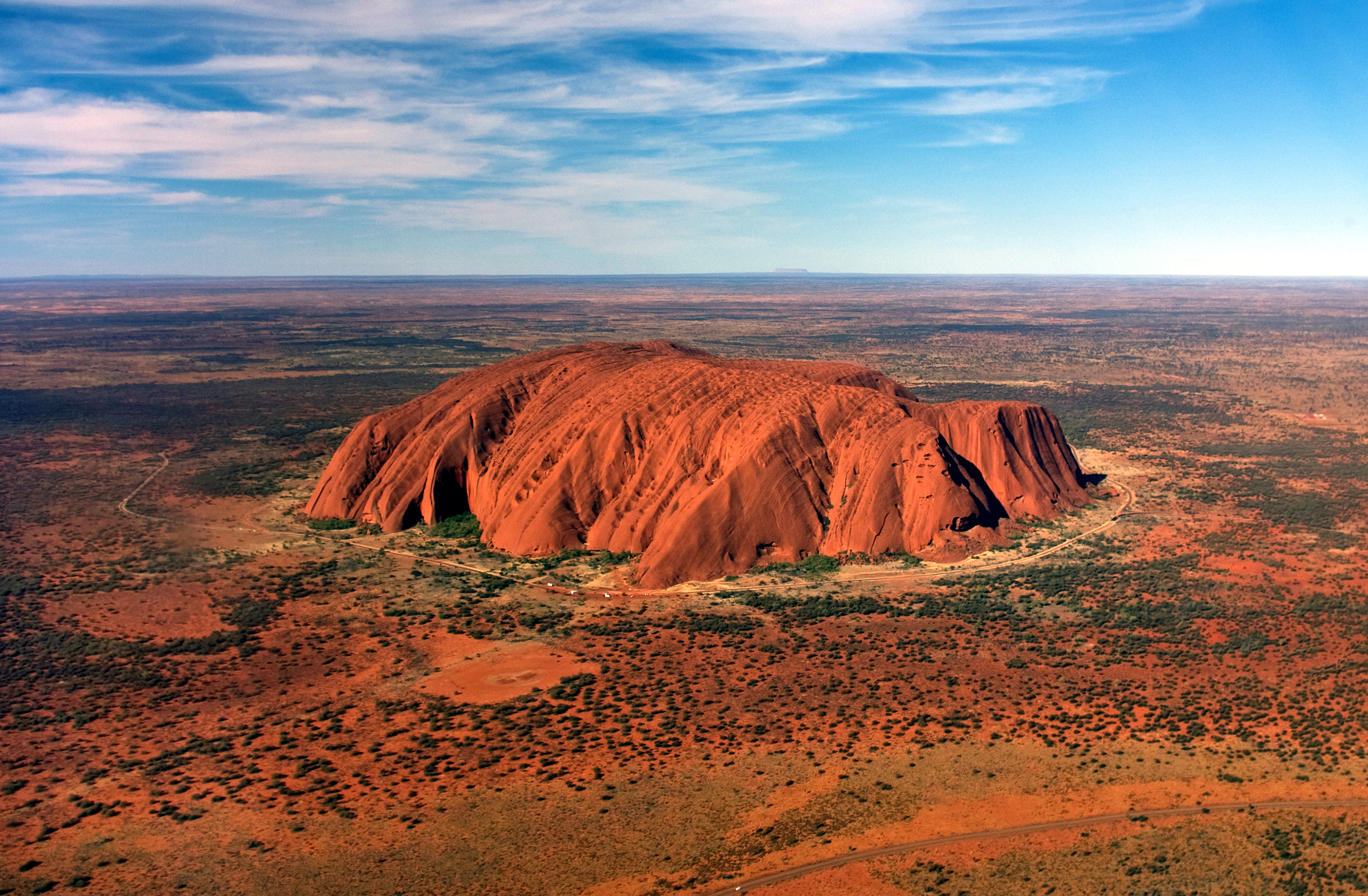
Uluru: The Rock That Reaches 2.5km Underground
Uluru rises 348 meters above the flat Australian Outback - a massive red dome that appears to have been dropped from space. But what you see is only the tip. The rock extends 2.5 kilometers below ground, a buried mountain formed 600 million years ago when Australia was covered by an inland sea. To the Anangu people, Uluru is not a geological curiosity - it's a living cultural landscape where ancestral beings walked during the Dreamtime. In 2019, after decades of debate, climbing the rock was permanently banned. Uluru remains sacred, ancient, and far larger than it appears.
The Formation
Uluru began as sand. Around 550 million years ago, rivers deposited vast quantities of sediment in an inland basin. The sand compacted into arkose - a coarse sandstone rich in feldspar. Tectonic forces tilted the rock beds nearly vertical, then erosion exposed the edges.
What we see as Uluru is actually the exposed edge of a massive underground formation, tilted 85 degrees from horizontal. The rock extends 2.5km below the surface. Neighboring Kata Tjuta (The Olgas) is composed of the same formation, exposed differently. The monolith is like an iceberg - the visible portion is a fraction of the whole.
The Color
Uluru's famous red color is essentially rust. The rock contains iron-bearing minerals that oxidize on the surface. The unweathered interior is actually gray. Rain streaks create dark patterns on the face, tracing water's path down the rock for millennia.
The color changes dramatically with light. At dawn and dusk, Uluru appears to glow - orange, red, purple, depending on atmospheric conditions. Photographers gather at sunrise and sunset to capture the shifting hues. The effect is real, not romantic exaggeration. The rock genuinely seems to change color, its iron-rich surface responding to the angle of light.
The Sacred
To the Anangu people, Uluru is not a rock - it's a living record of the Dreamtime, when ancestral beings created the world. Specific features of the rock mark events from these creation stories: a cavity where an ancestor camped, striations where a battle was fought, caves where ceremonies were held.
Some areas of Uluru are sacred and cannot be photographed or entered by non-Anangu. The rock's significance predates European contact by tens of thousands of years. When the British 'discovered' Uluru in 1873, the Anangu had been its caretakers for at least 30,000 years.
The Climb
For decades, tourists climbed Uluru via a chain-assisted route up the western face. The Anangu repeatedly asked them to stop - the climb path crossed a sacred area, and the practice was disrespectful. It was like climbing on a church altar.
On October 26, 2019, climbing Uluru was permanently banned. In the final days before the ban, thousands rushed to make the climb, creating lines that stretched across the rock. Since the ban, the climbing path has been closed and is slowly recovering. The Anangu's request - first made in 1985 - was finally honored.
The Experience
Visitors can still walk around Uluru's 9.4km base, visit cultural centers, and take guided tours led by Anangu rangers. Seeing the rock at sunrise and sunset remains permitted - and magical. The Field of Light, an art installation of 50,000 glowing spheres, illuminates the desert near Uluru at night.
What you cannot do is treat Uluru as a climbing gym. The ban disappointed some tourists but was welcomed by many Australians. The rock is not a challenge to be conquered - it's a 600-million-year-old sacred site that deserves respect. Standing at its base, watching it glow at sunset, it's hard to disagree.
From the Air
Uluru (25.34S, 131.04E) sits in Australia's Red Centre, 335km southwest of Alice Springs. Ayers Rock Airport (YAYE) is 6km north. From the air, Uluru is unmistakable - a massive red oval in the flat ochre desert. Kata Tjuta (The Olgas) is 25km west. The desert extends in all directions to the horizon. Weather is arid with extreme temperature variation - summer days above 40°C, winter nights near freezing.