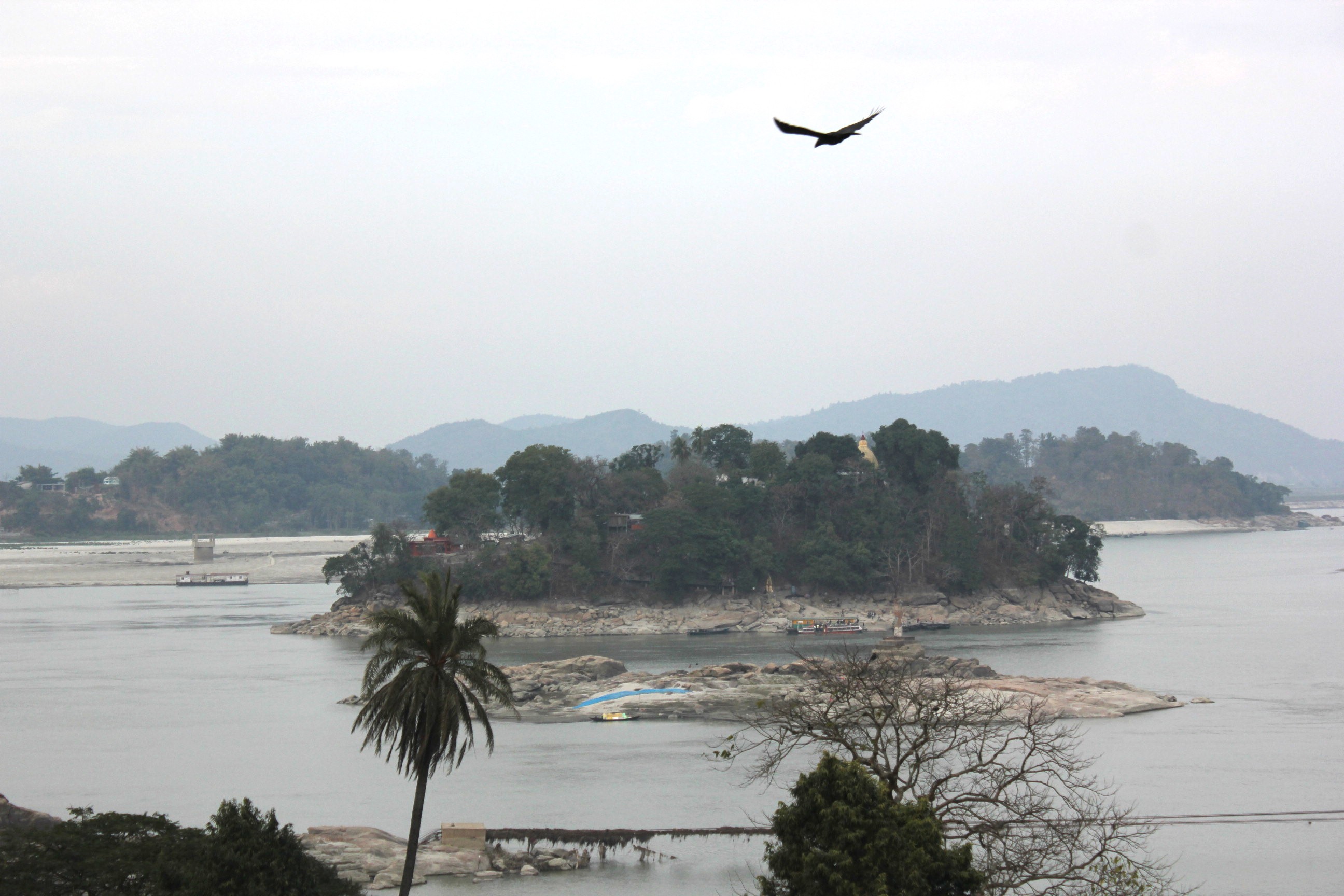
Umananda Temple
The Brahmaputra is not a river that invites intimacy. One of the largest waterways on Earth, it moves through Assam with a breadth that can make its banks seem like distant shores. Yet in the middle of this immense current at Guwahati sits a hillock so small it barely qualifies as an island - Umananda, also called Peacock Island, reputedly the smallest inhabited riverine island in the world. On its summit, reached by a flight of steep stone steps, stands a Shiva temple that has been destroyed and rebuilt, desecrated and restored, shaken to rubble by earthquake and raised again by devotion. The island's persistence mirrors the temple's: both improbably small, both enduring against a river that could swallow them.
Ashes on the Hillock
Hindu mythology gives the island a violent origin. According to the Kalika Purana, Shiva once meditated on this hillock when Kamadeva, the god of desire, interrupted his concentration. Shiva's fury burned Kamadeva to ashes on the spot, and the hill became known as Bhasmacala - the hill of ashes. The name carries a double meaning: the island is named for Uma, another name for Shiva's consort Parvati, and Ananda, meaning happiness. The Kalika Purana places the goddess Urvasi here as well, bringing amrit - the nectar of immortality - for the enjoyment of the goddess Kamakhya, whose own famous temple sits on a hill overlooking the Brahmaputra just a few kilometers away. The mythology layers thick on this small piece of rock, each story compressing enormous cosmic drama into a space you can walk across in minutes.
An Ahom King's Commission
The brick temple that visitors see today traces its lineage to 1694, when Bar Phukan Garhganya Handique built it on the orders of King Gadadhar Singha, one of the Ahom dynasty's most powerful rulers. But evidence on the island points to much older worship. Stone sculptures and carvings from the early medieval period survive here, including a four-armed female figure and rock-cut images of Ganesha - remnants of a stone temple from the post-Gupta era. The Ahom-era temple did not last long in its original form. The Mughal army desecrated it during one of the many conflicts between the two powers over control of the Brahmaputra valley. In an ironic reversal, the Mughal emperor Aurangzeb himself later granted a jagir - a land endowment - to the temple when Guwahati came under his control.
The Earthquake and the Merchant
The 1897 Assam earthquake, one of the most powerful seismic events ever recorded in South Asia, devastated the temple. What Gadadhar Singha had built two centuries earlier collapsed into rubble. The reconstruction that followed came not from a king or a government but from a wealthy local merchant, whose identity history has not clearly preserved. This anonymous patron made one curious choice: he inscribed the interior walls of the rebuilt Shiva temple with Vaishnavite slogans - devotional phrases belonging to the tradition of Vishnu worship rather than Shiva's. Whether this was deliberate syncretism or simply the merchant's personal devotion overriding convention, the result is a Shiva temple whose walls speak to a different deity entirely. It is a small theological puzzle that visitors encounter without always recognizing its oddity.
Eleven Gods on a River Rock
Despite its diminutive size, Umananda Temple houses representations of eleven Hindu deities. The main shrine belongs to Shiva, but surrounding it are images of Surya, Ganesha, Devi bearing a scorpion emblem, Vishnu, and Vishnu's ten incarnations. The sculptural program suggests that the island's worshippers did not confine themselves to any single tradition within Hinduism. Country boats ferry visitors from Kachari Ghat on the Guwahati riverbank, a short crossing that can feel much longer when the Brahmaputra is running high. The steps that climb from the landing to the shrine are steep enough to make the ascent feel like a small pilgrimage. At the top, the temple and its surrounding shrines occupy nearly every usable surface on the island's summit - a compression of sacred space that makes the devotion concentrated and intense, everything built on the edge of what the rock will hold.
From the Air
Located at 26.20°N, 91.75°E on Peacock Island in the middle of the Brahmaputra River at Guwahati, Assam. Best viewed at 2,000-4,000 feet AGL. The tiny island is visible as a green dot in the broad Brahmaputra channel. Guwahati's waterfront lies to the south, with the Kamakhya Temple hill visible nearby. Nearest airport is Lokpriya Gopinath Bordoloi International Airport (VEGT), approximately 20 km to the west.