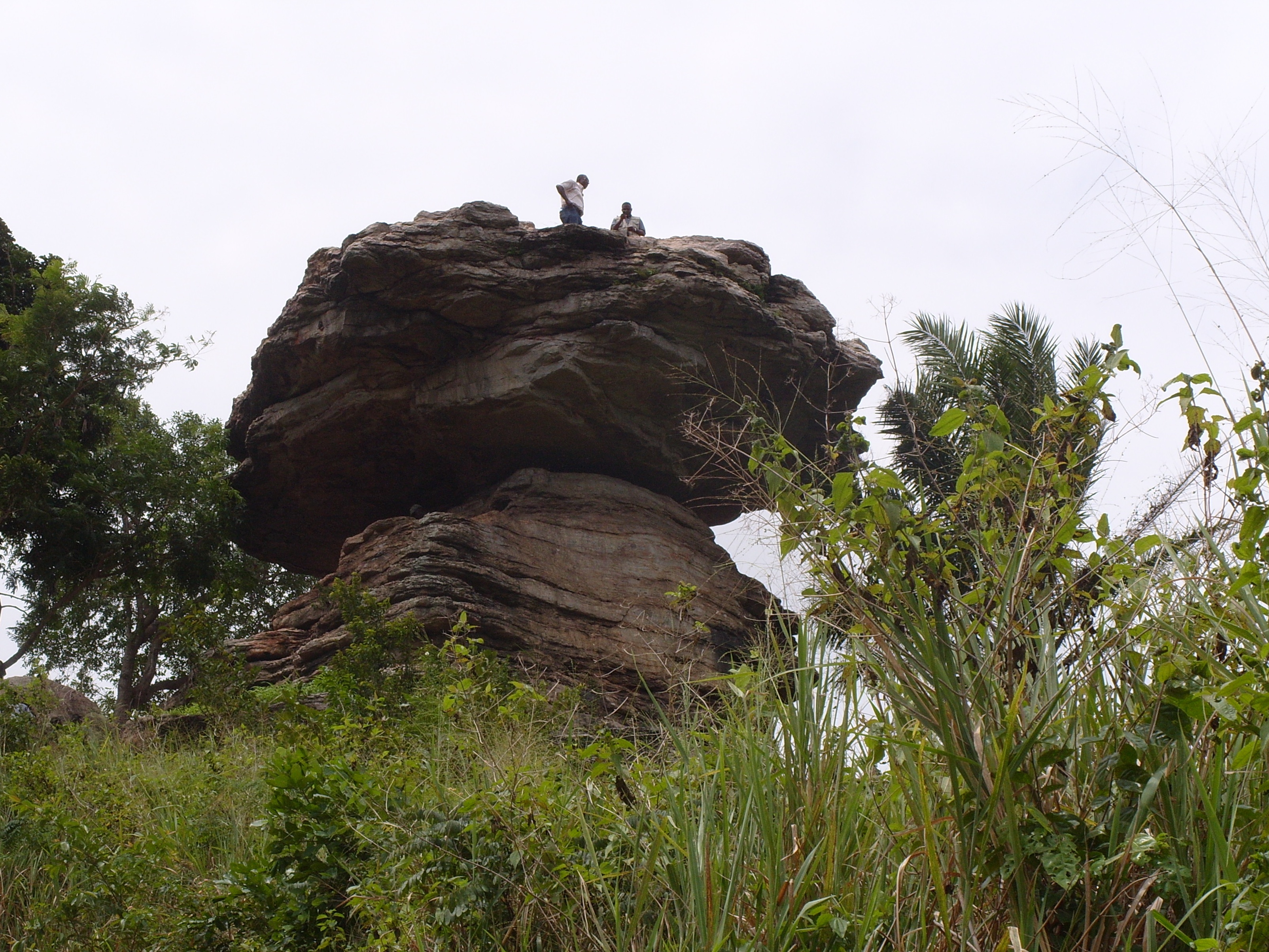
Umbrella Rock
Ten tonnes of rock balanced on a pillar no wider than a person's torso. Holes pierce the central column, as if the stone were laced rather than solid, and the flat overhang extends outward in every direction like a parasol opened against the forest canopy. Umbrella Rock sits seven kilometers from Boti Falls in Ghana's Yilo Krobo District, and the name could not be more literal: the overhang is large enough to shelter twelve to fifteen people standing beneath it. How it got there is a question of geology measured in centuries of erosion and weathering. Why it stays there is a question most visitors prefer not to examine too closely while standing underneath.
The Hunter's Discovery
According to the oral history of the Yilo Krobo people, the rock was found by a hunter working the deep forest decades ago. He had ventured far enough from the village that the canopy had closed overhead and the trails had thinned to animal tracks. When he came across the formation, balanced impossibly on its narrow base, he turned back and brought others to see what the forest had been hiding. The story carries the quality of many discovery narratives in West Africa: an individual encounter with something the landscape had kept secret, followed by the slow incorporation of that secret into communal knowledge. Today the rock is one of the main tourist attractions in the Eastern Region, though reaching it still requires the kind of effort that filters out casual visitors.
The Trail Through the Trees
Most visitors reach Umbrella Rock by hiking from Boti Falls, a trek of roughly 45 to 60 minutes through thick forest along uneven terrain. The trail climbs and drops through the Huhunya forest reserve, passing forest springs that trickle across the path and trees that appear to grow directly out of bare rock, their root systems invisible beneath the stone surface. One landmark along the route is the so-called sound bowl, a concave rock formation that local communities once used to amplify and send messages across the forest. Striking it produces a deep, resonant tone that carries farther than the voice alone. The path is moderately challenging, with some steep sections that grow slippery after rain, but it requires no technical equipment. About 22 kilometers from Koforidua, the regional capital, the hike occupies a middle ground between casual stroll and serious trek.
Geology in Slow Motion
The formation itself is entirely natural, the product of differential erosion working on rock of varying hardness over hundreds or thousands of years. Softer stone weathered away beneath the harder cap, narrowing the supporting column while the overhang above retained its mass. The visible holes through the pillar suggest that water found paths through weaknesses in the stone and widened them over time. The result is a structure that looks engineered but is purely accidental, a geological balancing act that continues to evolve with every rainy season. Similar formations exist across West Africa and other tropical regions where intense rainfall and chemical weathering accelerate the sculpting process. What makes Umbrella Rock distinctive is its scale and its accessibility: a formation dramatic enough to draw attention, close enough to a major waterfall to justify the detour, and stable enough, so far, to let visitors stand beneath it without undue concern.
Two Attractions, One Journey
Umbrella Rock and Boti Falls are almost always visited together, and the pairing makes geographic and experiential sense. The falls deliver the dramatic spectacle: a 30-meter twin waterfall, a canyon filled with spray, local mythology of marriage and rainbows. The rock provides the quieter counterpoint: a forest hike, a geological curiosity, and the satisfying strangeness of standing beneath something that should not, by any intuitive reckoning, remain upright. Together they anchor a day trip from Koforidua or a longer excursion from Accra, and they offer the kind of variety that keeps visitors moving through the Eastern Region's landscape rather than lingering at a single site. The rock has appeared in Ghanaian tourism campaigns and travel guides for years, its silhouette instantly recognizable. For a formation discovered by an anonymous hunter in the deep forest, it has traveled far.
From the Air
Located at 6.18N, 0.22W in the Yilo Krobo District, Eastern Region of Ghana, approximately 22 km from Koforidua and 7 km from Boti Falls. The rock formation is beneath forest canopy and not directly visible from altitude, but the surrounding Huhunya forest reserve and the road corridor from Koforidua are identifiable. Nearest major airport is Kotoka International (DGAA/ACC) in Accra, roughly 95 km to the southwest. The terrain is hilly with moderate elevation in this part of the Eastern Region.