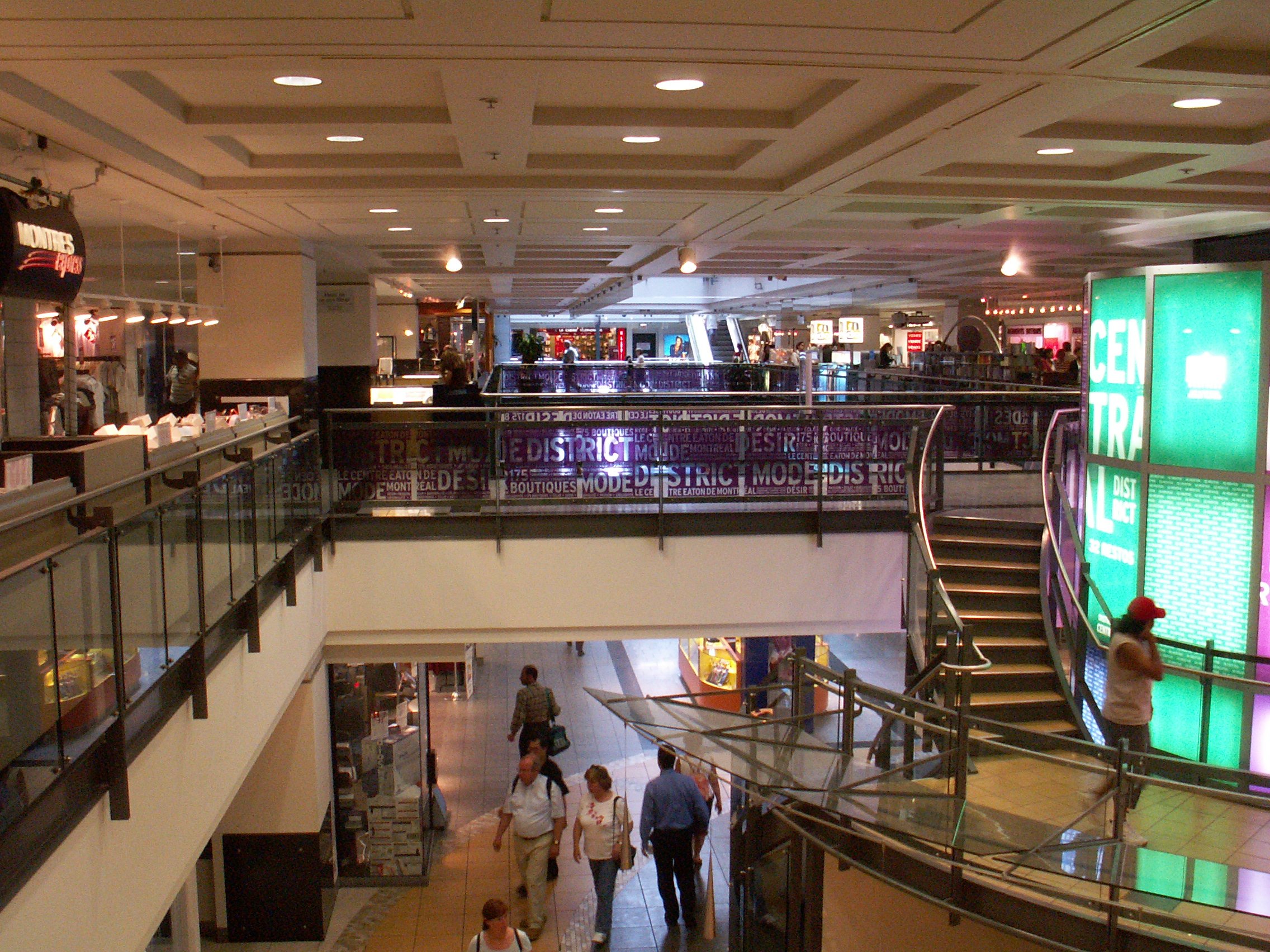
Underground City, Montreal
Half a million people walk through Montreal every day without ever stepping outside. They move through fluorescent-lit corridors beneath the downtown core, passing storefronts and food courts, ducking into Metro stations and emerging inside university lecture halls, hockey arenas, and hotel lobbies. Known officially as RESO -- a play on the French word reseau, meaning network -- Montreal's Underground City is the largest subterranean complex in the world. It stretches 32 kilometers beneath the city's central business district, linking 10 Metro stations, 2,000 shops, 1,200 offices, 200 restaurants, four universities, and the Bell Centre, home of the Montreal Canadiens. From the air, nothing betrays its existence. The downtown skyline of glass and steel gives no hint that an entire parallel city hums beneath the pavement.
Born from an Ugly Pit
The Underground City began as an act of urban cosmetics. In the early 1960s, an unsightly open pit of railway tracks scarred the southern entrance to the Mount Royal Tunnel, right in the heart of downtown. Urbanist Vincent Ponte envisioned something bold: cover the pit with a gleaming office tower and shopping mall, then connect it to Central Station and the Queen Elizabeth Hotel via underground tunnels. Place Ville Marie opened in 1962, and those first two tunnels became the seed of a network that would grow for six decades. When the Montreal Metro launched in 1966 -- timed for Expo 67 -- the tunnels multiplied. Bonaventure station suddenly connected to the Chateau Champlain hotel, Place du Canada, Place Bonaventure, Central Station, and Windsor Station, forming the first true core of the subterranean city. The transit commission sweetened the deal by offering aerial rights above Metro entrances through emphyteutic leases, and developers raced to plug their buildings into the growing grid.
A City That Never Stopped Growing
Each decade brought a new wave of expansion. In 1974, Complexe Desjardins anchored a second downtown segment between Place-des-Arts and Place-d'Armes stations. Between 1984 and 1992, three major shopping centres -- Cours Mont-Royal, Place Montreal-Trust, and the Promenades Cathedrale, built directly beneath Christ Church Cathedral -- stitched the Peel and McGill Metro areas together. The 1990s brought mega-projects: Le 1000 De La Gauchetiere, Montreal's tallest building, and the Montreal World Trade Centre both joined the web. The Bell Centre's construction connected Lucien-L'Allier station, and a tunnel between Eaton Centre and Place Ville-Marie finally linked the two halves of the central network. By 2003, the redevelopment of the Quartier International added continuous corridors decorated with museum-sponsored art installations, completing a route that lets pedestrians walk from UQAM's Sherbrooke Pavilion to the Bell Centre without once encountering weather.
Winter's Antidote
Montreal winters are long, and they are fierce. Temperatures routinely plunge below minus twenty Celsius, and blowing snow can make a five-minute walk feel punishing. The Underground City exists because Montrealers refused to let climate dictate their lives. The network is climate-controlled and well-lit, arranged in a U-shape with two north-south axes connected by an east-west corridor. More than 120 exterior access points dot the surface, and another sixty Metro station entrances outside RESO's official boundaries have their own smaller tunnel offshoots. For many Montrealers, the underground is simply how you get around downtown -- a massive mall complex linking Metro stations that feels so natural you may not even realize you are in it. Most of the network operates from 5:30 AM to 1:00 AM, matching Metro hours, though some sections close after business hours.
More Than Corridors
The statistics read like those of a small city, not a tunnel system. RESO encompasses approximately 1,600 housing units, 40 banks, movie theatres with 40 screens, seven major hotels, and three exhibition halls including the Palais des Congres and Place Bonaventure. Four universities -- McGill, Concordia, UQAM, and the Universite de Montreal -- maintain campus buildings plugged directly into the network, and several have their own supplementary tunnel systems. Place des Arts, the Musee d'art contemporain, and a cathedral all sit within reach. Every February, Art Souterrain transforms the central segment into a contemporary art gallery during the Montreal Highlights Festival, turning utilitarian corridors into exhibition space. The name RESO itself, adopted in 2004, ends with a stylized 'O' in the shape of the Montreal Metro logo -- a small typographic wink acknowledging that this entire parallel city exists because of a transit system that arrived in time for a World's Fair.
Cracks in the Foundation
Maintaining a city beneath a city comes with hazards. On August 24, 2007, construction crews discovered a seven-meter fissure in the ceiling of a corridor linking McGill station to The Bay department store, running beneath de Maisonneuve Boulevard. The discovery shut down shops, streets, and buildings while engineers assessed the risk of collapse. Green Line Metro service halted between Berri-UQAM and Lionel-Groulx for the weekend. Work crews installed more than 1,000 temporary metal supports before service was restored on Monday. Inspections revealed that a nearby building, the Parkade Montreal at 2021 Union, had concrete panels in danger of falling off, prompting emergency repairs. A later report blamed the construction of a bike path for the structural damage. Street traffic on De Maisonneuve did not resume until March 2008. The incident was a reminder that the Underground City, for all its scale and ambition, demands constant vigilance.
From the Air
Located at 45.503N, 73.572W in downtown Montreal. From the air, the Underground City is invisible -- look for the cluster of skyscrapers centered around Place Ville Marie and the cruciform-shaped rooftop of the Bell Centre to the west. The nearest major airport is Montreal-Pierre Elliott Trudeau International (CYUL), approximately 15 km west. Montreal/Saint-Hubert (CYHU) lies to the southeast. Best viewed at 3,000-5,000 feet AGL to appreciate the density of the downtown core that conceals 32 km of tunnels beneath it.