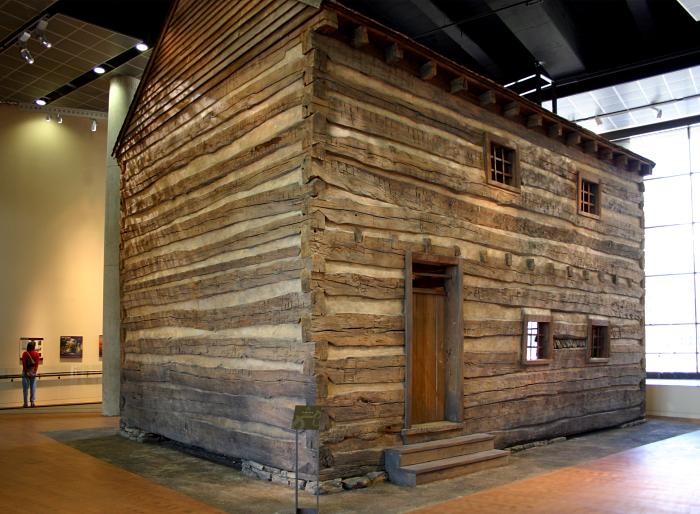
The National Underground Railroad Freedom Center: America's Slave Pen
There's a slave pen inside the National Underground Railroad Freedom Center. The museum on Cincinnati's riverfront was built around it - a two-story log structure from Mason County, Kentucky, where enslaved people were held awaiting sale down the river. The pen was moved timber by timber and reconstructed inside the museum, preserving the cramped cells where human beings were caged like livestock. Visitors enter the pen and stand where the enslaved stood, seeing what they saw: darkness, confinement, the certain knowledge of being sold away from everyone they loved. The Freedom Center uses the pen as its emotional center - the horror that the Underground Railroad worked to combat, preserved not as artifact but as witness.
The Pen
The slave pen was built around 1830 on a Mason County, Kentucky farm - a holding facility where enslaved people awaited transfer to the domestic slave trade. The structure has two stories: a ground floor where the enslaved were held, and an upper floor where the slaveholder conducted business. The cells are cramped, dark, and designed for control, not comfort. The pen was one of many such facilities in the border states, where enslaved people changed hands before being shipped to the cotton-hungry Deep South. This particular pen survived intact because subsequent owners used it as a barn, preserving its structure while erasing its memory.
The River
The Ohio River, flowing past the Freedom Center, was the boundary between slavery and freedom - Kentucky on one side, Ohio on the other. Cincinnati sat on the freedom shore, a destination for those who escaped and a transit point for those continuing north. The city's position made it central to the Underground Railroad, the informal network of safe houses and guides that helped enslaved people reach free territory and, eventually, Canada. The river that carried slave-trade boats also carried people to freedom; the same geography that enabled commerce enabled escape.
The Museum
The National Underground Railroad Freedom Center opened in 2004, designed by BOORA Architects to frame views of the Ohio River and the Kentucky shore beyond. The museum's exhibits trace slavery's history, the Underground Railroad's operations, and freedom's ongoing pursuit. But the slave pen is the emotional core - a physical artifact of horror that abstractions can't convey. Standing inside, visitors confront what words can only describe. The museum extends the story beyond the 19th century, connecting slavery to modern human trafficking and contemporary struggles for freedom. The pen reminds visitors that horror is not historical abstraction; it happened in structures like this one, to people whose names are mostly lost.
The Stories
The Freedom Center preserves individual stories alongside the pen's collective horror. Harriet Tubman, who escaped slavery and returned repeatedly to guide others north. John Parker, who ran a Ripley, Ohio foundry by day and ferried escapees across the river by night. Levi Coffin, whose Cincinnati home sheltered over 2,000 people on their way to freedom. The stories humanize what the pen dehumanized - transforming 'people who escaped slavery' into individuals with names, families, fears, and courage. The Underground Railroad worked because people helped strangers at risk of their own lives. The museum honors that courage.
Visiting the Freedom Center
The National Underground Railroad Freedom Center is located on Cincinnati's riverfront, between the Bengals and Reds stadiums. The museum is open Tuesday through Saturday; admission fees apply, with discounts for students and seniors. Plan at least 2-3 hours; the exhibits are dense and emotionally demanding. The slave pen is in the main gallery; its impact is powerful and disturbing. The Rosa Parks Experience allows visitors to experience the Montgomery bus boycott through interactive theater. The Everyday Freedom Heroes gallery connects historical struggles to contemporary activism. Downtown Cincinnati has extensive dining and lodging. The riverfront is walkable; the Freedom Center is accessible by foot from most downtown hotels.
From the Air
Located at 39.10°N, 84.51°W on Cincinnati's Ohio River waterfront. From altitude, the Freedom Center appears as a modern building complex between Paul Brown Stadium and Great American Ball Park. The Ohio River flows west, with Kentucky visible across the water - the same view that escapees saw when they reached freedom's shore. Downtown Cincinnati rises to the north. The Roebling Suspension Bridge crosses the river nearby; it opened in 1867, carrying freedom seekers to safety during its early years. The geography that made Cincinnati a slave-trade hub also made it an escape destination; both histories are visible from altitude.