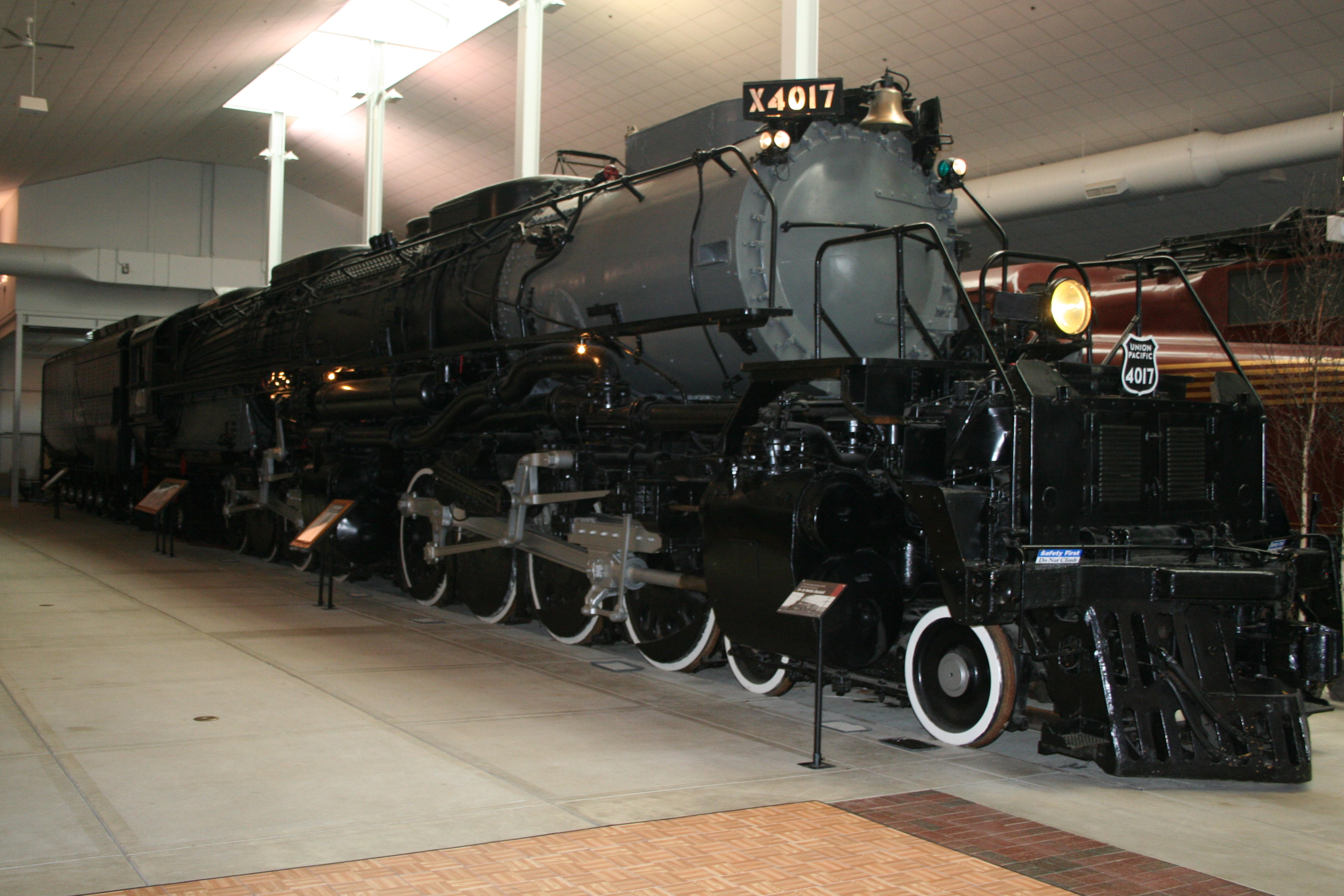
Union Pacific Big Boy: The Locomotive That Outweighed a 747
A worker chalked 'Big Boy' on the smokebox of the first locomotive during assembly at the American Locomotive Company plant in Schenectady. The name stuck. Between 1941 and 1944, ALCO built 25 of these behemoths for Union Pacific - the only locomotives ever to use the 4-8-8-4 wheel arrangement, meaning four wheels in the leading truck, two sets of eight massive driving wheels, and four more supporting the enormous firebox. The combined weight of engine and tender outweighed a Boeing 747. They were built to haul freight over the Wasatch Range between Ogden, Utah, and Green River, Wyoming, conquering a 1.14% grade that had demanded double-heading with smaller locomotives. In 1943 tests, a Big Boy consumed 11 tons of coal and 12,000 gallons of water per hour at full throttle, producing 6,290 drawbar horsepower at 41.4 miles per hour. They were the heaviest reciprocating steam locomotives ever built.
Engineering the Impossible
Union Pacific's challenge was specific: the 1.14% grade climbing eastward out of Ogden into the Wasatch Range. The railroad's existing Challenger-type locomotives could handle most of the route, where grades topped out at 0.82%, but the Wasatch climb demanded double-heading and helper operations that slowed service. In 1940, UP engineers redesigned the Challenger 'from first principles,' as locomotive historian Tom Morrison wrote. They enlarged the firebox to approximately 150 square feet, increased boiler pressure, added four driving wheels, and reduced the wheel diameter from 69 to 68 inches. The design eliminated compounding, booster engines, and feed water heaters, but added complexity elsewhere - the proliferation of valves and gauges on the backhead made running a Big Boy more demanding than any previous locomotive. They were built with such safety margins that they normally operated well below their maximum capacity.
Mountains and Coal Mines
The Big Boys burned low-quality bituminous coal from Union Pacific-owned mines in Wyoming. An automatic stoker carried coal from the tender to the firebox at slightly over 10 tons per hour. Water came from two injectors: a Nathan type rated for 12,500 gallons per hour on the right side, an Elesco exhaust steam injector at 14,050 gallons per hour on the left. Upon arrival in 1941, the locomotives were assigned to the Utah Division between Ogden and Green River - the route they were designed to conquer. In 1944, their territory expanded east to Cheyenne over Sherman Hill. By 1948, they were working the line south from Cheyenne to Denver. In their final years of steam service, they ran only between Cheyenne and Laramie, fired up for fall rush traffic. The last revenue train pulled by a Big Boy completed its run early on July 21, 1959.
The Crews Who Ran Them
Locomotive crews held the Big Boys in high regard, finding them sure-footed and more user-friendly than other motive power. The machines were capable - rated hauling tonnage increased several times over the years. Tests in April 1943 proved a Big Boy could handle 4,200 tons on the 1.14% Wasatch grade, exceeding the designed capacity of 3,600 tons, at average speeds of 18 to 20 miles per hour. Most grades on Union Pacific's Overland Route were no steeper than 0.82%, allowing Big Boys to handle trains of roughly 6,000 tons. In 1953, the opening of Track 3 via Harriman with its 0.82% grade theoretically allowed a Big Boy to haul a 6,000-ton train unassisted the entire way from Council Bluffs, Iowa, to Ogden. But postwar increases in coal and labor costs, combined with the efficiency of diesel-electric power, spelled the end. Four Big Boys remained in operational condition at Green River, Wyoming, until 1962.
Eight Survivors
Eight Big Boys survived into preservation. Most sit on static display at museums across the United States - at the Forney Transportation Museum in Denver, at Steamtown National Historic Site in Scranton, at the RailGiants Museum in Pomona. One stands in Cheyenne itself, No. 4004, repainted in 2018. Union Pacific re-acquired No. 4014 in 2013 from the RailGiants Museum, where it had sat since 1961. The railroad transported the locomotive to its steam shop in Cheyenne - the same city where Big Boys had once been assigned - and began a painstaking restoration. The work took six years. In May 2019, No. 4014 moved under its own power for the first time in 60 years. Union Pacific sent it on tour for the 150th anniversary of the transcontinental railroad's completion. The largest and most powerful operating steam locomotive in the world had returned.
Tracking Giants
The surviving No. 4014 is based at Union Pacific's steam shop in Cheyenne, Wyoming, at coordinates 41.14 N, 104.80 W - within sight of Francis E. Warren Air Force Base where the Thunderbirds perform each July. When operating, 4014 tours across Union Pacific's system; schedules are posted on the railroad's heritage website. Static Big Boy displays are more predictable: No. 4004 in Cheyenne, No. 4005 at the Forney Museum in Denver, No. 4012 at Steamtown in Scranton, No. 4017 at the National Railroad Museum in Green Bay, No. 4018 at the Museum of the American Railroad in Frisco, Texas. From altitude, a running Big Boy would be visible as a plume of steam and smoke moving along the tracks - a sight that disappeared from American railroads in 1959 and returned sixty years later.
From the Air
No. 4014 is based at Union Pacific's steam shop in Cheyenne, Wyoming at 41.14 N, 104.80 W near Francis E. Warren AFB. When operating, 4014 tours UP's system - check railroad heritage schedule. Static displays at multiple museums including Cheyenne (4004), Denver Forney Museum (4005), and Steamtown NHS in Scranton (4012). A running Big Boy produces visible steam plume along tracks. Cheyenne Regional Airport (KCYS) serves the area; Denver International (KDEN) 100 miles south.