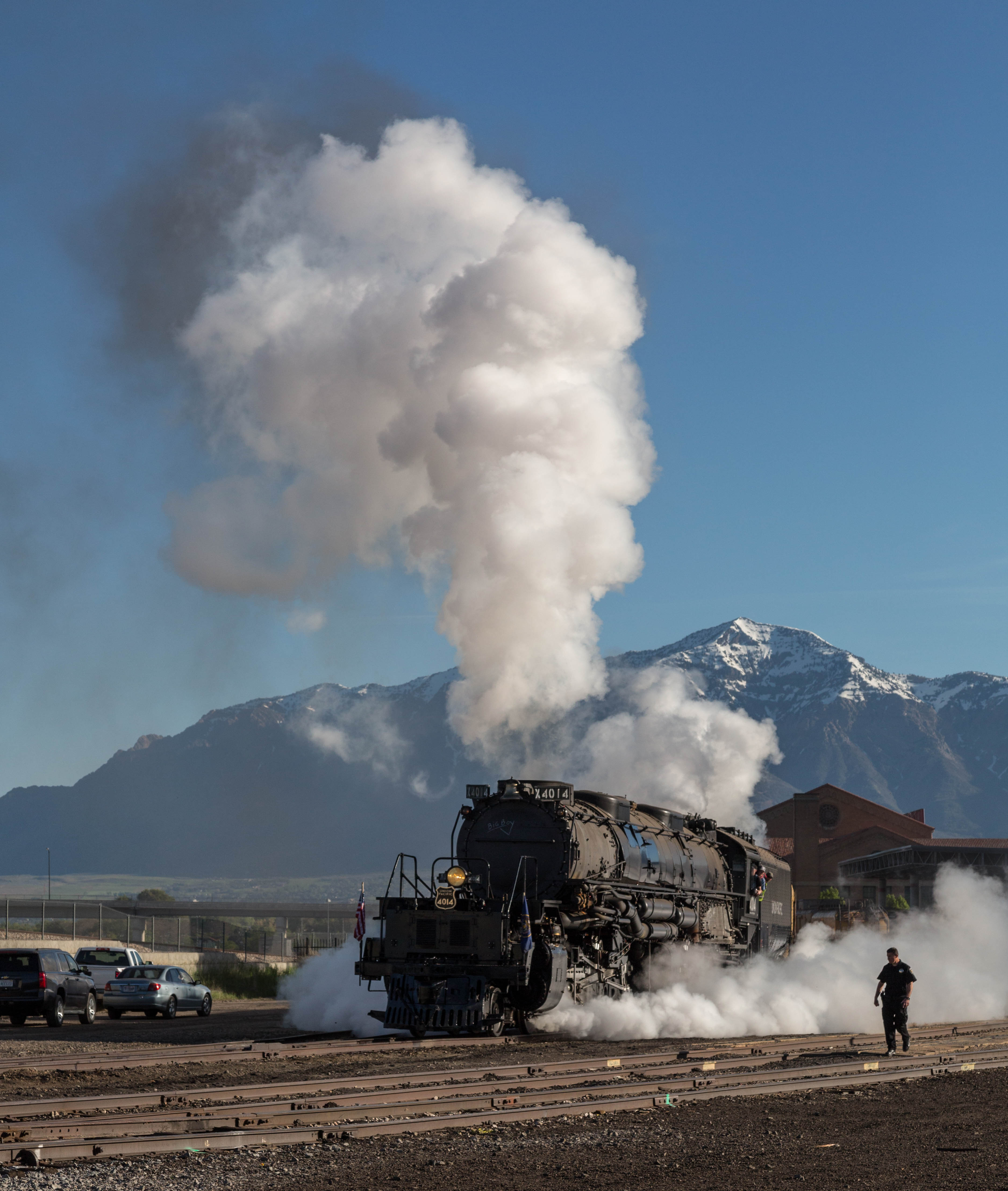
Union Station (Ogden, Utah)
The famous Golden Spike ceremony at Promontory Summit in 1869 made for spectacular photographs, but both railroad companies knew that desolate location was no place for a real junction. The actual meeting point of America's transcontinental railroads would be Ogden, a city that earned the nickname 'Crossroads of the West' by becoming the transfer point for travelers heading anywhere in the Intermountain region. The grand Spanish Colonial Revival station that stands today, completed in 1924, once processed thousands of passengers daily. Now it houses something arguably more valuable: one of the finest collections of historic locomotives in the American West.
How Bars and Brothels Lost the Railroad
Three Utah cities competed to become the junction between the Union Pacific and Central Pacific railroads: Corinne, Uintah, and Ogden. Corinne emerged as the early favorite, but it had a problem. The Church of Jesus Christ of Latter-day Saints, whose members comprised most of Utah's settler population, did not want their territory represented by a Hell on Wheels town full of bars and brothels. In 1874, Brigham Young encouraged church members to donate or sell land parcels to him, which he then donated to the railroads on one condition: build in west Ogden. The strategy worked. Ogden became the junction point, and from this station travelers could connect to the Utah Central Railroad south to Salt Lake City, the Utah and Northern Railway into Idaho, and the Rio Grande Western across the mountains to Colorado.
Curious American Custom
The current station building was completed in 1924 in Spanish Colonial Revival style, built on the foundation of an earlier structure that newspaper readers had complained required walking a quarter-mile of wood boardwalk over swampy ground to reach. The new station was dedicated on November 22, 1924, with a publicity stunt that made international news: thirteen young women pulling the first arriving train by ribbons. The photograph appeared in La Domenica del Corriere, an Italian newspaper, under the headline 'Curious American Custom.' Inside, the Grand Lobby's ceiling extends to the full roof height, with trusses originally painted in bright geometric designs, now covered with faux wood grain. Murals depicting the construction of the transcontinental railroad adorn the north and south walls.
The Crossroads Goes Quiet
Rail traffic through Ogden peaked during both World Wars, when the station became a crucial stopover for soldiers and materials moving across the country. Businesses along nearby 25th Street thrived on the influx. But after 1945, the combination of commercial aviation and the Interstate Highway System steadily drained passengers from the rails. By 1950, daily passenger trains had dropped to twenty. On May 11, 1997, at 7:38 AM, the final Amtrak Pioneer departed eastbound from Union Station. No revenue passenger service has used the platforms since. The adjacent Ogden Central station now serves Utah Transit Authority's FrontRunner commuter rail, while the original station building found new purpose as a museum complex.
Giants of Steam and Turbine
The Utah State Railroad Museum and Spencer S. Eccles Rail Center now occupy the station, preserving an exceptional collection of locomotives. Union Pacific 833, an FEF-2 class steam locomotive built by ALCO in 1939, holds the distinction of being the largest locomotive in the United States ever moved by truck when it was transferred here in 1999. But the crown jewel may be UP X-26, one of only two surviving Union Pacific gas turbine-electric locomotives. Built by General Electric in 1961 and advertised as 'the most powerful locomotive in the world,' these massive machines were known as 'Big Blows' for the roar of their turbines. The other survivor rests at the Illinois Railway Museum.
Rails May Return
In December 2022, Ogden City purchased the land under and around the station from Union Pacific for $5.5 million, ending decades of uncertainty about the property's future. The city has ambitious plans to redevelop the area into a downtown hub, potentially moving FrontRunner commuter rail platforms to the original station building itself. If successful, passengers would once again pass through the Grand Lobby where millions traveled during the golden age of rail. The station also displays the flatcar that carried the Olympic flame during the 2002 Winter Olympics torch relay and a restored World War II hospital car. From railroad junction to museum complex to potential transit hub again, Ogden's Union Station continues to evolve while preserving the machines that built the West.
From the Air
Located at 41.22N, 111.98W at the west end of Historic 25th Street in Ogden, Utah. The station complex is visible from altitude, situated between the Wasatch Range to the east and the Great Salt Lake to the west. Nearest airports include Ogden-Hinckley (KOGD) approximately 3nm southwest and Hill Air Force Base (KHIF) 6nm south. Salt Lake City International (KSLC) is 30nm south. Best viewed from 2,500-4,000 feet AGL. The rail yards and distinctive Spanish Colonial Revival architecture are identifiable landmarks.