Union Station Toronto: The Cathedral of Canadian Rail
On August 6, 1927, the Prince of Wales stepped off a train and into a hall so grand he could not help himself. "You build your train stations like we build our cathedrals," he told his hosts. They handed him the first ticket ever issued at the station - valid for all time, between all stations - and a first-class fare to his ranch in High River, Alberta. The ribbon was cut with gold scissors. Nearly a century later, the comparison holds. Toronto's Union Station remains a monument of limestone and ambition, its 22 Roman Tuscan columns lining Front Street like sentries guarding the busiest transportation hub in Canada. More than 72 million passengers pass through each year, making it second only to New York's Penn Station in North American rail traffic.
Stone and Light
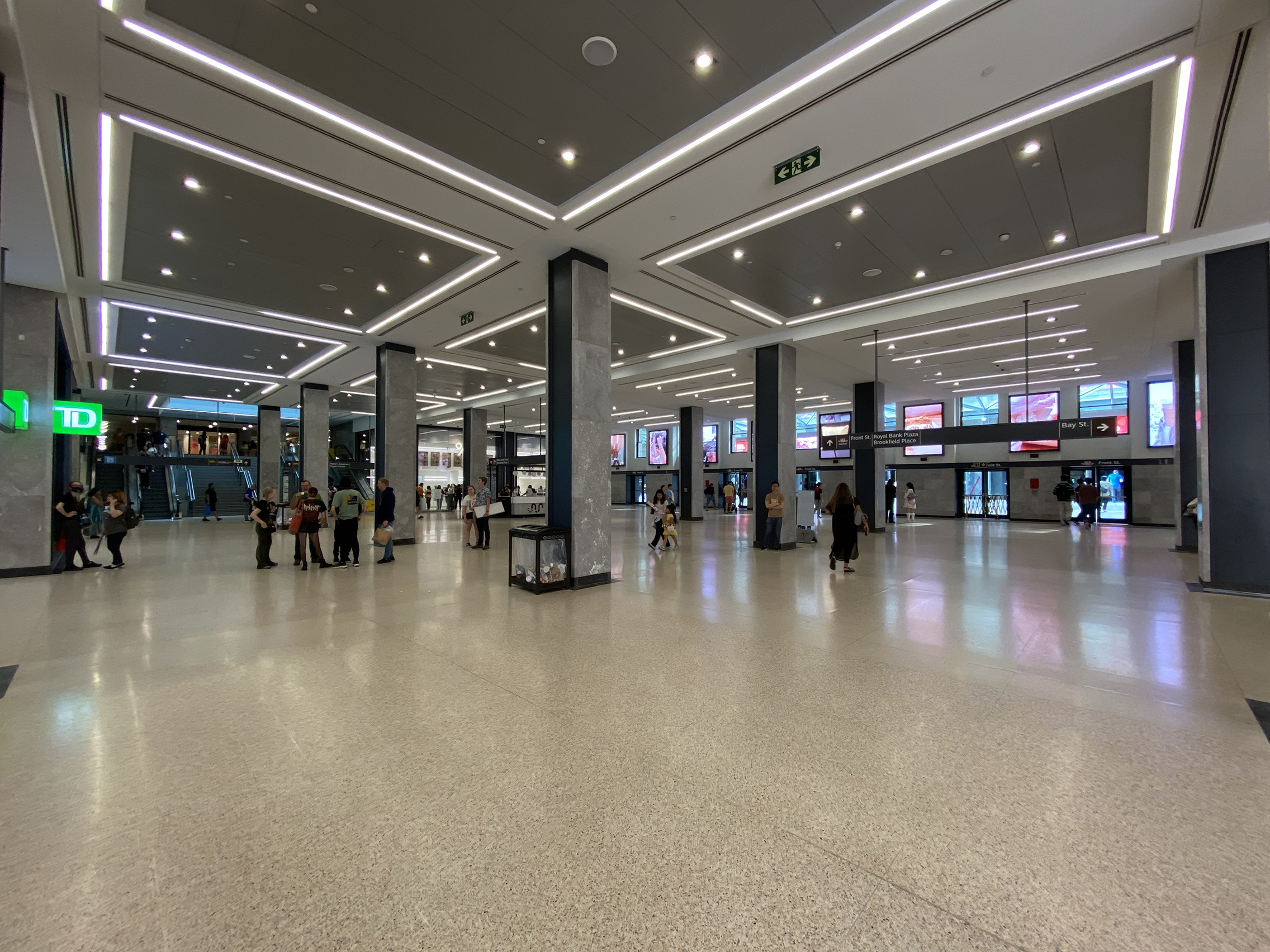
The Great Hall announces itself through material. Walls of Zumbro stone from Missouri rise to meet a vaulted ceiling, while underfoot Tennessee marble stretches in a herringbone pattern the full length of the main section. Below the cornice, the names of Canadian destinations are carved in stone - from Halifax to Vancouver, a geographical roll call that once mapped the reach of the Grand Trunk and Canadian Pacific Railways. Many of those names still appear on Via Rail departure boards today. The exterior tells its own story in smooth beige Indiana and Queenston limestone, the ashlar pattern projecting solidity. Each of the 22 Bedford limestone columns weighs 75 tons. The facade's 28 three-storey bays stretch the entire block between Bay and York Streets, a statement of permanence in a city that constantly reinvents itself.
Three Stations Before One
The Union Station visible today is actually Toronto's third. The first, a wooden structure, opened in 1858 for the Grand Trunk Railway, shared with the Northern Railway and the Great Western Railway. A second Union Station replaced it in 1873, and the Canadian Pacific Railway began using it in 1884. The Great Toronto Fire of 1904 destroyed the block immediately east but spared the station, and the cleared land became the site for the grand third version. Construction began in 1914 but World War I drained workers and materials. The headhouse was finished by 1920, yet the station did not open to the public for another seven years while the elaborate approach track system was designed and built. During that limbo, the bankrupt Grand Trunk Railway was nationalized and absorbed into Canadian National Railways in 1923, reshaping the ownership of the very station it had helped conceive.
The Hidden Floors
Union Station has always kept secrets. From 1927 until 2008, a gun range operated on the seventh floor - originally built for Canadian Pacific and Canadian National Railway police to practice their marksmanship. The range eventually opened to the public as the Canadian National Recreation Association handgun club before the city closed it as a symbolic gesture against gun violence. Below the Great Hall, a different transformation unfolded. A massive renovation deepened the GO Transit concourses to create two storeys of space, with a food court opening in January 2019 on the lower level. The project ballooned from a projected $640 million to over $823 million, running years behind schedule. The contractor, Bondfield Construction, filed for bankruptcy protection in 2019. Above, the original Bush-style train shed, designed by A.R. Ketterson and built between 1929 and 1930, was partially replaced with a glass atrium by Zeidler Architecture, flooding the platforms with daylight for the first time.
The Pulse of a Nation
Union Station handles 65 million passengers annually. Two-thirds are GO Transit commuters fanning out along seven rail lines to Barrie, Kitchener, Oshawa, Niagara Falls, Milton, Richmond Hill, and Stouffville. Another 20 million ride the TTC subway connection on Line 1. Via Rail intercity trains use the Great Hall, while the Union Pearson Express, launched in 2015 for the Pan American Games, whisks travelers to Pearson Airport every 15 minutes from a separate platform accessible via the SkyWalk. The station connects to Toronto's PATH underground network, to streetcar lines, and to a bus terminal at CIBC Square. Ninety-one percent of all Toronto commuter train passengers pass through Union Station. It is not merely a building in the city's transportation network - it is the network's beating heart.
Heritage in Motion
Designated a National Historic Site of Canada in 1975 and a Heritage Railway Station in 1989, Union Station was inducted into the North America Railway Hall of Fame in 1999. But heritage status creates its own tensions. When the renovated train shed roof turned out to be too low for future electrification in 2016, the options were raising the roof or lowering the tracks - because the shed is a protected heritage feature. Decorative cast-iron columns on Platform 3, the northernmost platform serving just one track, were painstakingly restored and reinstalled when that platform reopened in January 2022. The preserved smoke vents over tracks 1 and 2, relics from the age of steam, remain as reminders of what once rolled through. Union Station endures as both museum and machine, carrying the weight of Canadian railway history while still delivering commuters to their Monday mornings.
From the Air
Located at 43.64N, 79.38W in downtown Toronto on the north shore of Lake Ontario. From the air, Union Station sits along Front Street between Bay and York Streets, just north of the rail corridor that defines Toronto's waterfront edge. The Beaux-Arts limestone facade and the distinctive glass atrium over the train shed are identifiable features. The CN Tower rises immediately to the west, connected via the SkyWalk. The Rogers Centre (formerly SkyDome) is also nearby. Toronto City Centre Airport (CYTZ) on the Toronto Islands is 2 km south. Toronto Pearson International Airport (CYYZ) is 27 km northwest. The station sits within Class C airspace. Lake Ontario provides the southern horizon, with the Toronto Islands visible as a foreground feature.