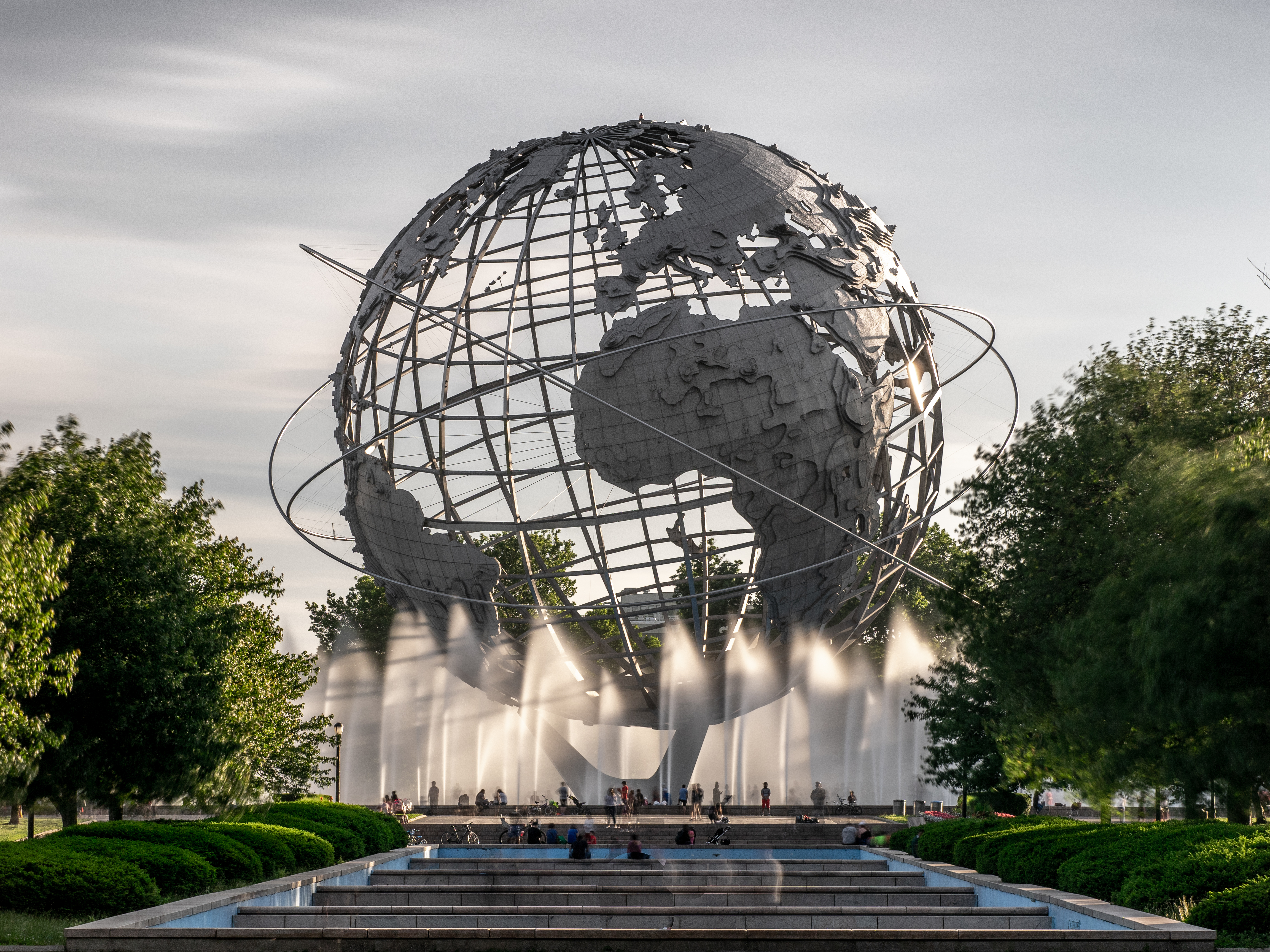
Unisphere
Critics were not kind. The Village Voice called it "probably one of the most uninspired designs we have ever seen." Oculus magazine dismissed it as "a heavy, literal version of the ancient armillary sphere, with decoration by Rand McNally." Progressive Architecture compared it to the set for the finale of a 1930s Warner Brothers musical. None of it mattered. U.S. Steel built the 140-foot globe for free in exchange for having the company's name on World's Fair marketing materials, and when 51 million visitors passed through Flushing Meadows–Corona Park during the 1964 fair, most of them walked past the Unisphere. Some still do.
Built in 110 Days
Construction on the Unisphere began on March 6, 1963. The last landmass was installed on August 13, 1963 — 110 days later. The globe measures 120 feet in diameter, weighs 700,000 pounds without its base and 900,000 pounds with it, and stands on a concrete foundation that includes the original piling ring from the Perisphere of the 1939 World's Fair. Six hundred additional piles were driven specifically for the Unisphere. The continents are fabricated in Type 304L stainless steel with a special texture pattern; the horizontal rings represent orbits of the first satellites. At night during the 1964 fair, dramatic lighting created the illusion of sunrise moving across the globe's surface, and small lights marked the capitals of nations.
Decline and Restoration
After the fair, U.S. Steel donated $100,000 to keep the Unisphere as a permanent feature of Flushing Meadows–Corona Park. The gesture did not guarantee dignity. By the 1970s, the globe was covered in grime, the pools were dry, and the surrounding plaza was tagged with graffiti. The fountains were turned back on for the 1978 US Open but went off again soon after. A serious restoration began in 1993 — structural repairs, grime removal, new floodlights, new fountains — and was completed in May 1994. That May, Queens residents successfully petitioned the city's Landmarks Preservation Commission to designate the Unisphere an official landmark. One speaker at the hearing said: "Its symbolism precedes its age."
Queens in Popular Culture
Over the decades the Unisphere has appeared in enough films and music videos to constitute its own filmography. Iron Man 2, Captain America: The First Avenger, and Spider-Man: Homecoming all used it as a backdrop. The sitcom The King of Queens made it a recurring visual shorthand for the borough. A Tribe Called Quest's "Award Tour," Craig Mack's "Flava in Ya Ear," and the Notorious B.I.G.'s "Mo Money Mo Problems" all featured the globe, making it an emblem of New York hip-hop as well as Cold War optimism. People have also climbed it — two unsuccessfully, with fatal results.
What Remains
The New York Times, writing in 2014, called the Unisphere the only relic of the 1964 World's Fair "untarnished by time and enhanced by memory." Everything else from that fair — the pavilions, the rides, the optimism about a Space Age future — has faded or been demolished. The Unisphere stands in the same spot it always has, the Queens Museum at its western flank, the Billie Jean King National Tennis Center to the north. Its fountains have been on and off over the decades, most recently shut down by 2025 due to electrical issues. The globe itself endures. It is 60 years old, still the world's largest, and still being argued about.
From the Air
The Unisphere is located at 40.746°N, 73.845°W in Flushing Meadows–Corona Park, Queens. At 140 feet tall with its distinctive three orbital rings, it is one of the more recognizable landmarks visible from low altitude over Queens. From cruising altitude the park appears as a prominent green rectangle amid the dense borough grid, with Citi Field and the Arthur Ashe Stadium complex visible just to the north. KLGA (LaGuardia Airport) is approximately 2 miles north.