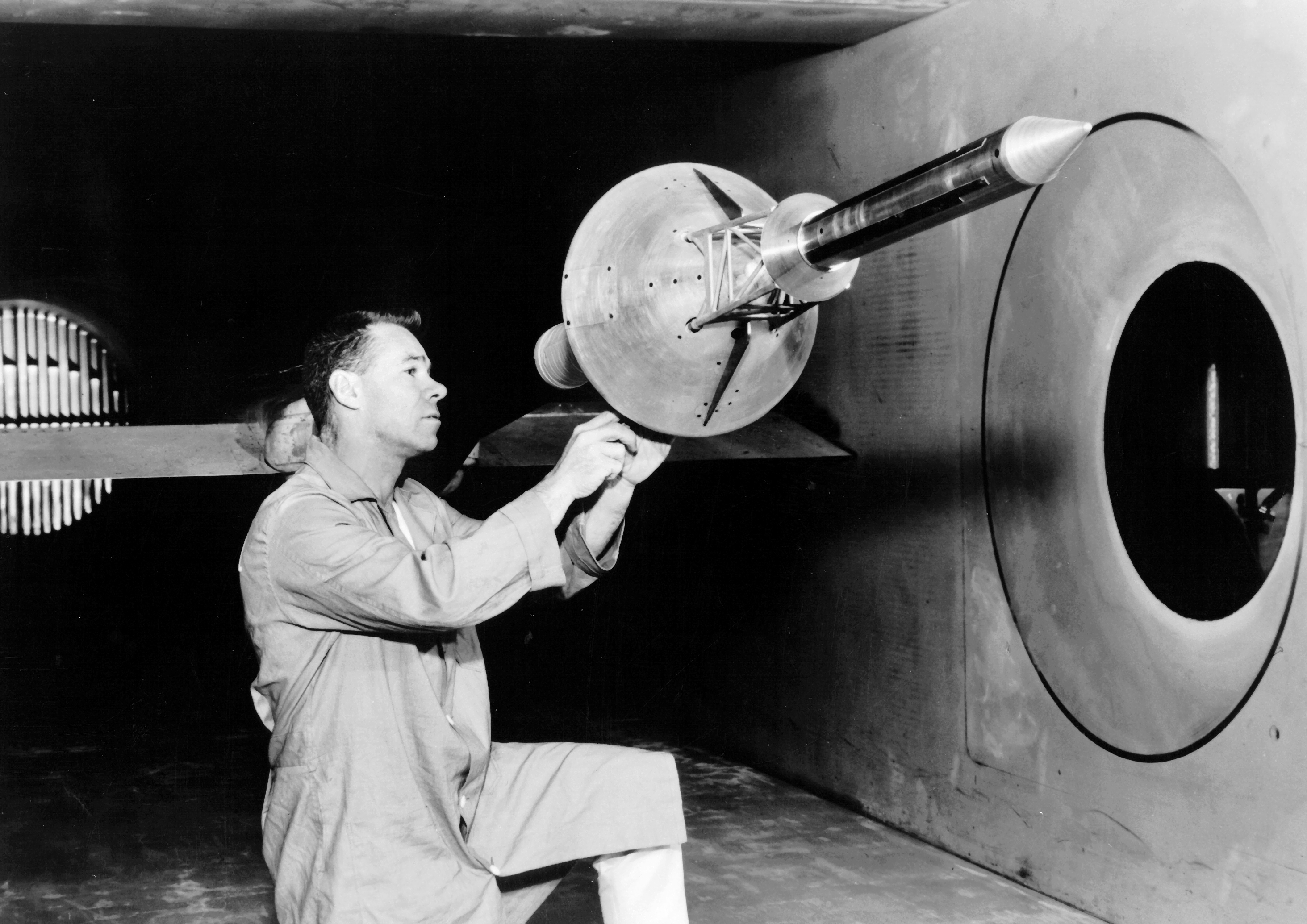
Unitary Plan Wind Tunnel
By 1945, America's lead in aviation was evaporating. German jet aircraft and V-2 rockets had demonstrated capabilities that American researchers could not match, and the wind tunnels needed to develop the next generation of aircraft simply did not exist. Four years later, Congress passed the Unitary Plan Act of 1949, authorizing the construction of a national network of supersonic wind tunnels. The facility built at NASA's Ames Research Center in Mountain View, completed in 1955, would become one of the most important aeronautical testing facilities in history.
260,000 Horsepower
The numbers behind the Unitary Plan Wind Tunnel are staggering. Its main drive system consists of four wound-rotor induction electric motors connected in tandem, each rated to produce up to 65,000 horsepower at 7,200 volts. Combined, they generate 260,000 horsepower -- enough power to simulate airflow from subsonic speeds up through Mach 3.5. The facility houses three distinct test sections: an 11-foot transonic tunnel capable of speeds from Mach 0.25 to 1.4, a 9-by-7-foot supersonic section reaching Mach 2.5, and an 8-by-7-foot section (now mothballed) that could push to Mach 3.5. Drive speed is controlled by a liquid rheostat system, and the airflow in the supersonic sections is produced by multi-stage axial-flow compressors, one of which weighs over 450 tons.
Every Plane You Have Flown On
The West Coast aircraft industry was the Unitary Plan's most eager customer. Boeing's entire fleet of commercial transports was tested here, along with the Douglas DC-8, DC-9, and DC-10. Military aircraft including the F-111 fighter, the C-5A Galaxy transport, and the B-1 Lancer bomber all passed through these test sections as scale models before their first flights. The Boeing 777, which would become one of the most successful widebody aircraft in aviation history, was refined here as well. In the 1960s and 1970s, the facility turned its supersonic capabilities toward space: every NASA crewed vehicle, including all Space Shuttle configurations, was tested in the Ames Unitary Plan Wind Tunnel complex. The Space Launch System has continued that tradition.
Declared Irreplaceable
In 1985, the Unitary Plan Wind Tunnel was designated a National Historic Landmark -- an unusual honor for a facility that was still actively in use and, in fact, is still operational today. The designation recognized that the tunnel complex represented a pivotal moment in American aeronautical capability: the Cold War decision to invest massively in testing infrastructure that would allow the nation to maintain air superiority. The facility runs year-round, using optical testing techniques including shadowgraph imaging, infrared thermography, and pressure-sensitive paint to measure forces on scale models with extraordinary precision. What started as a response to German wartime advances became the foundation on which decades of commercial and military aviation were built.
From the Air
The Unitary Plan Wind Tunnel is at 37.417°N, 122.060°W within the NASA Ames Research Center at Moffett Federal Airfield (KNUQ). The facility is a large industrial structure visible near Hangar One. Moffett Field has restricted airspace; check NOTAMs. San Jose International (KSJC) is 6 nm southeast. Palo Alto (KPAO) is 5 nm west.