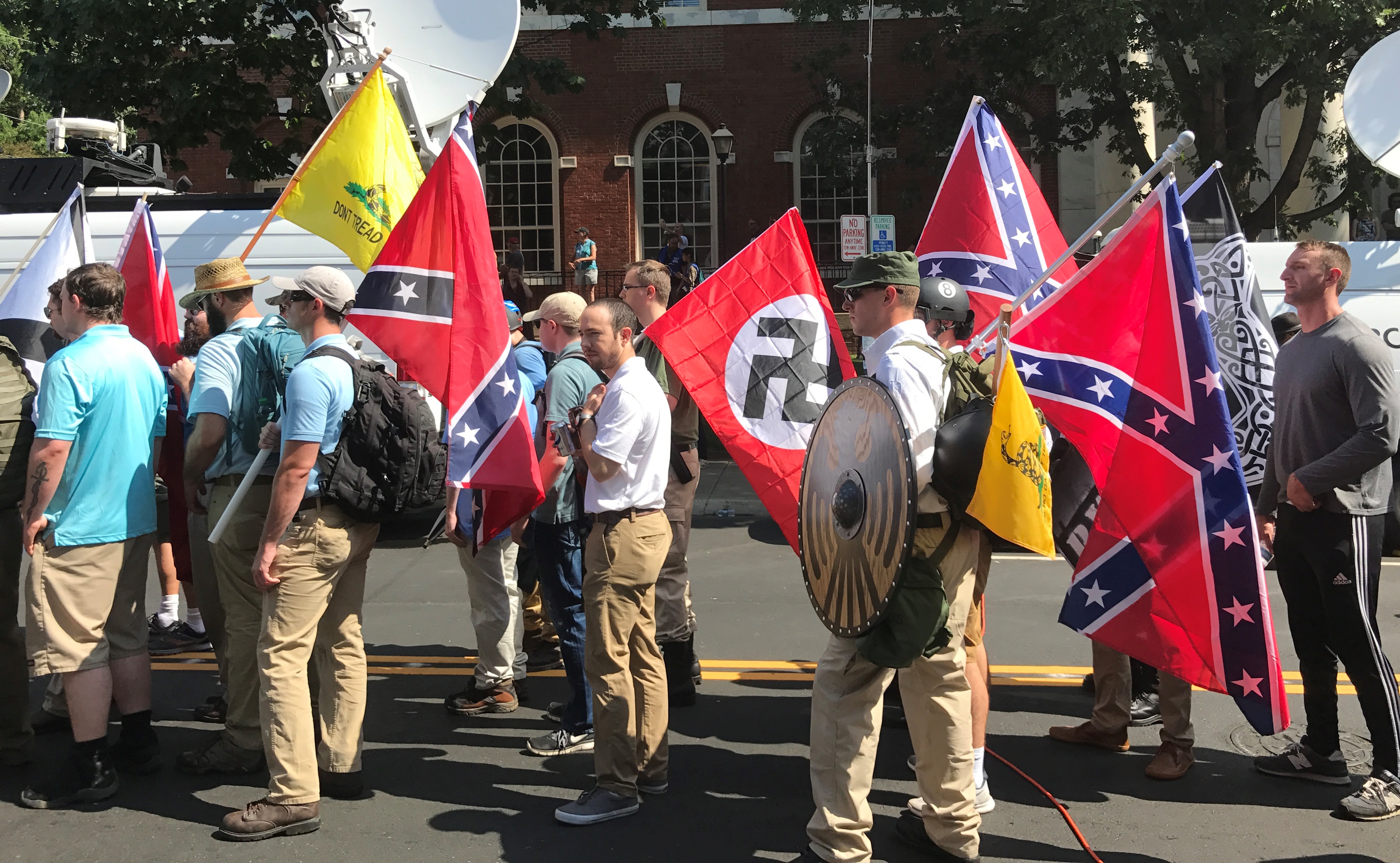
Unite the Right Rally
Heather Heyer was 32 years old. She worked as a paralegal and as a bartender. On August 12, 2017, she walked into downtown Charlottesville to stand against a white supremacist rally that had overtaken the small Virginia college town. That afternoon, a car plowed into the crowd of counter-protesters where she stood. Heyer was killed. Thirty-five others were injured. Two Virginia State Police officers monitoring the rally from a helicopter died when their aircraft crashed nearby. What had been billed as a gathering to protest the removal of a Robert E. Lee statue became the most violent white supremacist event in the United States in decades -- and the moment that made "Charlottesville" a single word carrying the weight of a national reckoning.
Torches in the Dark
It began the night before. On Friday, August 11, hundreds of marchers carrying tiki torches walked through the University of Virginia campus, chanting white nationalist and antisemitic slogans. They converged on the Rotunda, Thomas Jefferson's architectural masterpiece, surrounding a small group of counter-protesters at the base of a statue of Jefferson. Scuffles broke out. University police had been in contact with march organizers about the planned route, but faculty warnings about the threat of violence had been ignored. The torchlit procession -- deliberately evoking imagery of Klan rallies and Nazi marches -- announced to the nation that what was coming Saturday would not be a peaceful demonstration about a statue.
The Day Everything Broke
Saturday morning, August 12, armed white supremacists -- neo-Nazis, Klansmen, neo-Confederates, far-right militia members -- gathered in Emancipation Park, formerly Lee Park. Counter-protesters filled the surrounding streets. Violence erupted almost immediately. By late morning, Virginia Governor Terry McAuliffe declared a state of emergency, and police ordered the crowds to disperse. The rally was over before it officially began. But the worst was still ahead. At approximately 1:45 p.m., James Alex Fields Jr. drove his car at speed into a crowd of counter-protesters on Fourth Street, slamming into a stopped sedan that struck a minivan, sending bodies flying. Fields reversed through the crowd and fled. He was arrested shortly after. In 2018, Fields was convicted in Virginia state court of first-degree murder. The following year, he pleaded guilty to 29 federal hate crimes to avoid the death penalty and was sentenced to life in prison.
A Town Forced to Reckon
Charlottesville is a city of roughly 50,000 people, home to the University of Virginia and known for its wineries, its Jeffersonian architecture, and its Blue Ridge setting. After August 2017, it became shorthand for racial strife. The violence accelerated the removal of Confederate monuments across the country -- about twenty were taken down in the weeks immediately following the rally. Baltimore removed its four Confederate statues overnight. In Durham, protesters toppled one themselves. On July 10, 2021, Charlottesville finally removed the statues of Robert E. Lee and Stonewall Jackson that had been at the center of the controversy. But as NPR correspondent Debbie Elliott observed on the rally's first anniversary, the deeper reckoning was just beginning. The new narrative was coming from the nearly 20 percent of Charlottesville residents who are not white and who had long experienced racial disparities that the rally merely exposed to a national audience.
What Remains on These Streets
The physical landscape of the rally has changed. The statues are gone. Emancipation Park has been renamed. A memorial to Heather Heyer stands where she fell. But the events of that weekend left marks that go deeper than bronze and stone. Twenty-year-old DeAndre Harris was beaten by six men with poles and pipes in a parking garage near the rally site, an assault captured on camera that led to multiple convictions. Clergy held interfaith prayer services at St. Paul's Memorial Church on University Avenue while violence raged blocks away. Across the country, vigils and demonstrations erupted in response. Charlottesville became both a warning and a catalyst -- a demonstration of how quickly the veneer of civic order can shatter, and a spark that energized movements for racial justice, Confederate monument removal, and anti-fascist organizing that continue to shape American politics years later.
From the Air
Located at 38.029N, 78.480W in downtown Charlottesville, Virginia. The former Emancipation Park (rally site) is in the central commercial district. Nearest airport: Charlottesville-Albemarle Airport (KCHO), approximately 8nm north of the city center. The University of Virginia Rotunda, where the Friday night torch march took place, is visible from altitude as a distinctive white domed structure. Charlottesville sits in the eastern foothills of the Blue Ridge Mountains; Shenandoah National Park and the Blue Ridge Parkway are visible to the west. Best viewed at 2,000-4,000 ft AGL. The downtown mall area where the car attack occurred runs east-west through the city center.