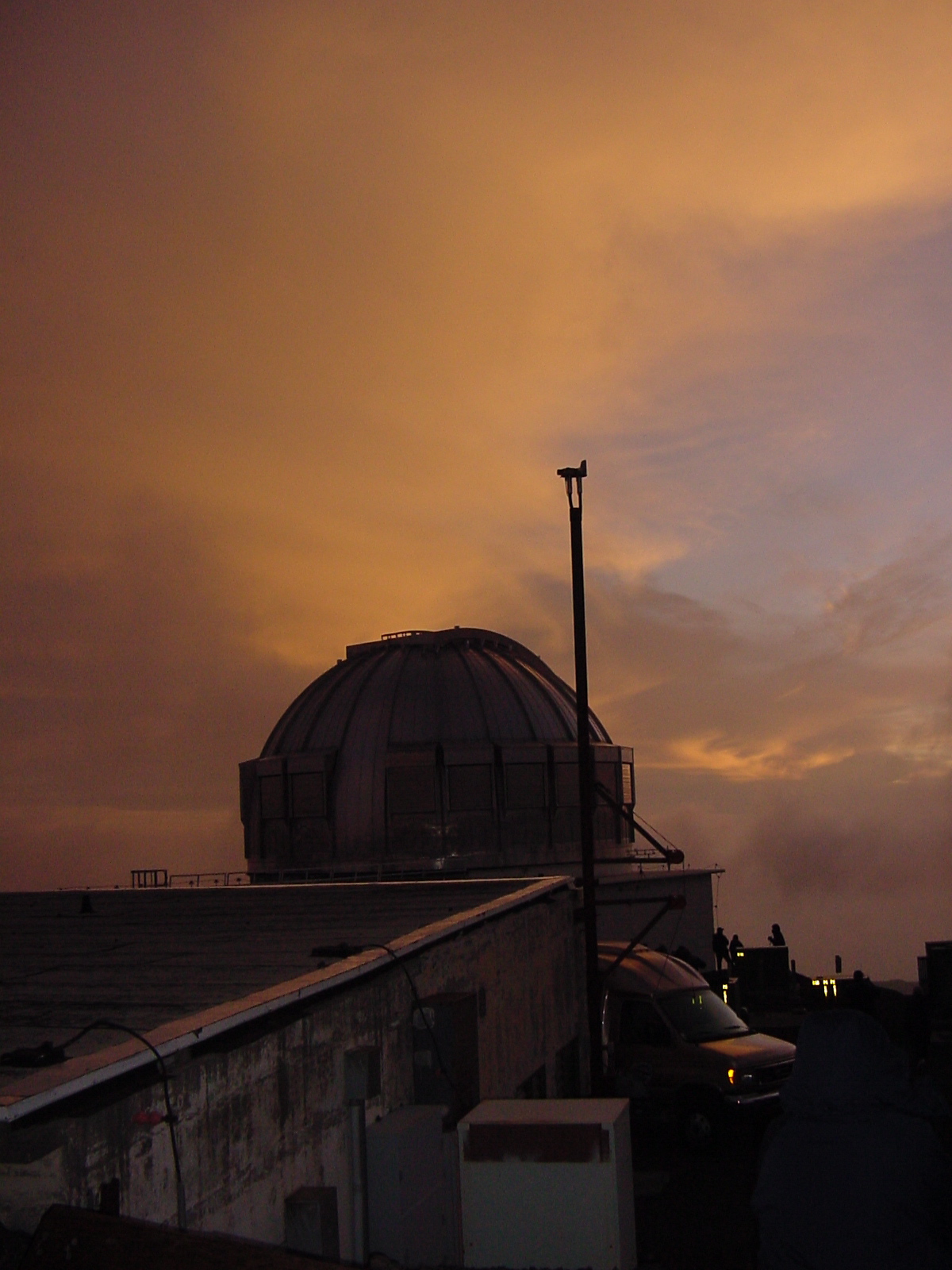
United Kingdom Infrared Telescope
They called it the Infrared Flux Collector before it had a proper name, which tells you something about the modesty of British astronomy in the 1970s. What Dunford Hadfields Limited of Sheffield built for the mechanical frame and Grubb Parsons of Newcastle ground for the optics turned out to be far more than a collector. The United Kingdom Infrared Telescope, a 3.8-meter reflector perched near the summit of Mauna Kea at nearly 14,000 feet, became the second-largest dedicated infrared telescope on Earth and one of the most productive survey instruments in modern astronomy. It was supposed to be decommissioned years ago. Instead, it kept finding reasons to stay alive.
A Mirror Built Like No Other
UKIRT's primary mirror weighs only 6.5 tonnes, roughly two-thirds thinner than comparable mirrors of the era. The engineers faced a problem unique to infrared astronomy: the telescope's own heat is the enemy. Heavier mirrors demand more powerful motors and control systems, all of which generate warmth that contaminates the infrared signal. So the builders went thin and compensated with ingenuity. The mirror sits on 80 pneumatic pistons arranged in concentric circles, each computer-controlled to cancel the stresses that a thinner sheet of glass inevitably develops. The technique worked so well that UKIRT's optical performance exceeded its procurement specifications. The entire instrument rides on an English Equatorial yoke mount sitting on ball bearings atop steel piers. Shear pins hold the bearings rigid during normal operations but release during earthquakes, allowing the structure to absorb seismic energy rather than resist it.
Two Infrared Twins on One Summit
UKIRT was constructed between 1975 and 1978, entering service in October 1979. NASA's Infrared Telescope Facility was built at virtually the same time, on the same mountain, for the same wavelengths. John Jefferies of the Institute for Astronomy acknowledged the awkwardness: "It has been sometimes a source of embarrassment that there are two of them at the same place at the same time. The natural question is asked, Why two? Why don't you build one and share it?" The answer was national priority. The UK wanted an infrared facility for its own astronomers, while NASA needed dedicated access for planetary science. The result was two independent telescopes standing a short walk apart, gazing through the same column of dry Hawaiian air.
UKIDSS and the Invisible Universe
In 2004, the installation of the wide-field imager WFCAM transformed UKIRT from a general-purpose instrument into a survey machine. The UKIRT Infrared Deep Sky Survey, known as UKIDSS, consumed roughly 80 percent of observing time in wide-field mode, systematically mapping the infrared sky to depths no previous survey had reached. In 2011, a UKIDSS observation revealed the most distant quasar then known, an object invisible in optical light but glowing clearly at the longer wavelengths UKIRT could detect. It had taken five years of methodical scanning to find. Once identified, other telescopes like the Very Large Telescope in Chile confirmed and analyzed the discovery, but UKIRT's patient, wide-field approach had made the initial detection possible.
Death Sentence, Reprieve, and a New Mission
In December 2009, the UK announced UKIRT was "subject to discussions leading to managed withdrawal." By 2012, its shutdown was scheduled for the end of 2013. But UKIRT refused to die quietly. On October 30, 2014, ownership transferred to the University of Hawaii. A new Scientific Cooperation Agreement brought together the University of Arizona, the University of Hawaii, and Lockheed Martin's Advanced Technology Center. The telescope's savior turned out to be an unlikely patron: NASA's Orbital Debris Program Office, which needed an infrared telescope to track space junk. Since December 2010, UKIRT has been operated entirely remotely from Hilo, with no observers on the mountain. About 60 nights per year go to Korean institutes, while the remaining time supports debris monitoring and research by Hawaiian and Arizona astronomers.
The Final Chapter
Decommissioning of UKIRT began on July 7, 2025, as part of the Mauna Kea Comprehensive Management Plan that requires older facilities to be removed before the Thirty Meter Telescope can be constructed. After more than four decades of operation, the telescope that was originally threatened with closure in 2013 outlasted its death sentence by over a decade. Its legacy lives on in the data archives, in the UKIDSS survey catalogs that continue to feed research papers, and in the engineering lessons of a mirror so thin it needed 80 pneumatic pistons to hold its shape. What began as the Infrared Flux Collector ends as one of the most consequential infrared telescopes ever built.
From the Air
Located at 19.823N, 155.471W near the summit of Mauna Kea on the Big Island of Hawaii, at approximately 13,800 feet elevation. The dome was visible among the observatory cluster on the summit ridge until decommissioning began in 2025. Nearest airports: Ellison Onizuka Kona International at Keahole (PHKO) about 35 nm west, Hilo International (PHTO) about 28 nm east. Summit conditions typically above the trade wind inversion with excellent visibility.