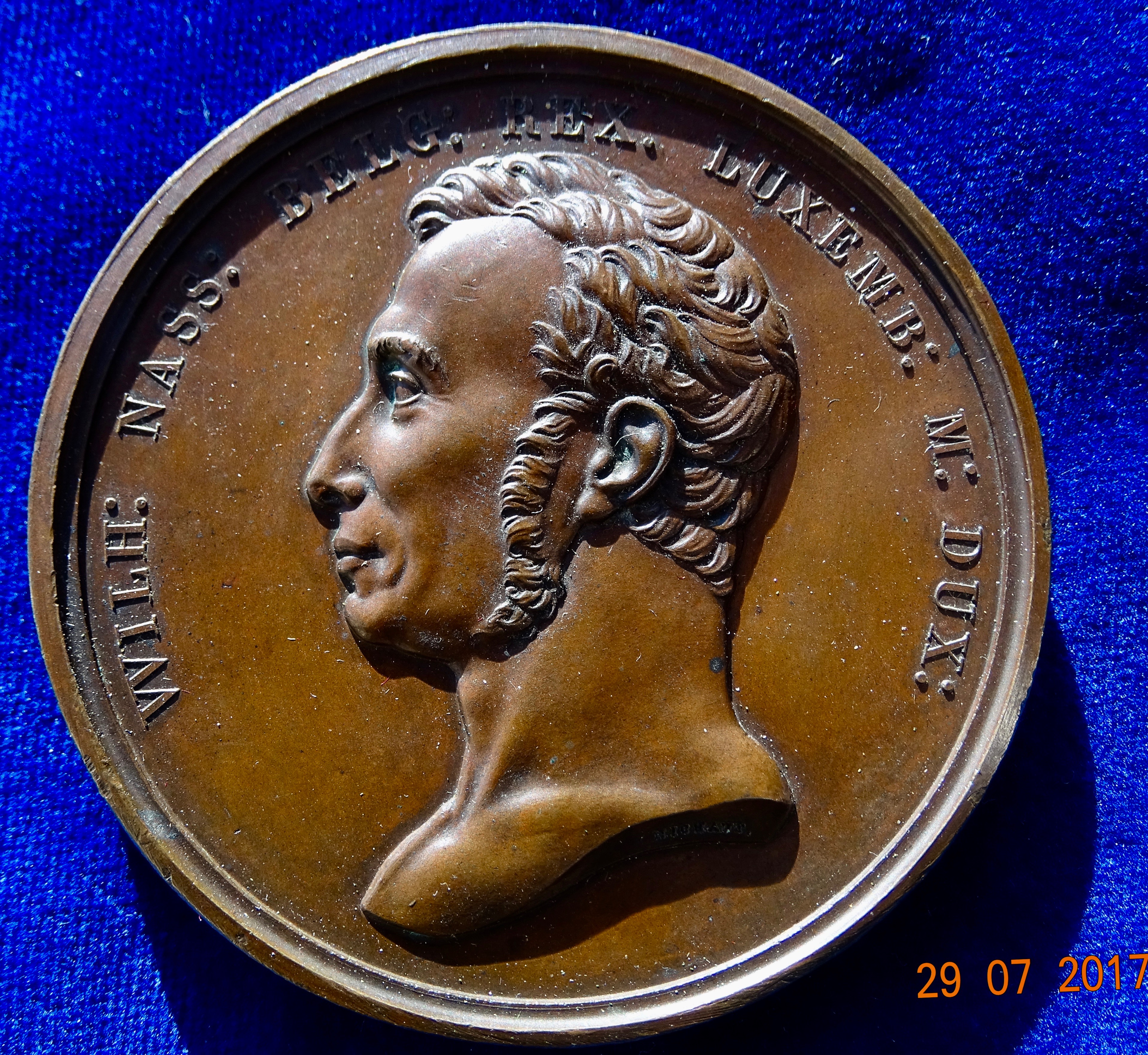
United Kingdom of the Netherlands
On the night of 25 August 1830, a Brussels opera audience walked out of a performance of Auber's La Muette de Portici and into a revolution. The aria they had just heard was about an Italian uprising against Spanish rule. The Belgians went into the streets, sacked the houses of unpopular ministers, and within six weeks declared themselves an independent country. The state they tore apart had existed for only 15 years. It was called, in 1815, the Kingdom of the Netherlands - a single country stretching from the Wadden Islands to the Ardennes, ruled by William I of Orange-Nassau, designed by the great powers at the Congress of Vienna to keep France boxed in. Today historians call it the United Kingdom of the Netherlands, with that 'United' tucked into the title to mark the moment when, briefly, Belgium and the Netherlands were the same place.
A Buffer State Drawn on a Map
After Waterloo, the great powers had a problem named France. The standard 19th-century solution was a buffer state: take small countries on the French border and fuse them into a bigger one. In June 1814, the Eight Articles of London quietly handed the Southern Netherlands - the old Austrian provinces and the Prince-Bishopric of Liege - to the son of the last Dutch stadhouder, William Frederik. In March 1815, with Napoleon escaped from Elba and marching north, William declared himself king. After Waterloo, the deal was finalised. William ceded the small Orange-Nassau principality and slivers of Liege to Prussia, and received in exchange the Duchy of Luxembourg, elevated to a grand duchy. He had united, by paper, the Low Countries his family had dreamed of for three centuries. A satirical British cartoon of the time called it a wedding.
One Country, Two Religions, Two Languages
The marriage had problems from the wedding day. The north was strongly Dutch Reformed, the south overwhelmingly Roman Catholic. The Catholic Church in Belgium resented the state's reach into education, and the educated French-speaking elite of Wallonia and Brussels resented William's policy that Dutch should be the sole official language in the Flemish provinces - Antwerp, East and West Flanders, Limburg from 1819, bilingual South Brabant from 1823. In Luxembourg, French stayed in administration and German in schools. The constitution split parliamentary seats equally between north and south, even though the south held 62 percent of the population. Northerners thought they were being generous; southerners thought they were being cheated. The richer south paid taxes to subsidise the poorer north. By the mid-1820s a coalition of Catholic conservatives and French-speaking liberals - usually mortal enemies - had stitched themselves into the Belgian Union of Opposition.
A King Who Built Things
For all the tensions, the 15 years of the United Kingdom were not wasted. William I poured state support into industrialisation. John Cockerill, the British-born industrialist, founded the steel works that became the heart of Wallonia's economy. New universities opened in Leuven, Liege, and Ghent in 1817. The Algemeene Nederlandsche Maatschappij ter Begunstiging van de Volksvlijt was set up in 1822 to encourage southern industry; the Netherlands Trading Society followed in 1825 to handle colonial trade. William built canals: the North Holland Canal, the Ghent-Terneuzen, the Brussels-Charleroi. Antwerp became a major port. The Industrial Revolution arrived in the Low Countries on Dutch state finance, and most of the modernisation happened south of the border that would soon exist.
The Ten Days That Did Not Work
The Belgian Revolution broke out on 25 August 1830. A Dutch military intervention into Brussels in September failed and only radicalised the rebels. On 4 October Belgium declared independence; in 1831 a constitutional monarchy was established under Leopold I, an uncle of the future Queen Victoria. William I refused to accept the secession. In August 1831 he launched the Ten Days' Campaign, marched a Dutch army into Belgium, and won several engagements - until France intervened on the Belgian side and the campaign had to be abandoned. For eight more years he held out. The Dutch state continued to claim the kingdom whole even as its southern half built railways, drafted constitutions, and held elections as Belgium. Only in 1839, with the Treaty of London, did the Dutch finally recognise what everyone else already had. The border between the two countries was set, and guaranteed neutral by the great powers - a guarantee that would matter very much in August 1914.
What Remained
The kingdom split, but its inheritance is everywhere. Luxembourg, the grand duchy William received in exchange for Orange-Nassau, is still a grand duchy - the only one left in the world. Belgium and the Netherlands are both still monarchies, with constitutions whose roots reach back through 1839, 1830, and 1815. The Dutch language status of Flanders, the equal weighting of representation, the careful balance of religious confession in government - these are arguments that began under William I and have never fully ended. Treaty maps still bear the borders set in 1839 and finalised in Maastricht in 1843. A buffer state that lasted 24 years on paper, drawn to fence in a France that no longer threatened anyone, left behind three countries that have spent two centuries trying to live alongside each other and, eventually, inside the same Benelux Union.
From the Air
The historical core of the United Kingdom of the Netherlands covered everything between roughly 50 N and 53.5 N, and 2 E and 7 E - that is, the entire Benelux plus the Belgian Ardennes and Luxembourg. The Dutch capital lay at 52.37 N, 4.88 E (Amsterdam); the southern capital at Brussels (50.85 N, 4.35 E). Nearest airports along the historical territory: Amsterdam Schiphol (EHAM), Brussels (EBBR), Luxembourg-Findel (ELLX). From cruise altitude on Atlantic westbound routes the entire former kingdom is visible from horizon to horizon below; the Belgian-Dutch border, fixed by the 1839 Treaty of London, still appears today as a slightly diagonal line cutting east from the North Sea coast at Knokke down through Maastricht.