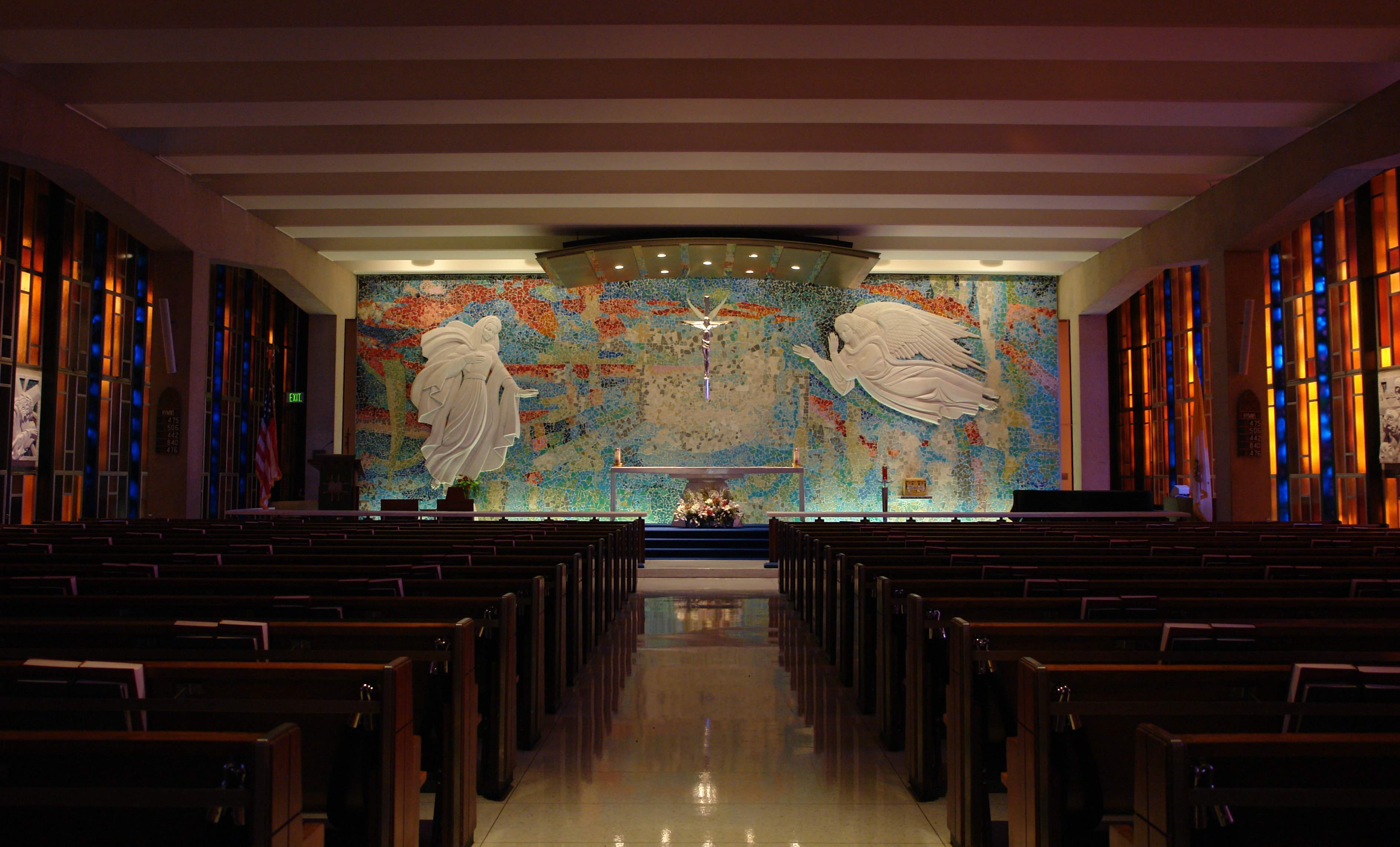
United States Air Force Academy Cadet Chapel
The pews are shaped like airplane propellers. That is not a metaphor. Inside the United States Air Force Academy Cadet Chapel, the ends of every walnut and mahogany pew are sculpted to resemble World War I propeller blades, their backs capped with aluminum strips mimicking the trailing edge of a fighter wing. It is that kind of building - one where faith and flight merge so completely that you cannot separate the two. Completed in 1962 on a mesa north of Colorado Springs, the chapel's seventeen aluminum-clad spires have become one of the most recognizable silhouettes in American architecture. Walter Netsch of Skidmore, Owings and Merrill designed the structure using 100 identical tetrahedrons, each weighing five tons, arranged into a tubular steel frame that looks less like a house of worship and more like a squadron of jets pointed skyward. The original plans called for twenty-one spires, but budget cuts trimmed it to seventeen. What remained was still radical enough to spark outrage. Critics called it an insult. Time would prove them spectacularly wrong.
One Hundred Tetrahedrons and a Ribbon of Light
The chapel's engineering is as bold as its appearance. The 100 identical tetrahedrons that form the structure are spaced one foot apart, and the gaps between them are filled with colored glass in aluminum frames. From outside, the spires are sheathed in triangular aluminum panels; between them, mosaics of stained glass create ribbons of color that shift with the sun. Inside the Protestant nave on the upper floor, those ribbons progress from dark to light as they approach the altar, pulling the eye forward through a space that seats 1,200. The chancel features a crescent-shaped reredos studded with semi-precious stones from Colorado and pietra santa marble from Italy. Above it hangs a towering aluminum cross. The shell alone cost $3.5 million to build, with furnishings and pipe organs donated by individuals and organizations worldwide. In 1959, a special Easter offering was collected at Air Force bases around the globe to help finish the interior.
Many Faiths Under One Roof
Netsch drew inspiration from Sainte-Chapelle in Paris and the Basilica of San Francesco d'Assisi in Italy, stacking multiple worship spaces on two levels so services could run simultaneously without interference. The Protestant chapel commands the upper floor. Below it, a Catholic chapel seating 500 features a glass mosaic reredos by Lumen Martin Winter, with Annunciation figures carved from Carrara marble - the same quarries Michelangelo used. Cardinal Francis Spellman dedicated the altar in September 1963. A circular Jewish chapel seats 100, its floor paved with Jerusalem brownstone donated by the Israeli Defense Forces and its foyer housing a Holocaust Torah scroll recovered from an abandoned Polish warehouse in 1989. A Buddhist chapel was added in 2007, a Muslim prayer space welcomes all denominations, and the Falcon Circle - dedicated in 2011 for followers of Earth-centered spirituality including Wicca and Druidism - makes this one of the most religiously inclusive military buildings in the world.
The Rain That Got In
Netsch's original plans included rain gutters beneath the aluminum spires, but budget constraints killed them. Workers caulked the panel seams instead. For decades, that caulk was reapplied again and again as water found its way through, silently damaging the main floor and its fixtures. In September 2019, the chapel finally closed for a $158 million renovation. An enormous temporary structure - cadets dubbed it The Box - was erected over the entire building so workers could strip every aluminum panel and stained glass block, install the gutters Netsch always intended, and repair the water-ravaged interior. The timeline originally called for completion by November 2022, but crews discovered more asbestos than expected inside the structure, pushing the finish date to 2027. The pipe organs, furniture, and liturgical fittings are all being cleaned and restored. When the scaffolding finally comes down, the chapel will be closer to Netsch's full vision than it has ever been.
From Scandal to Landmark
When the design was first revealed in the 1950s, the public reaction was harsh. Many Americans expected a military chapel to look traditional - stone walls, steeple, stained glass windows in familiar patterns. What they got was a steel and aluminum machine for worship that looked like nothing before it. But by 1996, the American Institute of Architects awarded the Cadet Chapel its National Twenty-five Year Award, recognizing it as a building whose significance had grown over time. In 2004, the chapel and its surrounding Cadet Area were designated a U.S. National Historic Landmark. The building that once scandalized now defines the Academy's identity. Its profile appears on brochures, recruitment materials, and in the memories of every cadet who has passed through. From the air, the seventeen spires catch light like no other structure on the Front Range, a row of silver blades standing at attention against the Rampart Range.
From the Air
Located at 39.008N, 104.890W on the U.S. Air Force Academy campus north of Colorado Springs. The seventeen aluminum spires are highly visible from the air, catching sunlight against the green mesa and the Rampart Range to the west. Currently enclosed in a temporary renovation structure through 2027. Colorado Springs Airport (KCOS) is approximately 15 miles to the southeast. Peterson Space Force Base is also nearby. The Academy campus itself is a large, clearly defined area along I-25 at roughly 7,000 ft elevation. Best viewed from the east or south at lower altitudes for the full spire silhouette against the mountains.