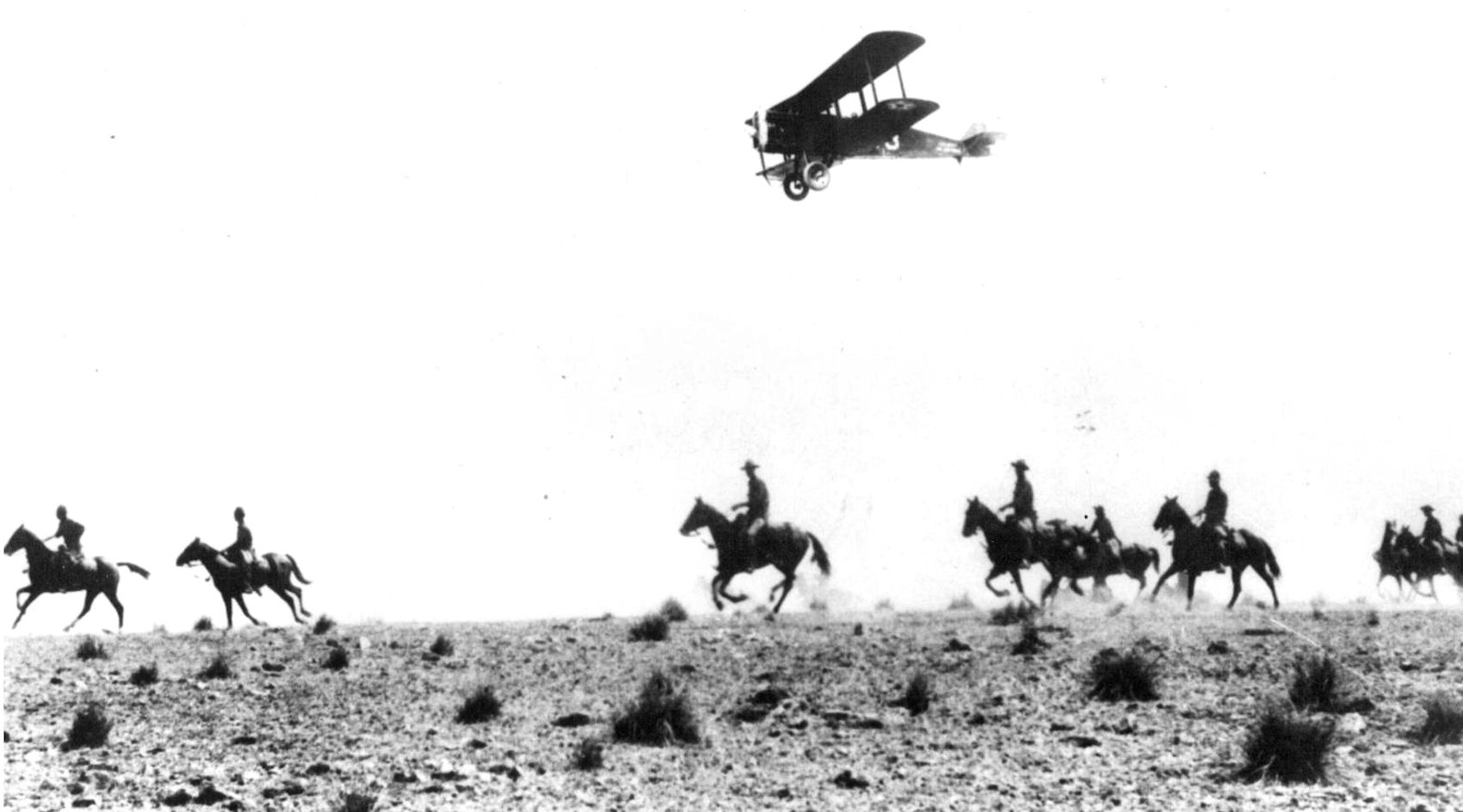
United States Army Border Air Patrol
The war in Europe was over, but the southern border remained unsettled. Pancho Villa's 1916 raid on Columbus, New Mexico had demonstrated the vulnerability of American border communities to cross-border violence, and the Army responded with the technology of the new century: aircraft. The United States Army Border Air Patrol operated from 1919 to 1921, deploying DH-4 biplanes along the US-Mexico boundary at a time when military aviation was barely two decades old and navigating the desert Southwest in an open cockpit without reliable maps required both skill and luck. For two pilots who ran out of both, the consequences were fatal.
Pancho Villa and the Justification for Aviation
The Punitive Expedition of 1916-1917, which sent General Pershing's forces into Mexico in pursuit of Pancho Villa after the Columbus raid, had already demonstrated the challenges of operating in the border region's terrain. The expedition failed to capture Villa and underscored how difficult conventional military operations were in the desert Southwest. Aviation offered a different approach: the ability to survey large areas rapidly, to detect threatening movements before they reached the border, and to respond faster than ground forces could. The Border Air Patrol represented the Army's post-war application of wartime aviation technology to a peacetime border security mission.
Calexico Field
Calexico Field served as a key western base for the Border Air Patrol, positioned at the intersection of the Imperial Valley and the Mexican border. The flat terrain of the Imperial Valley provided good conditions for early aircraft operations — landing fields could be established without significant grading on the dry lakebed and agricultural land. From Calexico, patrols could cover the southern border from the Colorado River west toward Tijuana, monitoring a corridor that remained active with cross-border movement even after Villa's forces no longer posed an organized military threat. At peak strength, the Border Air Patrol deployed 104 officers, 491 enlisted personnel, and 67 aircraft along the entire border.
Lost Over Baja California
On August 20, 1919, two pilots — Lieutenant Waterhouse and Lieutenant Connolly — became disoriented over Baja California and were forced to land in terrain far south of the border. Getting lost in early military aviation was not uncommon: navigation relied on dead reckoning, visual landmarks, and maps of variable quality. Baja California's peninsula, stretching hundreds of miles south, offered limited landmarks and few obvious routes back to the border. The two pilots survived the landing and survived for seventeen days in the desert before being found — or encountered — near Bahia de los Angeles, approximately 225 miles south of Calexico.
Murder After Survival
The seventeen-day survival ordeal would have been a remarkable story of military resilience under extreme conditions. What made it a tragedy was what happened next: according to historical accounts, the pilots were murdered by fishermen near the location of their discovery. The precise circumstances of their deaths were pieced together through the investigation that followed — an investigation conducted under the challenging conditions of cross-border jurisdiction in 1919, without the communications infrastructure that would eventually make such incidents tractable. Their bodies were eventually located approximately 225 miles south of Calexico. They had survived the desert only to be killed by the first humans they encountered.
Two Years and Done
The United States Army Border Air Patrol operated from 1919 to 1921 before being discontinued. The threat that had justified it — organized Mexican revolutionary violence against American border communities — had diminished without disappearing, and the cost of maintaining an aviation patrol along the full length of the southern border proved difficult to sustain in the peacetime budget environment that followed World War I. The patrol's two-year history captured the early application of military aviation to a law enforcement and border security mission, a function that aircraft would eventually perform far more systematically as the technology and the doctrine matured. In 1919, it was pioneering work conducted by pilots who were learning, often through harrowing experience, what early military aviation in the desert Southwest actually required.
From the Air
The Border Air Patrol's Calexico Field operated at approximately 32.67°N, 115.51°W, in the Imperial Valley adjacent to the US-Mexico border. Calexico International Airport (KCXL) represents the successor facility in the same general area. From the air, the flat agricultural landscape of the Imperial Valley extends north and the urban grid of Calexico and Mexicali marks the border. The patrol's operational area — from the Colorado River westward along the Mexican border — is visible in full from cruising altitude as a straight line through the desert landscape.