Yokosuka: The Shipyard That Changed Hands
In 1860, Lord Oguri Kozukenosuke, the Tokugawa Shogunate's Minister of Finance, made a declaration that would reshape the coastline of a quiet fishing village: "If Japan is to assume an active role in world trade, she must have proper facilities to build and maintain large seagoing vessels." He turned to France for help. French engineer Leonce Verny surveyed the Japanese coast and found what he was looking for at Yokosuka -- a sheltered inlet that reminded him, on a smaller scale, of the great French naval port of Toulon. Construction began in 1865. The dry docks Verny built are still in use today, more than 160 years later. They have served three navies, launched some of the most famous warships in history, and now berth the most powerful forward-deployed strike group in the United States fleet.
From Iron Works to Imperial Arsenal
What began as the "Yokosuka Iron Works" was renamed the Yokosuka Navy Yard in 1871 and reorganized completely by another French engineer, Louis-Emile Bertin, from 1886. Under Japanese control, the yard grew into one of the Imperial Japanese Navy's premier arsenals. The battleship Yamashiro slid down its ways. The aircraft carriers Hiryu and Shokaku -- both destined to strike Pearl Harbor -- were built in these same docks. The Yokosuka Naval Air Technical Arsenal designed major combat aircraft on adjacent grounds. By World War II, the complex had sprawled across the Miura Peninsula: shipbuilding plants, gun factories, ordnance depots, fuel storage, a seaplane base, and a naval air station. At its 1944 peak, the yard employed over 40,000 workers, and the surrounding area had become one of the most heavily militarized stretches of coastline in the Pacific.
Surrender at the Gate
On August 30, 1945, Vice Admiral Michitaro Totsuka, the last Japanese commander of the Yokosuka Naval District, surrendered his command to Rear Admiral Robert Carney. U.S. Marines of the 6th Marine Division, British Royal Marines, and American naval personnel occupied the base peacefully. The shipyard was deactivated and its equipment sent to other countries as war reparations. Commander Fleet Activities Yokosuka -- COMFLEACT -- was established shortly after the occupation. The shops and dry docks sat idle until April 1947, when the Ship Repair Department was organized and the facilities were reactivated to maintain the U.S. Pacific Fleet. Then came June 25, 1950. The Korean War transformed Yokosuka overnight from a quiet occupation posting into a vital forward logistics hub. The base has not slowed down since.
America's Permanent Carrier in the Pacific
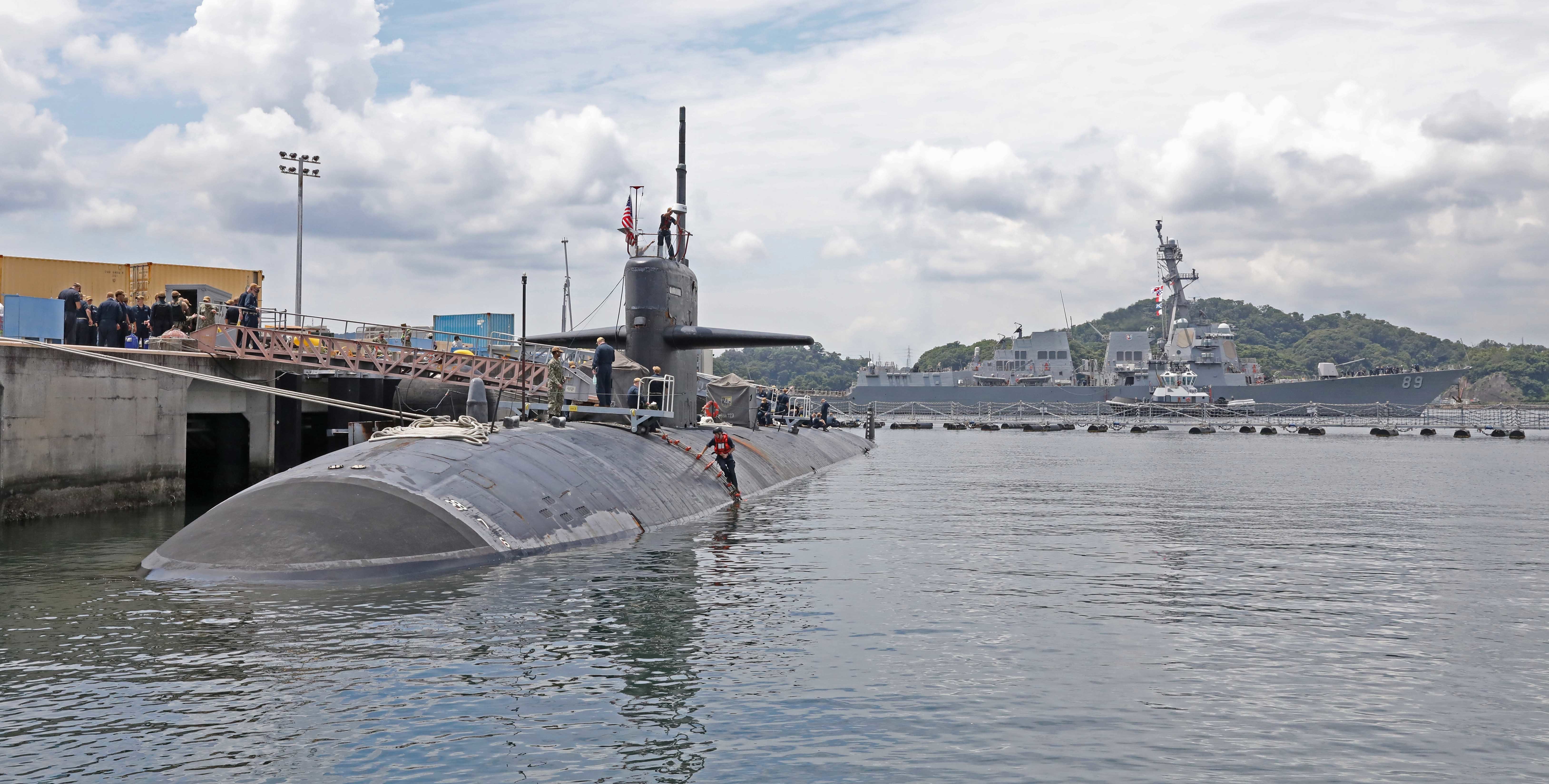
The pivotal moment came on October 5, 1973, when USS Midway and Carrier Air Wing Five steamed into Yokosuka, marking the first permanent forward deployment of a complete carrier task group in a Japanese port. The arrangement, born from a 1972 accord between the United States and Japan, allowed the Navy to maintain three carriers in the western Pacific at a time when budgets demanded fleet reductions. Midway called Yokosuka home for eighteen years before departing in August 1991, her crew spelling out "Sayonara" on the flight deck. USS Independence took her place, followed by USS Kitty Hawk in 1998. Then came the nuclear age: on September 25, 2008, USS George Washington arrived, making Yokosuka the homeport of the only permanently forward-deployed nuclear-powered aircraft carrier in the U.S. Navy. Today, the base's 568 acres and 55 tenant commands support Carrier Strike Group Five and Destroyer Squadron 15.
Two Flags, One Harbor
When the U.S. occupation of Japan formally ended in 1952 and Japanese rearmament commenced, portions of the former Yokosuka Naval District were returned to house the Japan Maritime Self-Defense Force, now known as JMSDF Yokosuka Naval Base. The two installations share the same harbor and cooperate on exercises and force protection. The base played a critical humanitarian role during Operation Tomodachi following the devastating 2011 Tohoku earthquake and tsunami, with personnel and ships deploying in relief operations even as approximately 3,000 American family members departed amid fears over the Fukushima nuclear crisis. Yokosuka remains what it has been since Verny laid its first stones: a place where geography dictates destiny. Sitting at the mouth of Tokyo Bay, 65 kilometers south of Tokyo on the Miura Peninsula, it commands the entrance to one of the world's most strategically vital waterways -- a fact that fishing villagers, shoguns, emperors, and admirals have all understood in turn.
From the Air
Located at 35.293°N, 139.671°E on the Miura Peninsula at the entrance to Tokyo Bay. The base covers 568 acres and is clearly visible from altitude, with large warships and a carrier typically berthed at the piers. The adjacent JMSDF Yokosuka Naval Base shares the harbor. Nearby Sarushima island lies approximately 1 nautical mile offshore to the east. Tokyo Haneda (RJTT) is approximately 25 nautical miles north-northwest. Naval Air Facility Atsugi (RJTA) lies approximately 15 nautical miles to the northwest. Best viewed at 3,000-5,000 feet AGL from the east, looking across Tokyo Bay toward the peninsula.