United States Grand Prix West
Clay Regazzoni crossed the finish line at Long Beach in his Ferrari on March 28, 1976, winning the inaugural United States Grand Prix West. The Ticino-born Swiss driver had been with Ferrari since 1970; he was comfortable with success, with the celebrity of Formula One, with the attention that followed a race winner. What he could not know, standing in the pit lane of a new California street circuit, was that he had four more years of racing before a brake failure at this same track would end his walking life. The Long Beach street circuit gave Clay Regazzoni his last Formula One victory and eventually gave him a wheelchair. History has a way of returning to its starting points.
The Circuit
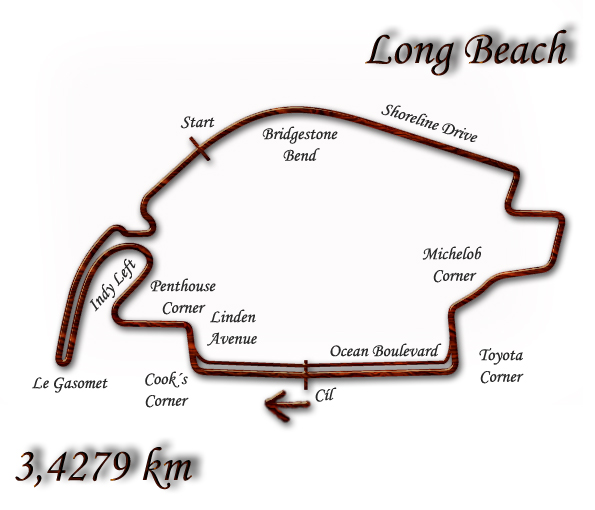
The Long Beach street circuit was laid out through downtown streets and along Shoreline Drive, the broad boulevard that ran parallel to the harbor. The circuit changed its configuration over the eight years of Formula One's presence, but retained its essential character: a mix of medium-speed corners, a long straight along the waterfront where cars could reach genuinely high speeds before braking hard for a tight hairpin, and the walls that street circuits always have instead of gravel traps. Contact with those walls was expensive and sometimes dangerous. There was no runoff, no margin for error. The circuit rewarded precision and punished optimism, which is why it produced the kind of racing that made Formula One worth watching.
The Champions Who Came
The eight years of the United States Grand Prix West produced a roster of winners that reads like Formula One's golden generation. Regazzoni in 1976 in the Ferrari. Jody Scheckter in 1977. Carlos Reutemann in 1978. Gilles Villeneuve in 1979, in a race remembered for the charismatic Canadian's particular combination of speed and bravery. Alan Jones in 1980 for Williams. After Regazzoni's 1980 crash, which ended his career and left him paralyzed, Jones's victory carried a different weight. Riccardo Patrese in 1982. And John Watson in 1983, in the race that produced one of Formula One's most improbable statistics.
Watson's Impossible Win
John Watson started the 1983 United States Grand Prix West from twenty-second position on the grid. Dead last. In Formula One, starting last and winning is not supposed to happen. The cars ahead of you are faster in qualifying; the track position you surrender at the start is almost never recovered. Watson recovered it. He drove through the entire field on a circuit where overtaking was difficult, threading past cars on the outside of corners, finding gaps that didn't exist until he made them exist. By the finish, he had passed twenty-one cars and won the race. His starting position of twenty-second remains the worst from which any driver has won a Formula One Grand Prix. The record has stood for over forty years.
Regazzoni at the Chicane
The 1980 race produced something that no spectator wanted to see. Clay Regazzoni, now driving for Ensign, suffered complete brake failure entering the chicane at the end of the Shoreline Drive straight. Without brakes, at approximately 180 miles per hour, the car hit the barrier. Regazzoni survived. He spent weeks in the hospital and emerged permanently paralyzed from the waist down, his spinal cord severed in the crash. He went on to race in adapted vehicles, competed in off-road events, remained a presence in motorsport culture, and died in a road accident in 2006 at the age of 67. The crash at Long Beach — at the track where he had won his final Formula One race four years earlier — defined the second half of his life.
After Formula One
Formula One left Long Beach after 1983. The Concorde Agreement between the teams and the governing body, the economics of sanctioning fees, and the complications of organizing a Grand Prix in an American city without the established motorsport infrastructure of a European venue all contributed to the departure. What remained was the circuit, the organization that Chris Pook had built, and a city that had developed a taste for racing. IndyCar stepped in, and the race became the Acura Grand Prix of Long Beach — a different formula, equally loud, equally contested. The street circuit that held Formula One's world championships for eight years continues to host racing every April, the walls unchanged, the cornering geometry the same as the day Regazzoni won the first one.
From the Air
Located at approximately 33.77°N, 118.19°W in downtown Long Beach, the street circuit runs along Shoreline Drive and through the streets east of the convention center and harbor. Long Beach Airport (KLGB) is approximately 3 miles north-northeast. The circuit's Shoreline Drive straight runs parallel to the harbor and is visible from altitude. The Queen Mary, moored at Pier J, provides a distinctive navigation landmark at the circuit's eastern end.