United States Holocaust Memorial Museum
The building does not announce itself. From the outside, it disappears into the neoclassical and Georgian facades of Washington, D.C., blending with its neighbors near the National Mall. But the moment you step through the entrance on Raoul Wallenberg Place, the architecture shifts. Steel and glass compress. Brick walls angle inward. Natural light retreats. Architect James Ingo Freed, who fled Nazi Germany with his parents in 1939 at the age of nine, designed the United States Holocaust Memorial Museum to be a physical passage from the familiar world into something deliberately unsettling. He called it a 'resonator of memory.' Since its doors opened on April 26, 1993, nearly 40 million people have walked through that threshold.
A Presidential Commission and a Unanimous Vote
The museum began as a promise. On November 1, 1978, President Jimmy Carter established the President's Commission on the Holocaust, chaired by Elie Wiesel, the Nobel laureate, author, and Auschwitz survivor. The commission's mandate was to determine how America should memorialize the victims. On September 27, 1979, Wiesel's commission delivered its report, recommending a national museum in Washington with three components: a memorial, an educational foundation, and a Committee on Conscience charged with monitoring genocide worldwide. In 1980, Congress voted unanimously to establish the museum and the federal government provided land adjacent to the Washington Monument. Nearly $190 million was raised from private sources for design, artifact acquisition, and exhibition creation. President Ronald Reagan helped lay the cornerstone in October 1988. When dedication day arrived on April 22, 1993, President Bill Clinton, Israeli president Chaim Herzog, and Elie Wiesel spoke. The museum's first visitor was the 14th Dalai Lama of Tibet.
Architecture as Witness
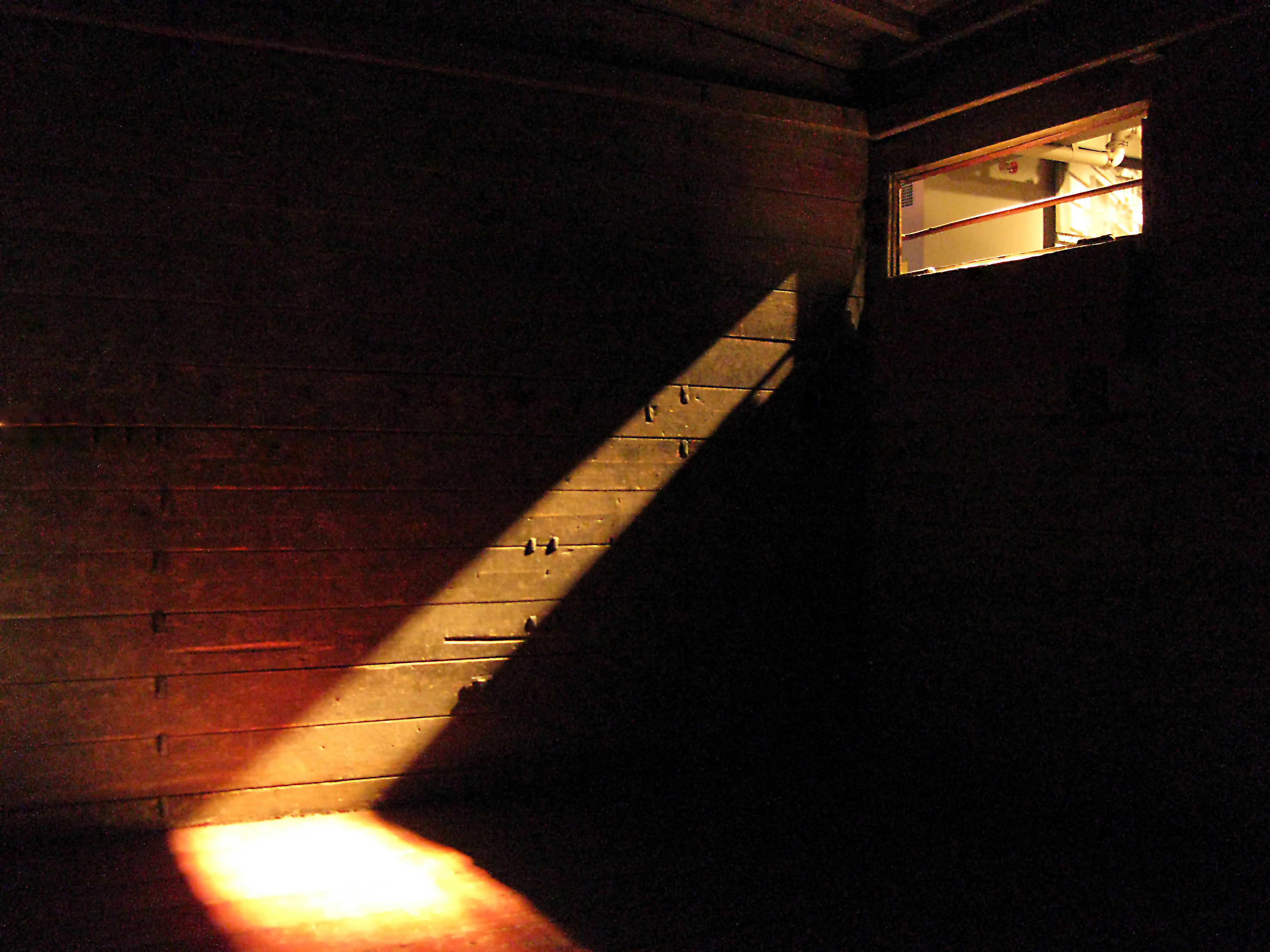
Freed's design for the museum, created with his firm Pei Cobb Freed & Partners, was a deliberate act of architectural dissonance. While the exterior conforms to the dignified language of Washington's public buildings, the interior strips away that comfort. Visitors encounter industrial materials, tight corridors, and glass bridges etched with the names of places lost to the Holocaust. The Hall of Remembrance, a hexagonal room with limestone walls and a red-tile floor, holds an eternal flame fueled by ashes from European concentration camps, where visitors can light candles in silence. The Permanent Exhibition spans three floors and uses more than 900 artifacts, 70 video monitors, and four theaters of historic footage and eyewitness testimony. First-time visitors spend an average of two to three hours inside. Among the most visceral objects is an original Deutsche Reichsbahn railcar, one of the types used to transport victims to the camps, donated by Poland's Chief Commission for the Prosecution of Crimes against the Polish Nation in 1991.
The Weight of Numbers
The scale of the museum's reach is staggering. Since 1993, more than 10 million school children, 120 heads of state, and 3,500 foreign officials from over 132 countries have visited. Less than 10 percent of visitors are Jewish. In 2024, the museum's website recorded 33.9 million visits from 243 countries and territories, with 57 percent originating outside the United States. The museum maintains offices in New York, Boston, Boca Raton, Chicago, Los Angeles, and Dallas. Its Holocaust Encyclopedia is published in all six official United Nations languages plus Greek, Portuguese, Persian, Turkish, and Urdu. Since 1999, the museum has trained more than 21,000 law enforcement officers, in partnership with the Anti-Defamation League, in ethics lessons rooted in Holocaust history. The Committee on Conscience, established by presidential mandate, uses the UN Genocide Convention to monitor emerging crises, from Darfur to Chechnya, that could produce genocidal atrocities.
A Guard Who Gave His Life
The museum has been the target of hatred that its exhibitions seek to explain. In 2002, a federal jury convicted white supremacists Leo Felton and Erica Chase of plotting to bomb the museum along with other institutions. On June 10, 2009, 88-year-old James von Brunn, a convicted antisemite, walked into the museum and shot Special Police Officer Stephen Tyrone Johns. Johns died of his injuries. Von Brunn was wounded by return fire and later died in federal prison before his trial concluded. The museum now honors Johns with a permanent memorial and an annual summer youth leadership program in his name, bringing 50 young people from the Washington, D.C. area to learn about the Holocaust. It is a reminder that the museum is not simply about the past. The hatred it documents is not confined to history books.
From the Air
Located at 38.8867°N, 77.0325°W on the south side of the National Mall in Washington, D.C., between the Washington Monument and the Bureau of Engraving and Printing. The museum is part of the cluster of buildings near the Smithsonian museums and is adjacent to the Tidal Basin. Best viewed at 1,500-3,000 ft AGL. Nearest airports: KDCA (Ronald Reagan Washington National, 2.5 nm south), KIAD (Washington Dulles International, 24 nm west). Note: This area falls within the Washington DC SFRA/FRZ restricted airspace zone.