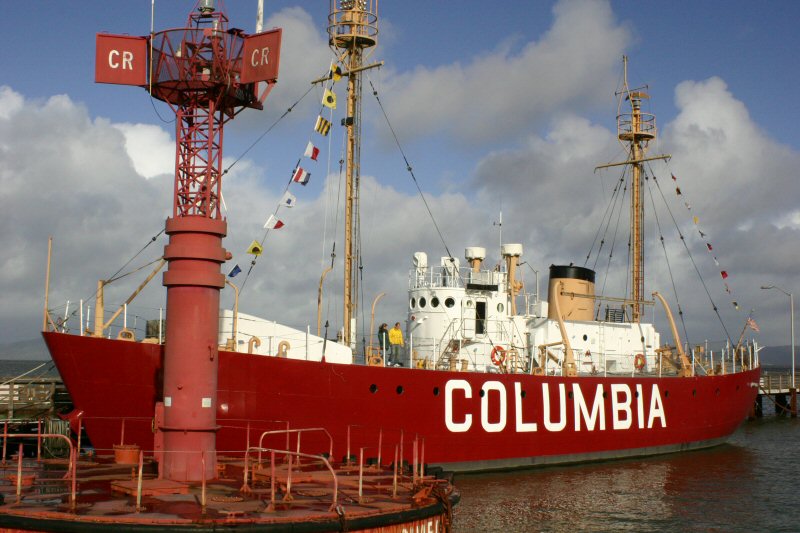
Lightship Columbia: Last Sentinel of the Graveyard
They called the waters at the Columbia River's mouth the Graveyard of the Pacific, and they were not exaggerating. Since the early 1800s, roughly 2,000 vessels have wrecked on or near the Columbia River Bar, where the force of the largest river flowing into the Pacific from North America collides with the open Pacific. Beginning in 1892, the U.S. Lighthouse Service anchored a series of lightships at this treacherous junction - floating lighthouses too important to leave unattended, too dangerous to staff comfortably. The last of these was WLV-604, the lightship Columbia, commissioned in 1951, decommissioned in 1979, and now sitting in a museum alongside the automated buoy that replaced her.
Built for the Worst Water on the Coast
Columbia was constructed at Rice Brothers Shipyard in Boothbay, Maine, and launched alongside her sister ship Relief (WLV-605). She was the fourth and final lightship assigned to the Columbia River station, replacing the aging LV-93, which had held the post since 1939. Her design reflected the punishment she would endure: a hull built to absorb relentless swells, powerful lights visible for miles in fog and rain, a foghorn that could cut through the roar of breaking seas. She arrived at her station near the river's mouth and stayed, more or less, for the next 28 years. The lightships that preceded her had collectively guided vessels across the bar since 1892 - nearly a century of floating sentinels marking the boundary between navigable water and disaster.
Eighteen Men and a Foghorn
The Coast Guard maintained an 18-man crew aboard Columbia at all times: 17 enlisted men and one warrant officer who served as captain. Everything the crew needed had to be on board, because in winter, weeks of rough weather could prevent any resupply. The men worked two- to four-week rotations, with ten always on duty. Life aboard was defined by two extremes - long stretches of tedious routine broken by gale-force storms that turned the ship into a bucking, rolling nightmare. The crew maintained the light, sounded the foghorn, monitored radio communications, and waited. There was nowhere to go. The lightship's entire purpose was to stay in one place, which meant her crew stayed too, riding out whatever the Pacific threw at them while commercial vessels navigated past toward safety.
A Landmark Twice Over
In 1978, Columbia was added to the National Register of Historic Places - a recognition of what she represented in maritime history. Then, in a bureaucratic twist, she was removed from the Register in 1983 because she had been relocated from her historic station. The logic was technically sound and practically absurd: the ship had been decommissioned in 1979, replaced by an automated navigational buoy that could do her job without requiring 18 men to ride out winter storms. She could not stay at her station and also be preserved. In 1989, common sense prevailed. Columbia was declared a National Historic Landmark, listed under the name Lightship WAL-604, and given permanent recognition. She was the last lightship decommissioned on the entire U.S. West Coast - the end of a maritime tradition that had guided ships since the 19th century.
Still Anchored, Finally Safe
Today, Columbia rests at the Columbia River Maritime Museum in Astoria, Oregon, moored permanently and safely for the first time in her existence. Beside her sits the very navigational buoy that replaced her in 1979 - the buoy itself now retired, a relic of the technology that made lightships obsolete. Visitors can walk her decks and imagine what it meant to live aboard a vessel whose sole purpose was to hold position in some of the most dangerous water on the Pacific Coast. The Graveyard of the Pacific has not grown less dangerous; modern navigation technology has simply made the danger more manageable. But for nearly a century, the difference between a safe crossing and a shipwreck at the Columbia's mouth often came down to whether a crew of men on a small, anchored ship could keep a light burning and a horn sounding through the storm.
From the Air
Located at 46.19°N, 123.82°W at the Columbia River Maritime Museum on Astoria's waterfront. The lightship is visible moored at the museum dock on the south bank of the Columbia River. From altitude, the Columbia River Bar is dramatically visible to the west - the turbulent meeting of river and ocean that Columbia once guarded. The bar's shifting sandbars and breaking waves are often visible from above. Nearest airport is Astoria Regional Airport (KAST), approximately 3 miles southeast. The Astoria-Megler Bridge, at 4.1 miles the longest continuous truss bridge in North America, crosses the Columbia nearby. Best viewed at 1,500-3,000 feet AGL. The museum complex is identifiable by the vessels moored alongside it on the waterfront.