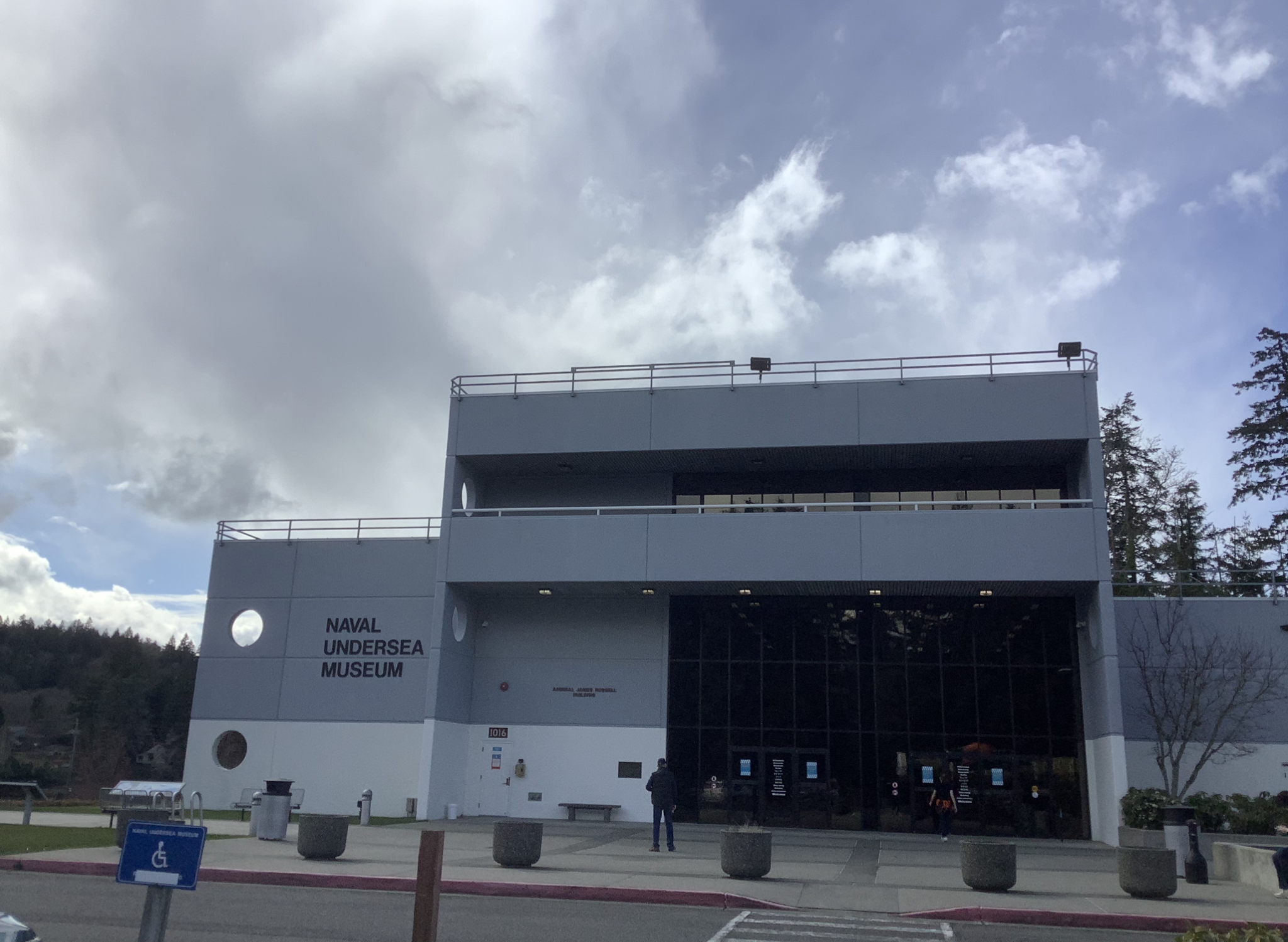
United States Naval Undersea Museum
The 55-ton sail of a nuclear fast attack submarine greets visitors before they even step inside. It is enormous and gray and entirely out of context on the quiet shore of Liberty Bay, like a piece of the deep ocean hauled into a small Washington town and left to dry in the rain. The United States Naval Undersea Museum in Keyport collects what the Navy has spent a century trying to keep hidden: the torpedoes, the mines, the submersibles, the technology of warfare conducted in a realm where human beings were never meant to survive. That it does so for free, in a building surrounded by evergreens on the Kitsap Peninsula, is one of the more improbable gifts of American military culture.
Torpedo Town's Museum
Keyport has been synonymous with undersea warfare since the early twentieth century, when the Navy established what became the Naval Undersea Warfare Center on the shore of Liberty Bay. The community earned the nickname "Torpedo Town" for good reason: this is where the Navy tested, maintained, and stored its torpedo arsenal for decades. The museum grew out of that legacy. The Naval Undersea Museum Foundation, a 501(c)(3) nonprofit, was established in 1980 to create a public institution worthy of the collection. Fifteen years of fundraising later, the Naval Undersea Museum and Conference Center complex opened in 1995. With more than 20,000 square feet of exhibit space, it holds the largest collection of naval undersea history and science artifacts in the country. It is one of ten museums operated by the Naval History and Heritage Command, and unlike many military museums, it is free to the public.
A Library of Silence
Behind the exhibits, a research library contains more than 6,500 volumes on undersea history, science, and operations. It holds a complete set of World War II submarine war patrol reports, the primary documents recording every mission undertaken by American submarines in the Pacific and Atlantic theaters. More than 115 oral history interviews from the U.S. Naval Institute's collection preserve the voices of submariners, divers, and engineers who did their work in places no camera could follow. The Foundation publishes the Undersea Quarterly, a journal that bridges the gap between classified operational history and public understanding. For researchers, the library is a rare point of access to a branch of naval history that, by its nature, resists documentation. Submarines do not leave wakes that can be photographed from shore.
What the Deep Gives Back
The exhibit floor reads like a timeline of human ambition beneath the waves. Torpedoes span from the earliest Whitehead and Howell designs to modern Mk 48 and Mk 50 weapons, each generation more lethal and precise than the last. A Confederate mine sits among them, a reminder that undersea warfare predates the twentieth century. Torpedo tubes from a ballistic missile submarine stand alongside a simulated submarine control room built from actual equipment. The deep submersibles Trieste II and Mystic anchor the collection -- Trieste II, the bathyscaphe that located the wreck of USS Thresher, and Mystic, the Deep Submergence Rescue Vehicle that Hollywood borrowed for the 1990 film The Hunt for Red October. A recreated control room from USS Greenling uses the genuine consoles and equipment stripped from the attack submarine when she was decommissioned, an immersive reconstruction that makes the cramped reality of submarine service tangible.
The Quiet Shore
Keyport is not on the way to anywhere. Visitors reach it by driving through the residential neighborhoods of the Kitsap Peninsula, past evergreen forests and modest homes, arriving at a place that feels deliberately removed from the world. That remoteness is fitting. The museum tells the story of warfare conducted in the most remote environment on Earth, where darkness is absolute and pressure can collapse steel. The exhibits interpret the ocean environment itself alongside the weapons designed to exploit it, covering Navy diving and salvage operations, mine warfare, and submarine technology. From the air, the museum complex is visible along the shore of Liberty Bay, adjacent to the active Naval Undersea Warfare Center facilities. The juxtaposition is deliberate: history and ongoing operations share the same waterfront, past and present separated by nothing more than a fence.
From the Air
Located at 47.70N, 122.62W on the shore of Liberty Bay in Keyport, Washington, on the Kitsap Peninsula. The museum sits adjacent to the Naval Undersea Warfare Center, a large military complex visible from the air along the bay's western shore. Liberty Bay is a narrow inlet opening to the south into the broader waters of Puget Sound. Nearest airport is Bremerton National Airport (KPWT), approximately 6 nm southwest. The Agate Pass Bridge to the east and the distinctive shape of Liberty Bay are key visual references. Best viewed from 2,000-3,000 ft AGL.