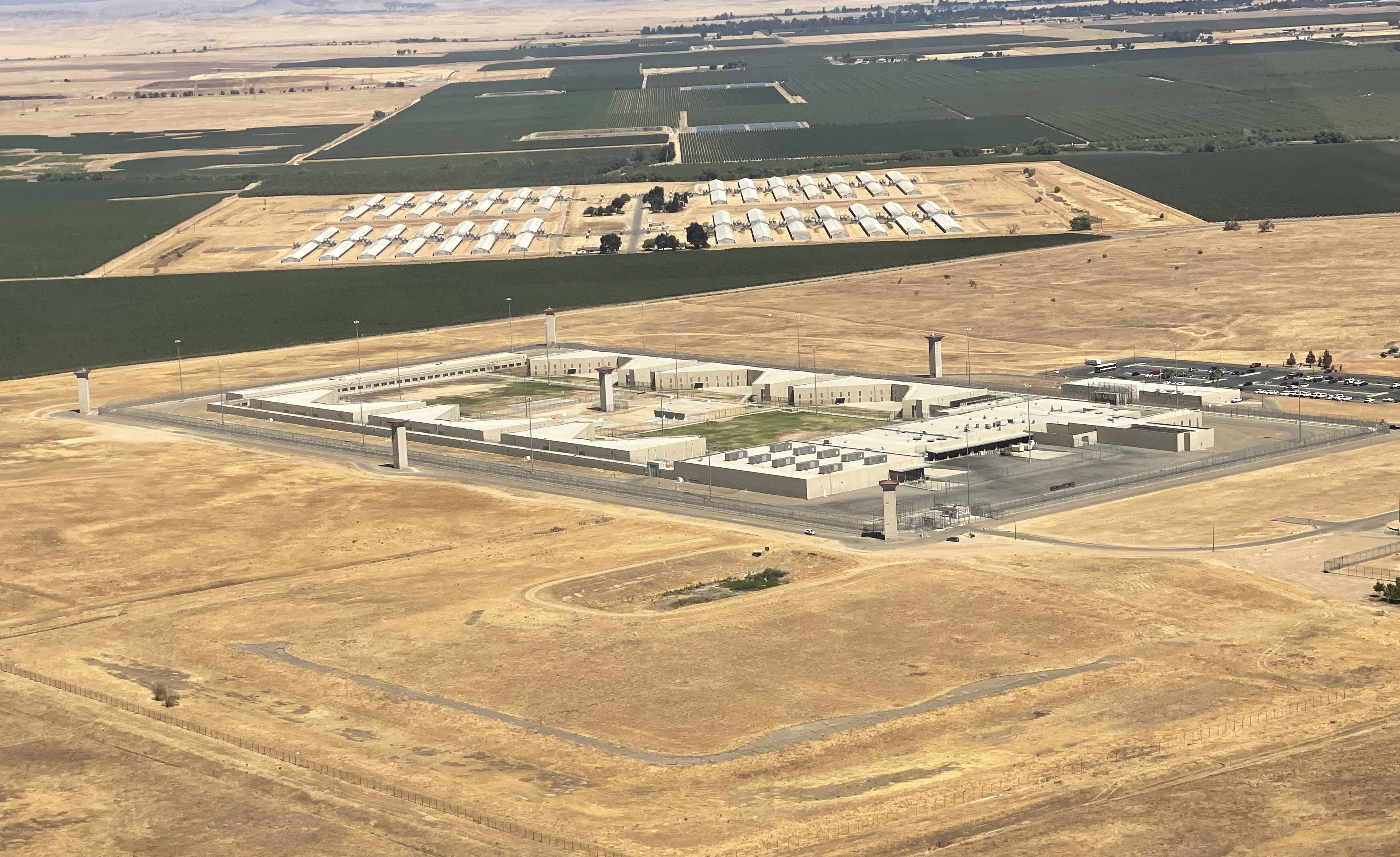
USP Atwater: From Runways to Cell Blocks
The runways of Castle Air Force Base once launched B-52 Stratofortresses into the sky above Merced County. When the base closed in 1995 under the Base Realignment and Closure process, the federal government found a different use for the land. By 2001, a high-security penitentiary rose where bomber crews had trained, its razor-wire perimeters and guard towers replacing the hangars and taxiways of the Cold War. USP Atwater sits on the valley floor about 130 miles southeast of San Francisco, surrounded by farmland so flat that the prison compound is visible from miles in every direction. It is a place designed not to be escaped from, built to house the federal system's most dangerous inmates - and its history has been marked by the kind of violence that raises hard questions about what happens behind those walls.
A Base Becomes a Prison
Castle Air Force Base had served the military since 1941, training bomber crews through World War II, the Korean War, the Vietnam War, and the long standoff of the Cold War. When the Department of Defense closed it, the surrounding community of Atwater lost its economic anchor. The Federal Bureau of Prisons stepped into the void, constructing a high-security penitentiary and a minimum-security satellite camp on the former military land. The transition from air base to prison was not unique - military closures across the country produced similar conversions - but it reshaped the identity of the area. Where the economy had once revolved around airmen and their families, it now depended in part on correctional officers and the federal payroll that accompanied them. The prison opened in 2001 and was designated to hold male inmates at the highest security classification, a population that includes those convicted of murder, espionage, organized crime, and terrorism.
The Death of Officer Rivera
On June 20, 2008, Correctional Officer Jose Rivera was conducting a routine count on the second floor of USP Atwater when inmate Joseph Cabrera Sablan attacked him with an eight-inch homemade knife. Rivera, a 22-year-old Navy veteran, tried to reach help but was knocked backward and tackled by a second inmate, James Ninete Leon Guerrero. Both assailants were already serving life sentences for murder. As Rivera stumbled down the stairs, Guerrero held him while Sablan stabbed him more than twenty times. Despite injuries that would kill him, Rivera managed to restrain both attackers until other officers arrived. He was transported to a hospital, where he died. The FBI investigated. Guerrero was sentenced to life without parole in 2014; Sablan received the same sentence in 2015. Rivera's death became a rallying point for federal corrections unions demanding better staffing and safety protocols in high-security facilities.
Failures Behind Locked Doors
Two years before Rivera's murder, another death had already exposed systemic problems at USP Atwater. On August 2, 2006, inmate Juwan Ferguson repeatedly asked correctional officers to remove his cellmate, Domosanies Slaughter, from their shared cell in the Special Housing Unit. Slaughter had been diagnosed with schizophrenia, and Ferguson's defense attorney later argued that USP Atwater was not equipped to handle inmates with severe mental illness. When Slaughter struck Ferguson, Ferguson beat him unconscious and continued the assault even after officers ordered him to stop, eventually killing him. Ferguson was convicted of voluntary manslaughter and initially sentenced to life, though an appeals court reduced his sentence to 96 months. The case laid bare a tension at the heart of the federal prison system: high-security facilities house the most volatile inmates, yet mental health resources at those facilities have often lagged behind the need. Slaughter's death was not just a tragedy of violence between two men. It was a failure of the institution charged with keeping both of them alive.
Life on the Inside
Despite its grim history, USP Atwater operates programs meant to prepare at least some of its inmates for eventual release. Mandatory GED classes serve those without high school diplomas. Vocational training offers apprenticeships in trades. Parenting classes attempt to maintain family bonds across prison walls. Adult continuing education and leisure programs fill hours that might otherwise breed the idleness that corrections professionals regard as dangerous. The minimum-security satellite camp, separated from the main penitentiary, holds inmates nearing the end of their sentences or those with lower risk profiles. From above, the compound reads as a series of concentric security layers: the satellite camp on the perimeter, the main institution behind multiple fences, and at the center, the housing units where daily life unfolds according to a schedule measured in counts, meals, and lockdowns. The flat valley around it offers no hills to block the view, no forests to hide in. The landscape itself is part of the security architecture.
From the Air
Located at 37.39N, 120.56W in unincorporated Merced County, California, on the former grounds of Castle Air Force Base. The prison compound is clearly visible from the air as a series of rectangular buildings surrounded by concentric security fences, set amid flat agricultural land. Castle Airport (MER) is immediately adjacent to the north. Merced Regional Airport (MCE) is approximately 10 miles south. The flat Central Valley terrain provides excellent visibility. The Castle Air Museum, with its collection of historic military aircraft displayed outdoors, is visible just north of the prison grounds.