Universal Esperanto Association
Behind a Rotterdam doorway sits the head office of a country that does not exist. The Universal Esperanto Association, headquartered here since the 1950s, represents speakers of a constructed language in 121 countries, with 5,501 individual members and roughly 9,200 more through national affiliates as of 2015. UEA is the closest thing the Esperanto movement has to a parliament, a press, and a foreign ministry rolled into one. It also operates the largest mail-order Esperanto bookstore in the world, with over six thousand titles. From this office a network of local delegates fans out across the planet, each one a volunteer contact point for anyone who arrives in their town speaking a language designed in 1887 to let strangers talk.
A Swiss Journalist with a Big Idea
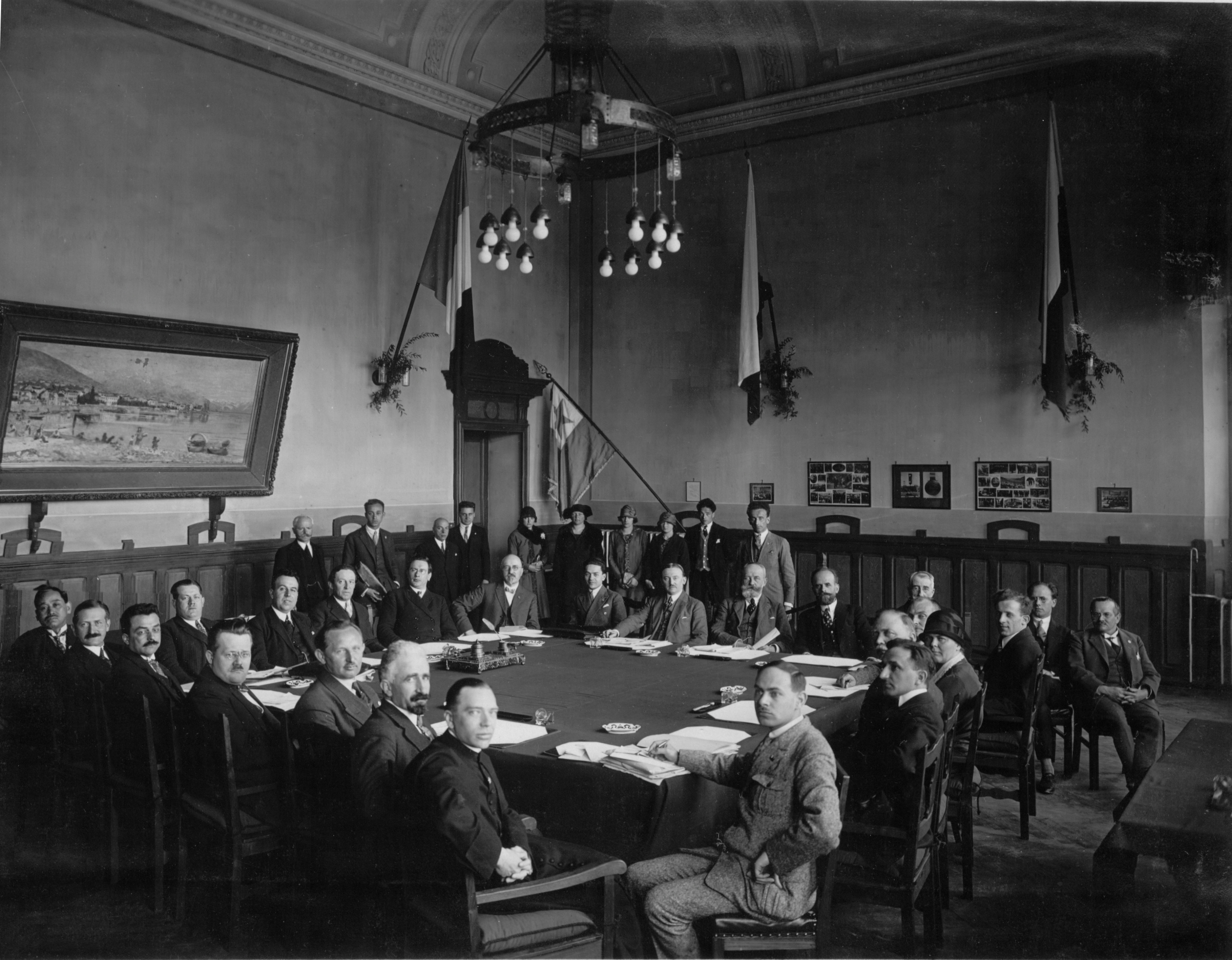
Hector Hodler founded UEA in Geneva in 1908. He was a young Swiss journalist who had inherited his father's painterly sense of humanism and his mother's gift for organization, and he believed that an international cause needed a single international body, not a federation of national clubs jealously guarding their territory. He bought the magazine Esperanto in 1907 and made it the association's official voice the following year. The model was simple: every town with members elected a local delegate, the delegates collected dues and sent them to Geneva, and the totality of delegates elected a Komitato to run things. Hodler dreamed of an organization fit to hold hundreds of thousands of members. UEA has never exceeded ten thousand. The disappointment is real. So is the persistence.
The 1936 Schism
The international Esperanto movement has the slightly comic, slightly tragic habit of all utopian projects: it splits. The first big rupture came in 1936. UEA, struggling financially in Geneva, decided to relocate to London where the activist Cecil Goldsmith was ready to take over as director and where currency rules made the budget survivable. A campaign led by a former president made the legal move from Switzerland impossible. After months of arguments and a referendum, the board and most of the Komitato simply walked out and founded a new organization, the Internacia Esperanto-Ligo, in September 1936. Nearly all national organizations and individual members followed them. Back in Geneva the old leaders presided over what was essentially an empty shell. The rump UEA and the IEL would not formally merge again until after the Second World War, when a Genevan official tricked the IEL board into reunion by falsely claiming a wealthy donor had left a large bequest. The Esperanto movement, in other words, has experienced everything that real politics experiences. The only thing missing is the army.
The Hero of Montevideo
After the war, the office moved to Rotterdam and the association was reshaped by Ivo Lapenna, a Croatian law professor based in London with a flair for prestige campaigns. Lapenna believed that institutional respectability would do for Esperanto what grassroots enthusiasm had not. In 1954, at the UNESCO conference in Montevideo, he secured a resolution recognizing Esperanto's role in international understanding. The win made him famous in Esperanto circles as the hero of Montevideo. He served more than thirty years on the UEA board, and then in 1974 he left and founded a rival organization. Splits, again. The Cold War made everything harder. UEA had to maintain national affiliates and individual members on both sides of the Iron Curtain, refusing the German national association in the 1930s when it submitted to Nazi rule and refusing the Cuban association in 1959 for the same reason on the other side of the political spectrum. The Communist Party's leading role, the statutes said, was incompatible with the association's required neutrality.
Books, Yearbooks, and the Hector Hodler Library
What survives in Rotterdam is unromantic and durable. The Hector Hodler Library, named for the founder, was one of the largest Esperanto collections in the world — nearly 30,000 books, yearbooks, and archival records. In 2023 the collection was transferred from Rotterdam to the National Library of Poland in Warsaw, where it now serves as a global Esperanto research archive. The Yearbook, Jarlibro de UEA, ran for 108 years as the association's reference of record, listing every delegate in every town and giving Esperanto speakers a way to find each other before the internet made it trivial. The book service ships from Rotterdam to anywhere a member writes from. Twice a year, in spring and autumn, the headquarters holds an Open Day. UEA holds consultative relations with the United Nations, UNICEF, the Council of Europe, and an A-liaison status with the International Organization for Standardization, where it works on terminology committee ISO/TC37. None of this gets headlines. It is the steady operational work of an institution that has decided to outlast its disappointments.
The World Congress, Year After Year
Every summer, somewhere on the planet, between 1,500 and 3,000 people gather for the Universala Kongreso de Esperanto. The first congress was held in 1905, two years before UEA existed. Since 2009 they have been hosted in Bialystok in Poland, the hometown of L. L. Zamenhof who invented the language; in Havana, Copenhagen, Hanoi, Reykjavik, Buenos Aires, Lille, Nitra, Seoul, Lisbon, Lahti, Montreal, and Turin. The 2020 and 2021 congresses moved online during the pandemic. Arusha in Tanzania hosted in 2024 and Brno in the Czech Republic in 2025. For a week, in whichever city this year's host has been chosen, the conversational language in the hallways and the lecture halls is one nobody grew up speaking. From a Rotterdam office, year after year, somebody schedules it.
From the Air
UEA's headquarters sits at roughly 51.91N, 4.46E, in central Rotterdam near the Erasmusbrug. From altitude the city's distinctive bridges and the Nieuwe Maas dominate the view. Rotterdam The Hague Airport (EHRD) lies about 7 km north. Amsterdam Schiphol (EHAM) is roughly 60 km north. The maritime climate brings frequent low cloud and rain.