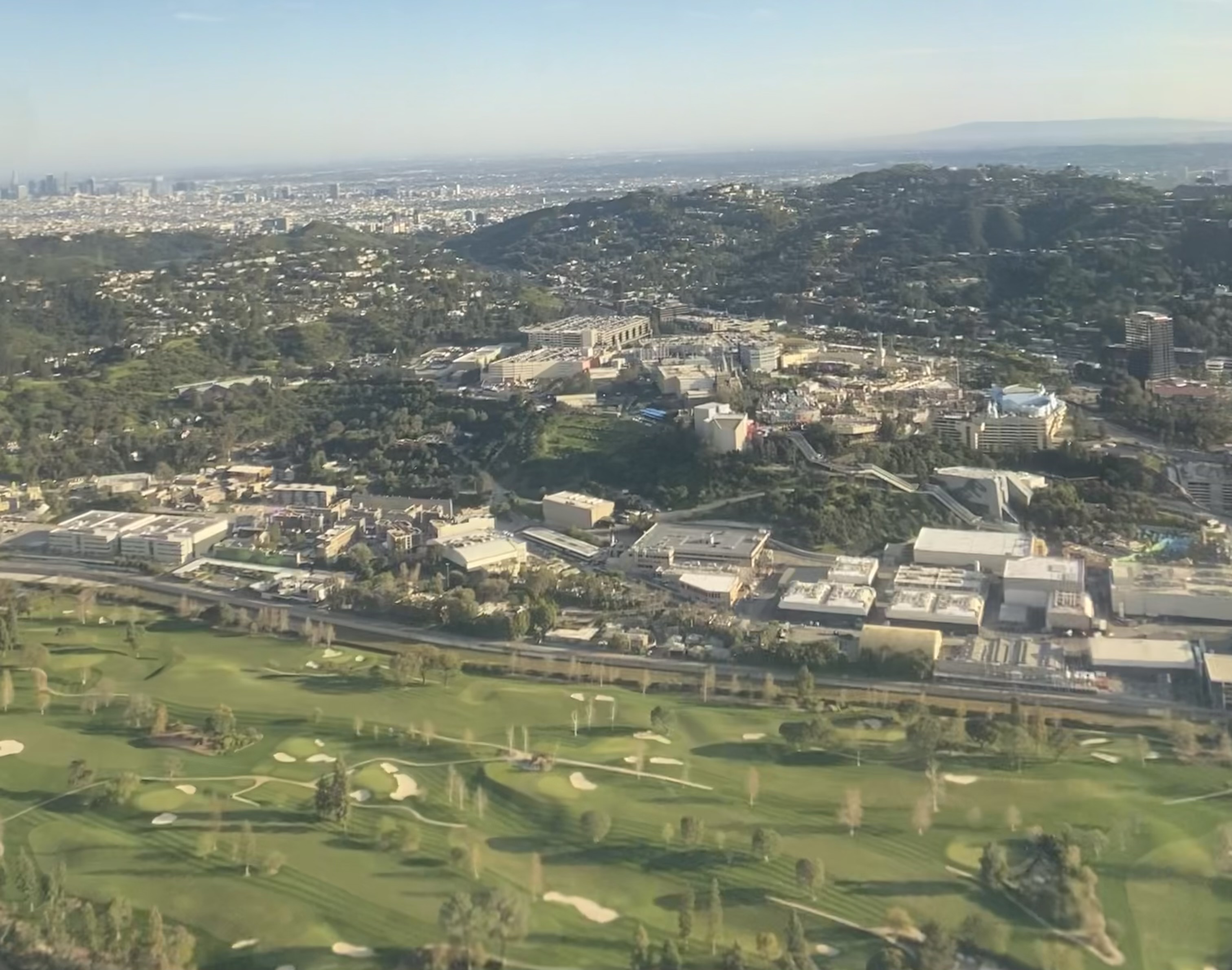
Universal Studios Hollywood
In 1914, German immigrant Carl Laemmle bought a chicken ranch in the San Fernando Valley and built something unprecedented: a movie studio with its own zoo, its own police force, its own mayor, and Native Americans living on the premises. When Universal City opened on March 14, 1915, Laemmle did something no studio executive would dare today. He invited the public in for five cents, which included a boxed lunch with chicken from the on-site farm. That original tour ended around 1930 when sound films made the stages too noisy for visitors, but the impulse to welcome audiences behind the curtain never died. Today, Universal Studios Hollywood hosts 8.7 million guests annually, making it the 16th most visited theme park on Earth.
A Century of Flames
Universal's backlot has burned nine times. The first fire came in 1932, when embers from a brush fire destroyed four movie sets and caused $100,000 in damage. Arsonists struck in 1957, burning the New York street set and causing half a million dollars in destruction. The most devastating blaze came on June 1, 2008, when a worker using a blowtorch to warm asphalt shingles ignited a three-alarm fire. Brownstone Street, New York Street, New England Street, and the King Kong attraction all burned. The iconic Courthouse Square, famous from countless films, survived its third fire with only the west side charred. Over 516 firefighters responded. Universal president Ron Meyer assured the public: 'Nothing irreplaceable was lost. We have duplicates of everything.' That statement would prove tragically wrong.
The Day the Music Burned
In June 2019, the New York Times revealed what Universal had concealed for over a decade. The 2008 fire had destroyed Building 6197, a warehouse adjoining the King Kong attraction that housed master tapes belonging to Universal Music Group. The losses were staggering: original recordings by Nirvana, The Roots, and countless other artists were gone forever. Questlove confirmed that masters for two albums, including unreleased material, were destroyed. Krist Novoselic of Nirvana believed the masters for Nevermind were 'gone forever.' Some artists, like Eminem, had digitized their recordings months before the fire. Others, including the catalogues of John Coltrane, Muddy Waters, and Chess Records, survived in a different vault. But the 2008 fire had erased irreplaceable pieces of music history that even Universal's archivists could not fully account for.
From Tram Tours to Wizards
When the Screen Actors Guild prohibited visitors from most soundstages in 1968, Universal had to reinvent itself. Jay Stein, President of the Recreation Division, championed creating experiences instead of showing actual production. The Flash Flood set that same year proved a hit, sending 20,000 gallons of water rushing down a narrow Mexican village street. The Parting of the Red Sea followed in 1973. Today the park sprawls across Upper and Lower lots connected by escalators called the Starway. The Wizarding World of Harry Potter, which opened in 2016, is the largest themed area in the Upper Lot, featuring a replica Hogwarts castle housing actual props from the films. Super Nintendo World opened in February 2023, and a Fast & Furious roller coaster is planned for 2026.
Hollywood's Living Backlot
Universal Studios Hollywood is not a museum frozen in time. It remains an active production facility where real films and television shows are made alongside the theme park attractions. The tram tour still winds through the backlot, passing sets that might be dressed for a period drama one week and a modern action film the next. The Metro B Line now brings visitors directly to Universal City station, connecting the park to downtown Los Angeles, Hollywood, and beyond. What began as a German immigrant's audacious experiment in transparency, inviting the public to watch movies being made, has evolved into something Laemmle could never have imagined: a place where the line between watching entertainment and living inside it has effectively disappeared.
From the Air
Located at 34.14N, 118.36W in Universal City, California, nestled between the Santa Monica Mountains and the San Fernando Valley. The complex is easily visible from the air by its distinctive layout, with the white studio buildings, the Upper and Lower Lot theme park areas, and the CityWalk entertainment district. The 101 Freeway runs along the southern edge. Nearby airports include Burbank (KBUR) 5nm east and Van Nuys (KVNY) 5nm northwest. The Hollywood sign is visible 3nm to the southeast on Mount Lee.