Université libre de Bruxelles
On 24 June 1834, a Brussels lawyer named Pierre-Theodore Verhaegen stood up at a meeting of the freemasonic lodge Les Amis Philantropes and proposed founding a university. Belgium was four years old. Its only universities were state-run institutions in Ghent, Liege, and Louvain, the last of which had just been refounded as a Catholic body answerable to Rome. Verhaegen and the lodge wanted something different: a university independent of both state and church, governed by what they called libre examen - free inquiry - with no doctrinal authority allowed to overrule the evidence. They named it the Free University of Brussels. The motto they chose, scientia vincere tenebras, translates as conquer darkness through science. They were not being subtle.
Built as a Counterweight
The political moment that produced the Universite libre de Bruxelles was sharp and specific. The Catholic University of Belgium had just relocated from Mechelen to Leuven; Belgian liberals worried that Catholic clergy would dominate higher education in the new country unless something was done quickly. Auguste Baron, study prefect at the Royal Athenaeum of Brussels and a friend of the astronomer Adolphe Quetelet, persuaded Verhaegen - then president of the Les Amis Philantropes lodge - that a private university was both legally permitted and politically necessary. The Belgian Constitution allowed it. The lodge had the money and the networks. In 1836 the institution was formally renamed the Universite libre de Bruxelles. It moved to the Granvelle Palace in 1842 and grew steadily until the First World War, expanding faculties, admitting its first women students in 1880, and accepting substantial funding from Ernest and Alfred Solvay and from Raoul Warocque to open new schools in the 1890s.
The Resistance Years
On 25 November 1941, the German occupiers closed the Universite libre de Bruxelles. The closure followed more than a year of escalating tension. The university had publicly protested the anti-Jewish ordinances of October 1940, but had still cooperated with the expulsion of Jewish professors and students - a compromise that some of its leaders would defend and others would condemn for the rest of their lives. The break came when the Germans demanded Flemish New Order professors be installed. The senate refused. Classes were suspended; the campus emptied. Many students went underground. A network of ULB students helped form Groupe G, a sabotage cell that became one of the most effective Belgian Resistance organisations of the war. Their most famous operation, in January 1944, blacked out much of Belgian industry for several days by destroying a single set of high-tension transformers. The university reopened in September 1944. The names of the students who did not return are inscribed on the Solbosch campus.
Splitting in Two
Brussels in the 1960s was a city of two languages and two universities pretending to be one. The Free University taught most of its courses in French; Dutch instruction had been added gradually since 1935. The political pressure that broke up the Catholic University of Leuven in 1968 along linguistic lines reached Brussels the next year. On 1 October 1969 the French and Dutch entities of the Free University formally separated. The act of 28 May 1970 made the split official: the French-speaking Universite libre de Bruxelles (ULB) and the Dutch-speaking Vrije Universiteit Brussel (VUB) became two distinct legal entities with separate administrations, separate rectors, and ultimately separate campuses. They still share the city, and in English they share an awkward translation - both names mean Free University of Brussels - which is why neither institution uses the English version officially.
The Nobel Laureates
Five ULB-affiliated scientists hold the Nobel Prize. Ilya Prigogine, born in Moscow and raised in Brussels, won the 1977 Nobel Prize in Chemistry for his work on dissipative structures and the thermodynamics of systems far from equilibrium - a body of theory that reshaped how chemists, biologists, and physicists think about self-organisation. Francois Englert, who taught at ULB for decades, shared the 2013 Nobel Prize in Physics with Peter Higgs for predicting the field that gives elementary particles their mass; Englert and his collaborator Robert Brout had published the prediction in 1964, weeks before Higgs, but the particle was named for Higgs and the wait for confirmation took nearly fifty years. Denis Mukwege, the Congolese gynaecological surgeon who founded Panzi Hospital in Bukavu to treat survivors of wartime rape, received his medical training at ULB and shared the 2018 Nobel Peace Prize. The university also counts Jules Bordet, the 1919 Nobel in Physiology or Medicine, and Albert Claude, the 1974 Nobel in the same field. Add Pierre Deligne (Fields Medal 1978), Jean Bourgain (Fields Medal 1994), and Jacques Tits (Abel Prize 2008) and the mathematics record is similarly improbable.
Three Campuses, One City
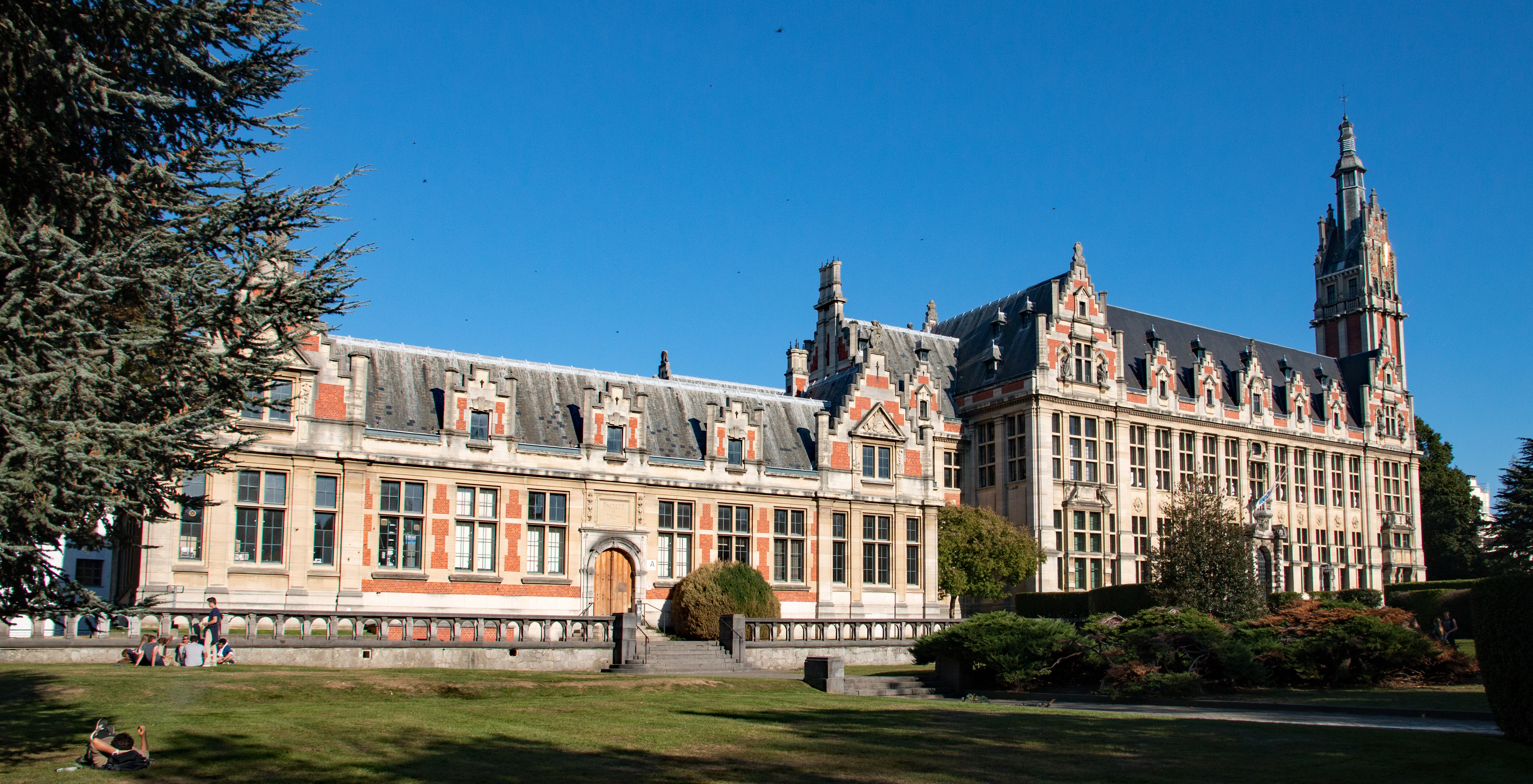
ULB is spread across three Brussels campuses. The Solbosch, in Ixelles and the City of Brussels, is the historical centre - home to administration, the humanities faculties, the Ecole polytechnique, and the museums of zoology and anthropology. The La Plaine campus, also in Ixelles, holds the sciences and pharmacy, served by Delta metro station. The Erasme campus in Anderlecht houses the Faculty of Medicine, the School of Public Health, and the Erasme teaching hospital, served by Erasme metro. Twenty-four thousand students study across the three sites. The university also keeps buildings in Charleroi and Nivelles for satellite operations. The campus that visitors usually see is the Solbosch, with its inter-war modernist core funded by the Belgian American Educational Foundation after the First World War. Walk it on a weekday and you can hear French, Dutch, English, and Arabic in roughly equal measure within a single block - which is exactly the kind of place Verhaegen and his fellow Masons probably had in mind when they argued, in 1834, that Brussels needed a university that owed nothing to anyone but the evidence.
From the Air
ULB's main Solbosch campus sits at 50.812 N, 4.381 E in Ixelles, immediately south of the City of Brussels. The Bois de la Cambre extends directly south. The La Plaine campus is 1.5 km east, the Erasme campus 6 km west in Anderlecht. Brussels Airport (EBBR) is 13 km north-east; Brussels-Charleroi (EBCI) is 41 km south. Brussels Central station is 4 km north. Brussels Class C TMA covers the campus to FL095; expect EBBR runway 25L approach traffic descending overhead in westerly winds.