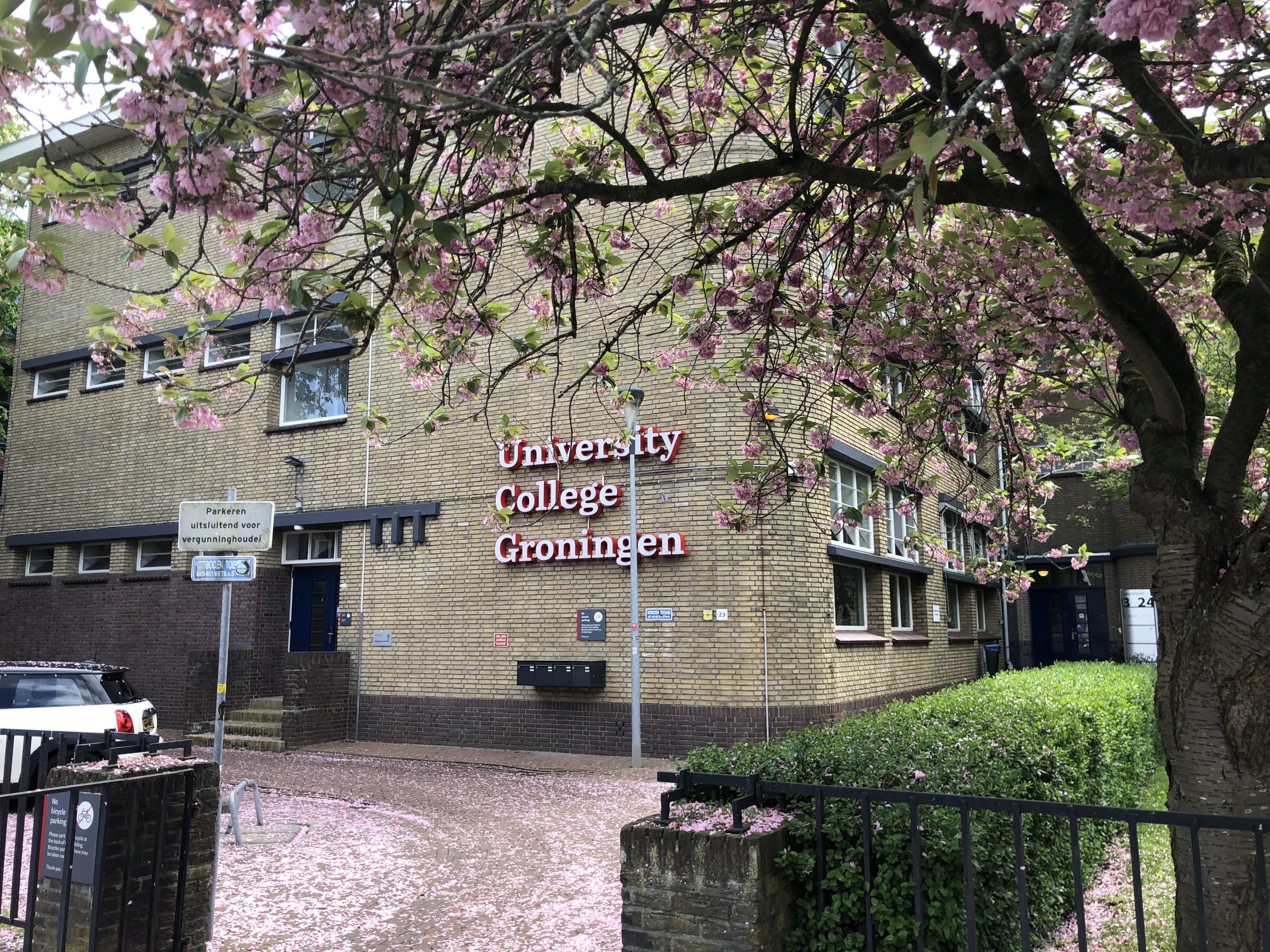
University College Groningen
The stained-glass windows depict household skills. Cooking, washing, sewing, all rendered in leaded glass for a 1932 building called the Prinses Julianaschool - a household school for girls, paid for by an association called the Vereniging voor Christelijk Nijverheidsonderwijs. The architects were the Groningen duo Kuiler & Drewes and the style was an emphatic expressionism: bright yellow brick on the outside, blue metal doors, those didactic windows on the inside. Today the students walking past them debate ethics in artificial intelligence, environmental psychology, and the philosophical foundations of international law. The building still teaches, but the lesson has changed.
From Household School to Honours College
The Prinses Julianaschool taught girls how to keep house in an industrial age. After the Second World War damaged the building, Kuiler & Drewes returned in 1952 to expand it. Architect D. Broos renovated again in 1962. From 2000 it served as office space, an interim use that municipal monument status quietly outlasted. In 2014 the University of Groningen opened University College Groningen on the site at Hoendiepskade 23/24, a small honours college within one of Europe's oldest universities. The first cohort was 30 students. The first class graduated in 2017. By the time the building's stained glass had reached its ninety-second year, the Class of 2024 numbered 130.
A Small School Inside a Big One
UCG sits as a faculty of the University of Groningen, the public research university founded in 1614 and now ranked inside the global top hundred. That parent institution has roughly 30,000 students. UCG has around 360. The distinction matters: a liberal arts college is supposed to feel small. Classes are taught entirely in English. The bachelor's degree, three years long, is in Liberal Arts and Sciences, with majors in Social Sciences, Humanities, Sciences, or a Free Major that students design themselves. Courses come from UCG's own faculty and from professors borrowed across the wider university. The pedagogy leans on project-based learning - which is to say, students are routinely asked to make something rather than just absorb it.
Who Comes, and What They Pay
More than half of UCG's students come from outside the Netherlands, a proportion that makes the dining hall sound multilingual and the seminar room polyglot in argument. Tuition is high by Dutch standards - roughly 2,000 euros above the standard rate for an EU/EEA bachelor's, a meaningful premium in a country where higher education is, by international standards, almost free. Admission demands solid high school grades. First-year students are required to live on the residential campus, a common arrangement at Dutch liberal arts colleges and a deliberate one: putting eighteen-year-olds from twenty countries in the same building for nine months produces an education that no syllabus alone can deliver.
Specialising Without Narrowing
The catalogue of major specialisations reads like a snapshot of what a small honours college in 2026 thinks is worth teaching. The science track offers Health and Life Sciences, Smart Technologies, and the magnificently named Mind, Machines and Morality - philosophy of mind sitting next to applied AI. Social sciences students can take Philosophy, Politics and Economics, or Mind and Behaviour, or International Relations and International Law, or International Business and Entrepreneurship. The humanities track is built around Culture and Social Change. Students can also stitch together a tailor-made specialisation to bridge whatever disciplines their planned master's degree happens to require. The point of a liberal arts education has always been that you are not yet sure what you are going to need. UCG is designed to make that uncertainty productive.
The Building Itself
The exterior of Hoendiepskade 23/24 remains stubbornly recognisable as the household school that opened in 1932. The bright yellow brickwork is hard to miss from the canal, the blue metal doors hard to mistake for anything contemporary. Next door, the smaller caretaker's residence still stands. Inside, the stained glass scenes of cooking and washing and sewing are now read by students as an oblique commentary on gender, labour, and what counts as worth knowing - exactly the kind of question a liberal arts college is supposed to provoke. From 2017 through 2020, Keuzegids Universiteiten ranked UCG as a Top Rated Programme. The student association is called Caerus, which is the right Greek god for a college this small: kairos, the opportune moment, the right time to act.
From the Air
University College Groningen is located on the Hoendiepskade in Groningen at approximately 53.22 degrees north, 6.55 degrees east. The site sits along the historic Hoendiep canal, which from altitude appears as a thin reflective ribbon cutting west through the city toward Hoogkerk. The building's bright yellow brick is not visible from cruise altitude; identify the position by the bend of the canal southwest of the city centre. Nearest field is Groningen Airport Eelde (EHGG), 12 km south.