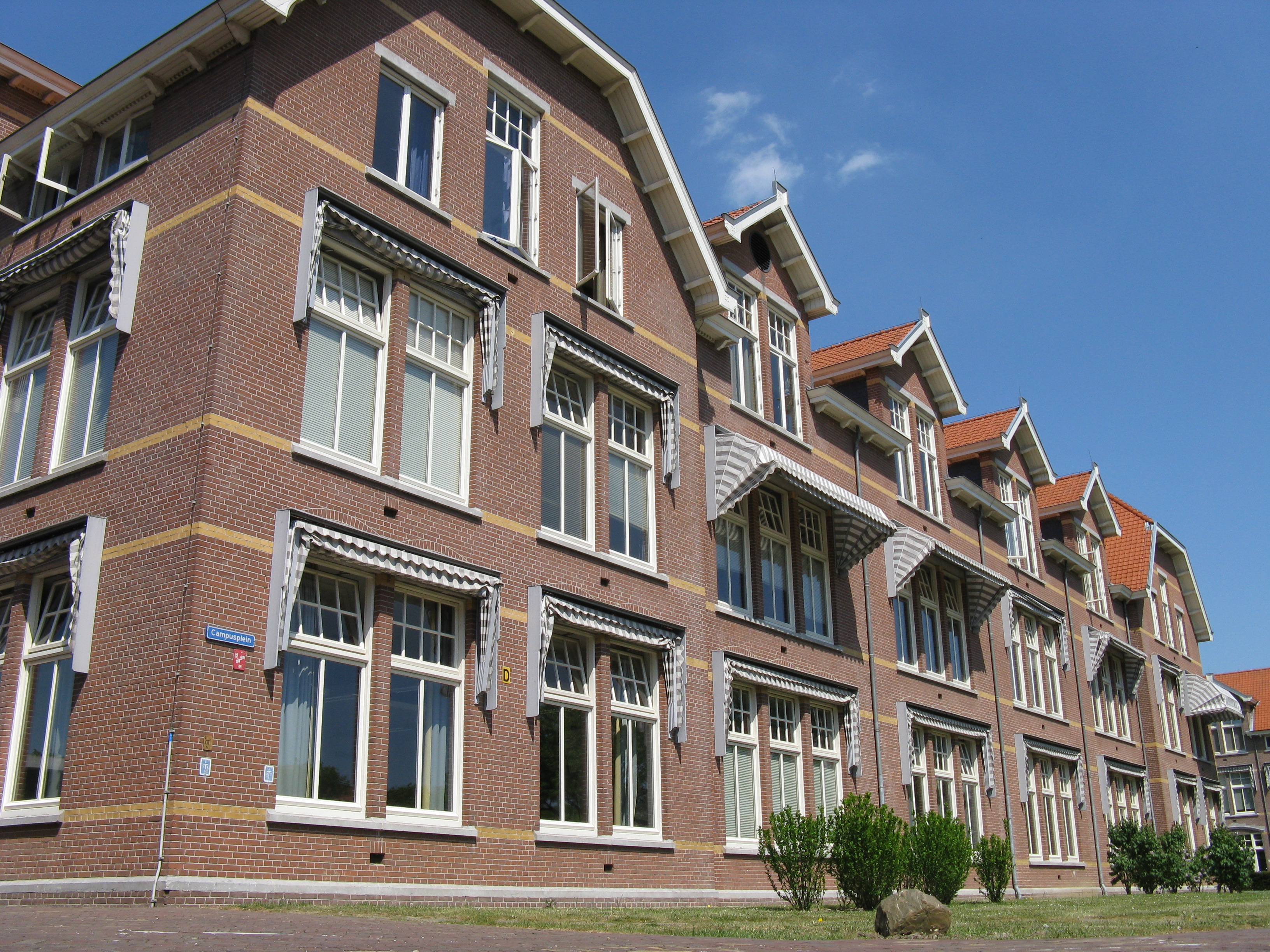
University College Utrecht
The buildings still look like a military base. Three long brick blocks face one another across a quad, the layout efficient and a little stern, the kind of arrangement an army engineer would draw. That is exactly what it was. The Kromhout Kazerne housed Dutch soldiers for decades, and in 1998 the Netherlands handed it to Utrecht University to do something that had never been tried in the country: open an English-language, residential, liberal arts college on the American honors model. The new tenants named the academic buildings Voltaire, Locke, and Newton. The students moved into the soldiers' barracks. The mess hall became a student bar.
The First of Its Kind
University College Utrecht was the first university college in the Netherlands. Roughly 750 students from around 70 nationalities study and live on the campus. The acceptance rate hovers around 22 percent. Admissions weighs not just grades but a letter of motivation, references, English proficiency, and an interview - a process foreign to Dutch undergraduate education before UCU made it normal. The Keuzegids, the Dutch national study choice guide that ranks roughly 400 bachelor programmes, has handed UCU its Top Rated Programme seal every year since 2013. It is accredited by the NVAO, the Accreditation Organization of the Netherlands and Flanders, and has consistently placed in the top five of Elsevier Magazine's survey of Dutch higher education institutions.
Naming the Halls After the Thinkers
The choice of building names tells you the school's intellectual ambition more than any brochure could. Voltaire holds the Humanities - history, philosophy, religious studies, literature, art history, performance studies, linguistics, and languages. Locke, named for John Locke whose Two Treatises shaped Anglo-American liberalism, houses the Social Sciences: law, psychology, political science, human geography, economics, anthropology, sociology. Newton holds the Sciences: cognitive neuroscience, life sciences, mathematics, physics, chemistry, and earth and environmental studies. A fourth building, Descartes, used to belong to UCU and now belongs to the Utrecht School of Economics. The students walk between Voltaire and Newton several times a day. Some of them notice the names. Some do not. Either way, the geography of the campus invites disciplines to brush against each other.
The Three-Year Bachelor
Students follow a three-year programme leading to a degree from Utrecht University - either a Bachelor of Arts or, with two extra lab courses, a Bachelor of Science. After the first year, a student elects a major in Humanities, Social Sciences, or Sciences, or builds a double or interdomain major by making a case to the Director of Education. Every student takes at least one course in each department, learns one new foreign language, and passes the core course Research in Context. Each course is worth 7.5 ECTS credits and runs on continuous assessment - papers, presentations, participation, exams - graded on the American A-to-F scale where an A equals a 4.0. First-year grades do not count toward the final GPA, a deliberate cushion against the disorientation of transitioning into the model.
Living on Campus
Almost every student lives on the Kromhout campus, in dormitories that were once soldiers' quarters. The old military mess is now the University College Student Association Bar, alongside a cafeteria, a gym, the UCSA office, and the Student Council office. The Auditorium - once a military museum - hosts large lectures and student performances. The residential model is deliberate. Students arrive from 70 different countries to spend three years inside the same compound, taking meals together, debating in Voltaire by afternoon, drinking in the old mess by night. The closeness produces both intensity and friction, and most alumni describe the experience as formative in a way larger universities rarely achieve.
The Cost of Admission
For the 2025-2026 academic year, tuition for students from the European Economic Area is around 5,398 euros, while students from outside the EEA pay around 16,484 euros. Campus fees of around 8,231 euros cover housing, electricity, water, and internet. Every student pays a 100-euro contribution to the UCSA. Financial aid exists. The numbers are higher than at a standard Dutch state university but lower than at almost any private American liberal arts college offering a comparable experience, and the school's continued top rankings suggest the value proposition holds. The barracks have not been a barracks for almost three decades. Whether the students arguing in Locke about social contract theory know they are sitting in a building named after the thinker who invented their argument is, in some sense, beside the point. The institution exists to make sure some of them eventually do.
From the Air
Coordinates 52.0833 N, 5.1478 E. Campus occupies the former Kromhout Kazerne in southeast Utrecht. From altitude, identify the rectangular barracks compound east of Utrecht Centraal and south of the city's medieval core. Nearby airports: Amsterdam Schiphol (EHAM) lies about 40 km west-northwest; Rotterdam The Hague (EHRD) is about 55 km southwest. Recommended viewing altitude 2,000 ft for institutional building visibility; the quad layout of the academic buildings is most distinctive from a steep angle.