University of Alabama
Three things define the University of Alabama, and they have nothing to do with each other -- except that they all happened here. In 1865, Union cavalry burned almost every building on campus. In 1963, a governor stood in a doorway trying to stop desegregation. And across more than a century of Saturdays, the Crimson Tide football program has accumulated 18 national championships, more than any other school in the country. Tuscaloosa's university, founded in 1820 and known simply as "the Capstone," carries the full weight and contradiction of the American South in its brick and mortar.
Wilderness Seminary
The university's origins trace to 1818, when Congress authorized the newly created Alabama Territory to set aside a township for a "seminary of learning." When Alabama joined the Union in 1819, the land grant expanded to 46,000 acres. The legislature established the school on December 18, 1820, naming it "The University of the State of Alabama." Architect William Nichols, who had designed the Alabama State Capitol, laid out a campus inspired by Thomas Jefferson's plan at the University of Virginia, centered on a domed Rotunda that served as library and heart of the grounds. The university opened its doors to students on April 18, 1831, with roughly 100 students per year during its first decade. It was an academy-style institution emphasizing the classics and natural sciences, perched on the frontier in what was then the state capital.
Ashes and Survivors
The university converted to a military campus during the Civil War, producing Confederate officers. On April 4, 1865 -- five days before Lee's surrender at Appomattox -- General John Croxton's Union cavalry burned the campus to the ground. Despite a desperate defense by the student cadet corps, the raid was devastating. Only four buildings survived: the President's Mansion (1841), Gorgas House (1829), the Little Round House (1860), and the Old Observatory (1844). These four structures still stand today as the oldest remnants of the antebellum university, scattered among 297 modern buildings across what has grown into a sprawling campus in the heart of Tuscaloosa.
The Schoolhouse Door
The university's most significant moment may have lasted only a few hours. Until the 1960s, Alabama admitted only white students. Autherine Lucy enrolled on February 3, 1956, the first Black student at any white public university in the state, but violent campus protests led to her suspension and expulsion after just three days. The university remained segregated until June 11, 1963, when Governor George Wallace staged his infamous "Stand in the Schoolhouse Door" at Foster Auditorium, blocking Vivian Malone and James Hood from registering. President Kennedy federalized the Alabama National Guard, and Deputy Attorney General Nicholas Katzenbach confronted Wallace with federal marshals. Wallace stepped aside. Malone became the first African American to graduate from the university in 1965. Lucy's expulsion was rescinded in 1980; she returned and earned her master's degree in 1992. The plaza in front of Foster Auditorium now bears the names of all three.
Crimson Tide Saturdays
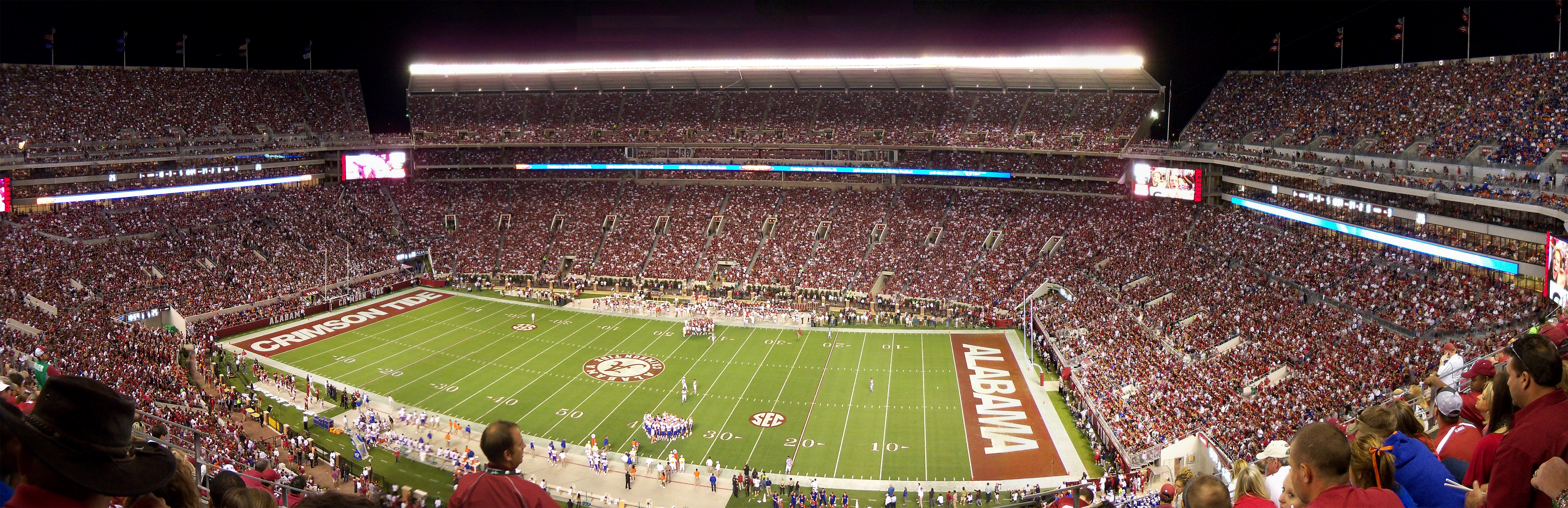
Football at Alabama operates on a scale that defies the word "tradition." The program, inaugurated in 1892, has won 30 SEC titles and 18 national championships. Bryant-Denny Stadium, which opened in 1929 with a capacity of 12,000, now holds 100,077 -- a monument to expansion as relentless as the program itself. The name "Crimson Tide" came from a 1907 sportswriter describing Alabama's jerseys, stained red from wet Birmingham dirt, after the team forced a tie against a heavily favored Auburn squad. Bear Bryant's record at Alabama was 232-46-9 with six national titles. Nick Saban added six more. The Iron Bowl rivalry with Auburn is among college football's fiercest. On game days, the Strip adjacent to the stadium fills with a sea of crimson, and the Million Dollar Band plays "Yea Alabama," the fight song Lundy Sykes wrote in 1926.
The Capstone Today
The University of Alabama enrolls nearly 40,000 students and claims 1,142 National Merit Scholars as of 2023, making it one of the largest enrolling institutions for merit scholars in the nation. The campus spreads across Tuscaloosa with 297 buildings, six libraries holding 2.9 million volumes, and landmarks that span its entire history: Denny Chimes, the Gorgas-Manly Historic District, the Alabama Museum of Natural History with its Sylacauga meteorite -- the only documented space rock to have struck and injured a person. Among its alumni are Supreme Court Justice Hugo Black, author Harper Lee, quarterback Joe Namath, and Wikipedia co-founder Jimmy Wales. On April 27, 2011, an EF4 tornado struck Tuscaloosa, killing six students and damaging 12% of the city, though the campus itself was spared. The university canceled the rest of the semester -- a rare interruption in a history that has weathered fire, social upheaval, and storms.
From the Air
The University of Alabama campus is centered at 33.211N, 87.546W in Tuscaloosa. The most prominent landmark from the air is Bryant-Denny Stadium (100,077 capacity), visible from high altitude. The campus lies east of the Black Warrior River, which bends around the western edge of the city. Nearest airport is Tuscaloosa National Airport (KTCL), approximately 3.5 miles northwest. At 3,000-5,000 feet AGL, the campus layout is clearly identifiable, with the Quad, stadium, and surrounding athletic facilities forming distinct patterns.