University of Bonn
There is a small bronze plaque inside the main building of the University of Bonn that almost no one stops to read. It records that this building - the Kurfurstliches Schloss, the former residential palace of the prince-electors of Cologne - was completed in 1705 for Joseph Clemens of Bavaria, occupied by French troops in 1794, taken over by Prussia in 1815, and turned into a university on 18 October 1818 by the personal decree of King Frederick William III. A monarchy gave a Catholic Rhineland province a Protestant-friendly university by signing a piece of paper. Two hundred years and eleven Nobel Prizes later, the palace is still the front door.
The Academy Before the University
The institution did not begin in 1818. Its forerunner was the Kurkolnische Akademie Bonn, founded in 1777 by Maximilian Frederick of Konigsegg-Rothenfels - the prince-elector of Cologne, who was also one of Beethoven's earliest employers. The Akademie was nonsectarian by design in an era when most German universities were not, and it had schools of theology, law, pharmacy, and general studies. In 1784 Emperor Joseph II granted it the right to award academic degrees, formally promoting it to a university. Then in 1794 French Revolutionary armies crossed the Rhine, the left bank became French territory, and the Akademie was closed in 1798 along with the universities of Cologne and Duisburg. For nearly two decades there was no university in the Rhineland.
A Province Without a University
The Congress of Vienna handed the Rhineland to Prussia in 1815. Berlin now governed a Catholic region from a Protestant capital, with no university anywhere in between - a politically awkward gap. Frederick William III decreed a new university on 18 October 1818 and chose Bonn over Cologne and Duisburg for two reasons. First, Bonn had a tradition of nonsectarian education from its eighteenth-century Akademie. Second, Bonn had buildings ready to use: the electoral palace stood empty, and Poppelsdorf Palace nearby could absorb the science departments. The new Rhein-Universitat - the sixth Prussian university - was equally divided between the two Christian denominations. It opened with a school of Catholic theology, a school of Protestant theology, and faculties of medicine, law, and philosophy. Thirty-five professors and eight adjunct professors taught the first classes. One year later, the dramatist August von Kotzebue was murdered by a student in Jena, the king imposed the Carlsbad Decrees on every German university, and Bonn was caught in the crackdown. The poet Ernst Moritz Arndt, freshly appointed professor of history, was banned from teaching for refusing to accept the censorship. The king also refused to grant the new university an official name or seal. The Rhein-Universitat remained nameless until 1840, when Frederick William IV finally granted the name it carries today: Rheinische Friedrich-Wilhelms-Universitat Bonn.
The Roll Call
Eleven Nobel Prize winners have been faculty or alumni - in chemistry, physiology and medicine, physics, literature, and economics. Five Fields Medalists in mathematics. Twelve Gottfried Wilhelm Leibniz Prize winners. The chemist August Kekule, who first drew the benzene ring. Heinrich Hertz, who proved electromagnetic waves exist by detecting radio waves. Justus von Liebig, founder of organic chemistry. The mathematicians Karl Weierstrass, Felix Klein, Friedrich Hirzebruch, Felix Hausdorff, and Peter Scholze, who taught at Bonn when he won the Fields Medal in 2018. Friedrich Nietzsche studied here briefly in 1864 before transferring to Leipzig. Karl Marx studied here briefly in 1835 before transferring to Berlin. Both spent their time at Bonn drinking, duelling, and reading. Heinrich Heine, the poet of the Lorelei, was an alumnus. Thomas Mann received an honorary doctorate that the Nazis stripped in 1937 and the university restored in 1946. Konrad Adenauer studied law here before becoming the first chancellor of West Germany. Robert Schuman, one of the founders of the European Union, studied here. So did Joseph Ratzinger, who held the chair of fundamental theology from 1959 to 1963 before he became Pope Benedict XVI. Prince Albert, before he married Queen Victoria, studied here. So did Kaiser Wilhelm II.
What Happened in 1933 and After
The Nazi takeover in 1933 brought Gleichschaltung to the university, replacing self-governance with a hierarchy of appointed leaders subordinate to the ministry of education. Jewish professors and students were expelled. Political opponents were ostracized. The theologian Karl Barth was forced to resign for refusing to swear an oath to Hitler, and he emigrated to Switzerland. The mathematician Felix Hausdorff, expelled in 1935, took his own life with his wife and sister-in-law in January 1942 after learning they were about to be deported to a concentration camp. The philosophers Paul Ludwig Landsberg and Johannes Maria Verweyen were deported and died in camps. On 18 October 1944 - the 126th anniversary of the university's founding - an air raid destroyed the main building. The university reopened on 17 November 1945, in the British occupation zone, with Heinrich Matthias Konen as its first postwar president. Konen himself had been expelled by the Nazis in 1934. Ten thousand applicants applied for 2,500 first-semester places.
The Modern Research University
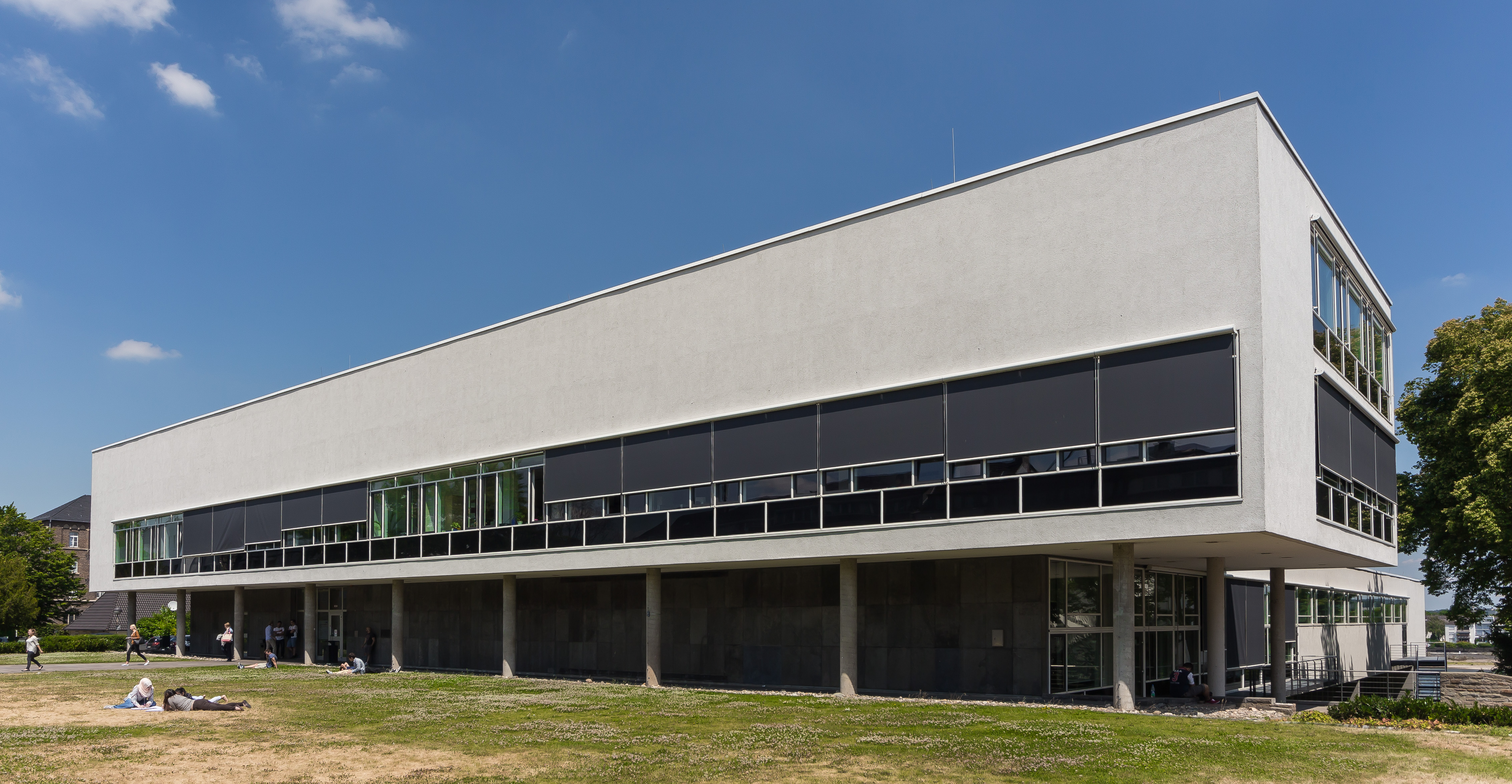
Bonn currently has about 32,500 students, more than 90 degree programs, and 6 Clusters of Excellence under the German federal research funding scheme - the most of any university in the country. The Hausdorff Center for Mathematics, named for the mathematician who killed himself rather than be deported, is one of them. The university does not have a single central campus: it owns 371 buildings across the city, with the humanities and theology faculties in the eighteenth-century electoral palace, the law and economics building on Adenauerallee, the sciences in Poppelsdorf and Endenich around the second former electoral palace, and the medical faculty out on the Venusberg west of the city. Reunification, when the 1991 Bundestag vote to relocate the capital to Berlin ultimately cost Bonn its role as seat of government in 1999, also delivered compensation in the form of three new research institutes affiliated with the university. The decision turned out to have upgraded the research profile considerably. The fluorescent ELSA particle accelerator in the physics institute hums on. Peter Scholze, the youngest Fields Medalist in recent history, walks across the Hofgarten to his office most weeks.
From the Air
The University of Bonn's main building, the Kurfurstliches Schloss, stands at 50.7339 degrees North, 7.1022 degrees East in the center of Bonn's old town, with the long axis of the Hofgarten stretching south. Poppelsdorf Palace, 1 km southwest, holds the science departments. The Venusberg hill, 4 km west, holds the medical campus. Nearest airport is Cologne Bonn (EDDK / CGN), 25 km north. From the air the palace's distinctive elongated U-shape and the Hofgarten green space mark the center of the old town. The Bonn Minster's tower is the most prominent vertical landmark in the same district.