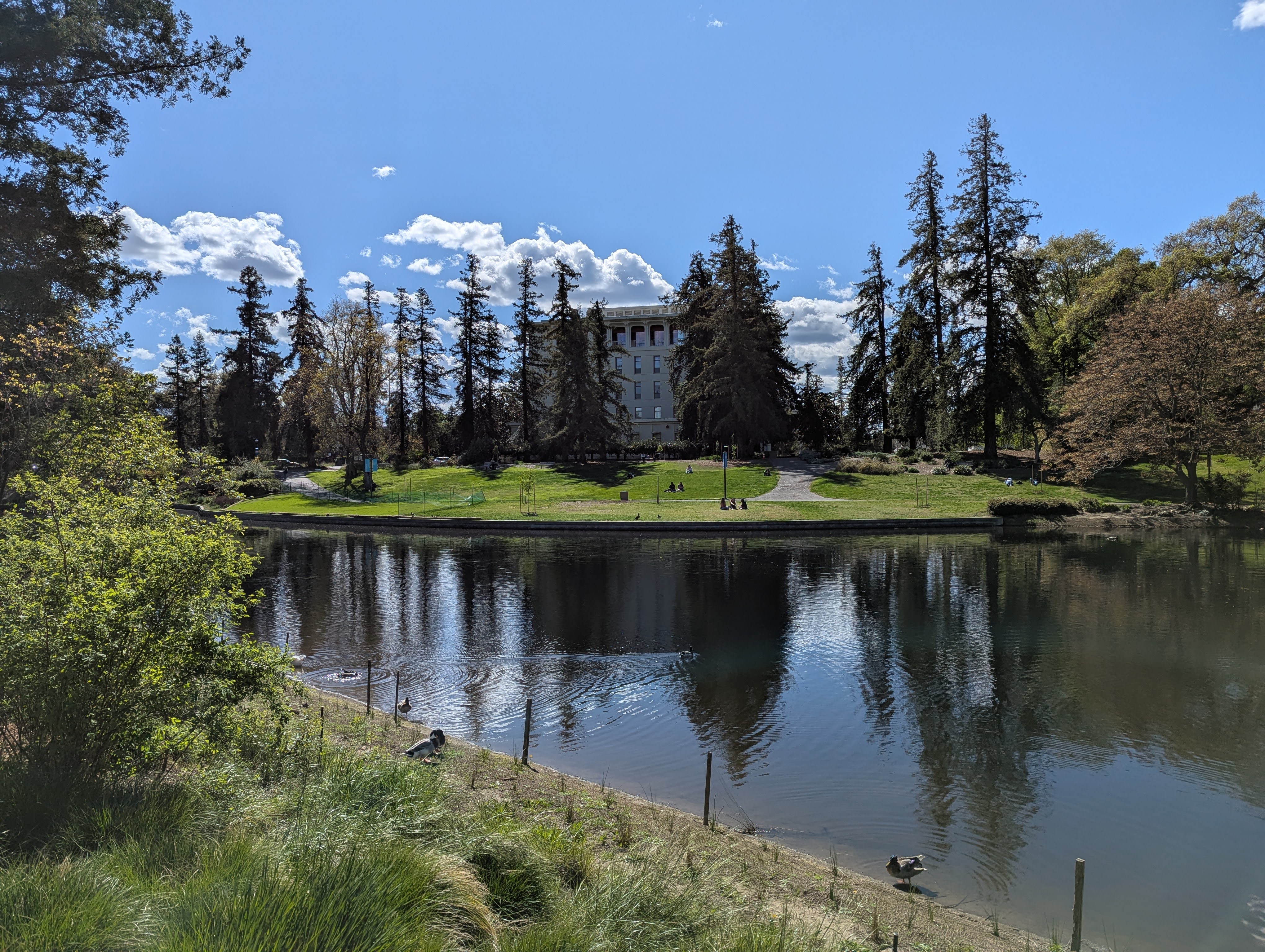
The Farm That Became a University
Most great universities start with a grand vision. UC Davis started with a problem: Berkeley's campus was running out of room to teach students how to farm. In 1905, the California legislature authorized a University Farm near the small town of Davisville, and for its first few decades the outpost remained exactly that, a place where students learned to grow crops and tend livestock in the flatlands of the Sacramento Valley. The transformation from agricultural annex to full-fledged university happened slowly, then all at once. Today UC Davis sprawls across 5,300 acres, making it the largest campus in the UC system by land area, a place where a student can study viticulture in the morning and visit a functioning nuclear laboratory in the afternoon.
From Davisville to Davis
The university's origins trace to Peter J. Shields, a Sacramento attorney who championed the idea of an agricultural school separate from Berkeley's main campus. The legislature agreed, and the University Farm opened in 1905 on land purchased west of Davisville. For years it operated under Berkeley's administration, a satellite campus devoted entirely to agricultural education. Students came to learn farming firsthand, not to earn degrees. That changed in 1959, when the Regents of the University of California granted Davis full status as a general campus, setting in motion a rapid expansion that would reshape both the institution and the town around it. The small agricultural community of Davis and the growing university became inseparable, each shaping the other's identity. The town shortened its name from Davisville decades earlier, but the university's growth gave the new name its weight.
Bicycles, Buses, and a Campus Unlike Any Other
Walk onto the UC Davis campus today and you notice the bicycles before anything else. Thousands of them, chained to racks, rolling through dedicated bike circles, governed by their own traffic signals. Davis is consistently ranked among the most bicycle-friendly cities in the United States, and the university is the reason. The campus police take cycling infractions seriously enough to issue tickets for riding without a headlight at night. But the most distinctive feature of Davis transportation is Unitrans, the city's bus system, which has been operated and managed entirely by students since 1968. Its fleet includes vintage London double-decker buses, believed to be the only non-sightseeing double-deckers in regular daily transit service in the country. The Capitol Corridor Amtrak line also stops in Davis, connecting the campus to Sacramento and the Bay Area.
A Nuclear Lab and a World-Class Research Engine
UC Davis is one of only two UC campuses with a nuclear laboratory. The Crocker Nuclear Laboratory, home to a nuclear accelerator since 1966, draws scientists and engineers from private industry, government agencies, and other universities to research everything from nuclear physics and radiation effects to planetary geology and air quality. The breadth of the research enterprise extends well beyond nuclear science. The university's veterinary school is consistently ranked among the best in the world, its medical center in Sacramento is a Level I trauma center, and its College of Engineering has partnered with Agilent Technologies to establish a millimeter wave research center. Notable alumni include Charles Moen Rice, the 2020 Nobel Prize laureate in Physiology or Medicine, and the university counts members of the National Academy of Sciences, National Academy of Medicine, and American Academy of Arts and Sciences among its faculty.
Picnic Day and the Student Republic
Every spring, Picnic Day turns UC Davis into something between a county fair and an open university. The event is the largest student-run open house in the United States, drawing thousands of visitors for a parade, chemistry magic shows, dachshund races called the Doxie Derby, film screenings, and dance competitions. It is a distillation of the campus's particular spirit, which blends agricultural roots with the energy of a major research institution. The student government, ASUCD, operates on an annual budget of over $22 million, making it one of the largest-funded student governments in the country. Under its umbrella sit enterprises like the student-run Coffee House and the Unitrans bus system. Greek life has been present since 1913, when the first fraternity was established, and today roughly eight percent of undergraduates participate in the system's fraternities and sororities.
The Aggies and Their Expanding Arena
UC Davis competes in NCAA Division I athletics as the Aggies, one of only three UC campuses to field a football team alongside Cal and UCLA. Football competes in the FCS division as members of the Big Sky Conference, while most other sports belong to the Big West Conference. The university's athletic trajectory mirrors its broader institutional arc: a steady climb from Division II, where the Aggies won the NACDA Directors' Cup four consecutive years from 1999 to 2003, to the Division I stage. Starting in July 2026, the Aggies will join the Mountain West Conference for most sports. Over 260,000 living alumni carry the Aggie name into the world, including two astronauts, a U.S. Treasurer, the former mayors of both Sacramento and San Francisco, and comedian Hasan Minhaj.
From the Air
Located at 38.54N, 121.75W in the flat Sacramento Valley, west of Sacramento. The sprawling 5,300-acre campus is clearly visible from altitude, bordered by Highway 113 to the west and Interstate 80 to the south. University Airport (KEDU) sits less than 2 miles west of campus. Sacramento Executive Airport (KSAC) is approximately 15 miles east, and Sacramento International Airport (KSMF) about 20 miles northeast. The agricultural land surrounding campus contrasts with the dense university development, making it easy to identify from the air.