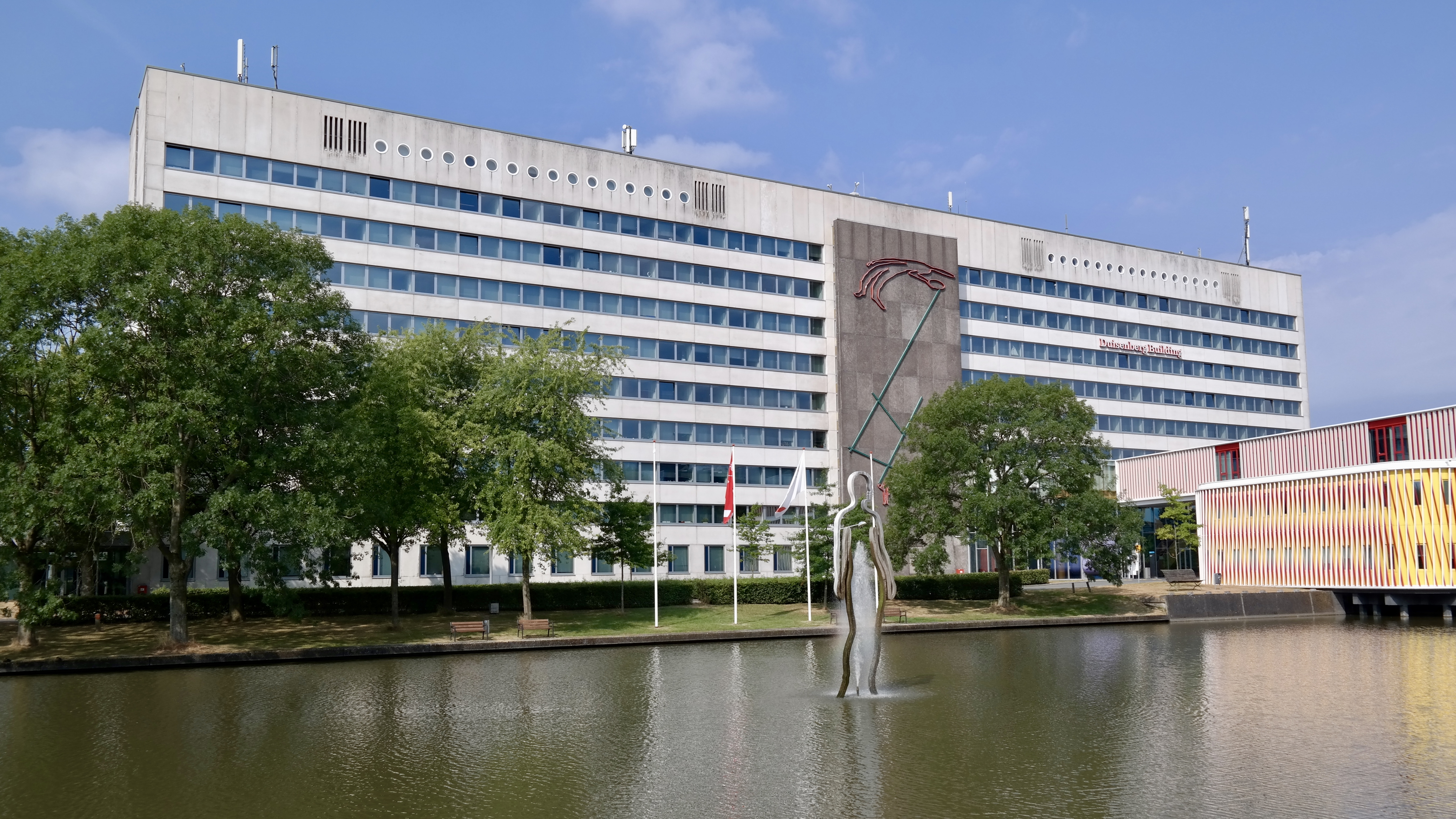
University of Groningen
In 1871, Aletta Jacobs walked into a lecture hall here. She was seventeen, the daughter of a doctor from the small town of Sappemeer, and she had asked the Minister of Education himself for permission to attend. He granted it provisionally - one year, on trial. She would become the first woman in the Netherlands to receive a medical degree, the first to attend a Dutch university in the regular way at all, and in a long career as a physician and a campaigner for women's suffrage she would build the rest of Dutch feminism on the precedent. She did it from a desk in Groningen.
The Second-Oldest University in the Country
The Regional Assembly of the city of Groningen and the surrounding Ommelanden founded the university in 1614, a few decades after Leiden. There were four original faculties: Theology, Law, Medicine, Philosophy. The first rector magnificus was Ubbo Emmius, who came from East Frisia just across the modern German border - a fitting start for an institution that has, ever since, drawn nearly half its scholars from outside the Netherlands. The coat of arms granted by the Estates in 1615 carries the inscription VERBVM DNI LVCERNA, an abbreviation of Verbum Domini Lucerna Pedibus Nostris: the word of the Lord is a lamp unto our feet. About a hundred students enrolled each year in the first 75 years. Not many. But the lamp was lit.
Standstill, Siege, and a Fire
The seventeenth and eighteenth centuries did not always go well. Theological quarrels, awkward relations with the Regional Assembly, and the month-long siege of the city in 1672 by the prince-bishop of Munster - the man Dutch history remembers as Bommen Berend - all kept enrolment hovering around two or three hundred. During that siege the university fielded a voluntary student company, a detail that says something about both the seriousness of the crisis and the medieval idea of what a university was. The French occupation of 1775 to 1814 saw Groningen administered, oddly, from Paris. Unlike Leiden, it stayed open, the only operating university in the puppet Kingdom of Holland. A new main building in 1850, the Academiegebouw, was largely paid for by the people of Groningen themselves. In 1906 it burned to the ground.
From Six Hundred to Thirty Thousand
When the university celebrated its tercentenary in 1914 it had 611 registered students. By 1924 there were a thousand. The Second World War knocked the numbers back. After 1945 they climbed again, reaching 20,000 by 1994. The current figure is around 32,700, with roughly 51 percent of the 4,350 PhD candidates international. Eleven faculties are scattered around the city, most of them clustered in or near the centre, with the natural sciences, business, and economics housed north of town on the Zernike Campus - named for Frits Zernike, the Groningen-affiliated physicist who won the 1953 Nobel Prize in Physics for inventing the phase-contrast microscope. The university shares Zernike with the Hanze University of Applied Sciences, which between them put about 40,000 students on the same set of bike paths.
The Nobel Lineage
Four Nobel Prize winners are claimed in the university's history. Ben Feringa, a synthetic organic chemist on the faculty, took the 2016 Nobel Prize in Chemistry for designing molecular machines - rotors and motors built from individual molecules, capable of being switched on and off by light. Frits Zernike's 1953 Physics Prize honoured a way of making the invisible visible: the phase-contrast microscope let biologists look at living cells without staining them dead first. Heike Kamerlingh Onnes, who studied at Groningen before holding a chair at Leiden, won the 1913 Physics Prize for the cryogenic work that produced liquid helium. Albert Szent-Gyorgyi, the Hungarian biochemist who worked here, took the 1937 Medicine Prize for isolating vitamin C. Johann Bernoulli, the eighteenth-century mathematician, taught here too. So did the historian Johan Huizinga and, in modern times, the astronomer Jan Oort, whose name labels the comet cloud at the edge of the solar system.
The Student City
Roughly one in three residents of Groningen is enrolled at one of the city's two universities, a ratio that gives the streets their distinctive sound: bicycle bells, conversations switching languages mid-sentence, beer-garden arguments at three in the afternoon. The city has earned the nickname World Cycling City, and the bike paths from the centre out to Zernike are integrated and labelled like an underground map. The housing crunch is real - in the autumn of 2021, hundreds of students arrived without anywhere to live and ended up in emergency shelters - and a protest occupation of the Academy Building followed. The university owns no student accommodation of its own; it works with the SSH housing cooperative. The city, perpetually short on rooms, has tried shipping-container villages and the somewhat strange invention called The Student Hotel. The contradiction at the heart of Groningen is that an old, dignified university keeps producing a city that is forever scrambling to keep up with how many young people want to come.
From the Air
The University of Groningen's historic core - the Academiegebouw on the Broerstraat - sits at the geographic centre of Groningen at roughly 53.22 degrees north, 6.57 degrees east. From altitude, the Zernike Campus reads as a separate cluster of larger buildings about 3 km north of the old city, on the edge of open countryside. The University Medical Center Groningen (UMCG) is the substantial complex just northeast of the centre. Nearest field is Groningen Airport Eelde (EHGG), 12 km south of the city.