University of Kansas
The hill was called Hogback Ridge before it became Mount Oread, and it was donated by a man who had watched his town burn from a stone barn. Charles L. Robinson, the first governor of Kansas, witnessed William Quantrill's guerrillas massacre 150 men and boys in Lawrence on August 21, 1863, hiding in plain sight while raiders circled his barn-fortress. Two years later, Robinson and his wife Sara gave the hilltop to the state for a university. The Board of Regents held its first meeting in March 1865, and work on the first building began that year. Today the University of Kansas enrolls over 31,000 students across five campuses, holds membership in the Association of American Universities, and claims a basketball legacy that stretches from the sport's inventor to its winningest all-time program. But everything begins with that hill, donated by a survivor of one of the Civil War's worst atrocities, in a town that refused to die.
A University or Else
Kansas almost lost the university before it opened. The enabling law required Lawrence to provide a $15,000 endowment and a campus site of no less than 40 acres. If Lawrence failed to meet those conditions, the university would go to Emporia instead. Robinson's land gift secured the deal. The early years were shaped by the tension between a secular institution and a deeply Christian state. Chancellor Joshua Lippincott reassured anxious parents that KU maintained strong Christian values, writing that "the University is a Christian institution founded by a Christian state" with daily prayers and a faculty of ministers. The campus grew through the vision of Chancellors Francis H. Snow, who emphasized scientific research, and Frank Strong, who advanced public service. During World War I, Strong -- a vocal opponent of foreign entanglements who helped found the Kansas League to Enforce Peace -- nevertheless pivoted to patriotism after Congress declared war in 1917, writing that the university "has always been loyal to country and to the flag."
Where Basketball Was Born, Raised, and Perfected
James Naismith invented basketball in 1891 at a YMCA in Springfield, Massachusetts. He brought the game to Kansas in 1898, becoming the school's first basketball coach -- and, famously, the only one with a losing record. His student Phog Allen succeeded him and earned the title "Father of basketball coaching." Allen founded the National Association of Basketball Coaches, which created what became the NCAA Tournament in 1939. Allen coached Adolph Rupp, who built the Kentucky dynasty, and Dean Smith, who did the same at North Carolina. The chain of coaching disciples extends through Roy Williams, Larry Brown, and current Hall of Fame coach Bill Self. KU has won six national championships, including four NCAA tournament titles in 1952, 1988, 2008, and 2022. The program holds the winningest record in college basketball history, with over 2,355 victories. Allen Fieldhouse, built in 1955, is routinely called one of the greatest basketball arenas in the world. Wilt Chamberlain played here in the 1950s before becoming an NBA legend.
From Apollo to the Early Internet
KU's contributions extend well beyond the basketball court. The School of Business launched interdisciplinary management science graduate studies in operations research in 1965, providing the foundation for decision science applications that supported NASA's Project Apollo command capsule recovery operations. The university's academic computing department played an active role in building the early Internet and developed Lynx, the text-based web browser that provided hypertext browsing and navigation before Tim Berners-Lee invented HTTP and HTML. The university spent $466 million on research and development in fiscal year 2023, ranking it 73rd nationally. Affiliated faculty and alumni include 325 Fulbright Scholars, 27 Rhodes Scholars, 5 NASA astronauts, 2 Nobel laureates, and 7 Pulitzer Prize winners. The debate team has qualified for the National Debate Tournament Final Four 22 times and won the championship six times -- more appearances than any other university.
The View from the Hill
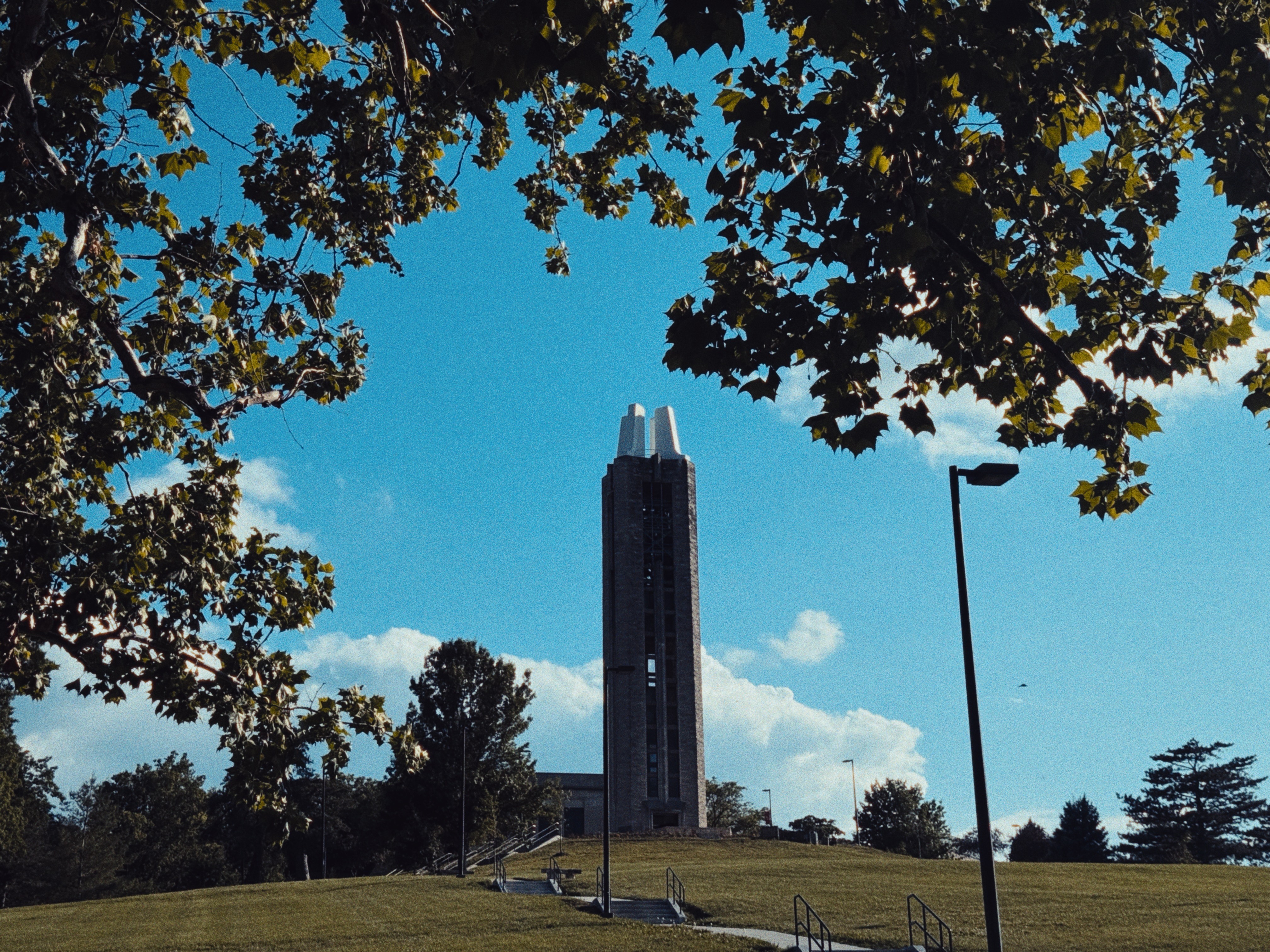
From the top of Mount Oread, the view stretches east across the Wakarusa Valley and north to the Kansas River. The War Memorial Campanile rises above the trees, dedicated to KU students who served in World War I. Allen Fieldhouse sits below, near the recently renovated David Booth Kansas Memorial Stadium -- the eighth oldest college football stadium in the country, which underwent an $85 million renovation. Watson Library anchors the academic core, while the Spencer Museum of Art houses cultural materials with particular emphasis on American Indian collections. The Natural History Museum, founded in 1927, contains significant collections in mammalogy, ornithology, and vertebrate paleontology. Rock Chalk Park, home to women's soccer, serves as a training facility for the 2026 FIFA World Cup. Kansas football dates to 1890, and the Jayhawks won their first BCS bowl game in 2008 with a 24-21 victory over Virginia Tech in the Orange Bowl. The school's colors are crimson and blue, and its teams carry the name Jayhawks -- an echo of the Kansas border fighters whose violence shaped the very ground on which the university stands.
From the Air
Located at 38.958N, 95.248W on Mount Oread in Lawrence, Kansas, elevation approximately 1,020 feet MSL. The campus is the prominent hilltop feature on the west side of Lawrence, easily visible from altitude. Lawrence Municipal Airport (KLWC) lies 4 miles north. The War Memorial Campanile tower is a visible landmark. Allen Fieldhouse and David Booth Kansas Memorial Stadium are large structures on the southeast side of campus. The Kansas River flows along the north edge of Lawrence. The Haskell-Baker Wetlands are visible to the southeast. Best viewed at 3,000-5,000 feet AGL, with the hilltop campus contrasting against the surrounding flatter terrain.