University of Manitoba
Marshall McLuhan once wrote for the student paper here. So did Izzy Asper, the media mogul who built CanWest Global. The Manitoban has been publishing since November 5, 1914, making it one of Canada's oldest student newspapers, and the caliber of people who passed through its offices says something about the broader institution. The University of Manitoba, founded in 1877, was the first university in western Canada. It sits on the Fort Garry campus in Winnipeg's south end, a sprawling complex of research buildings, athletic facilities, and five affiliated colleges where courses range from English to engineering to French-language instruction at the Universite de Saint-Boniface. With 96 Rhodes Scholars -- more than any other university in western Canada -- it has quietly shaped the intellectual and professional life of the prairies for nearly a century and a half.
A Province Builds Its First University
Manitoba was only seven years old as a province when the University of Manitoba received its charter in 1877. Western Canada had no university at all. The institution began as an examining and degree-granting body that federated existing denominational colleges, a model borrowed from the University of London. St. John's College, St. Boniface College, and Manitoba College pooled their resources under a shared administrative umbrella. The approach reflected the realities of a young, thinly populated province: no single institution had the enrollment or funding to stand alone. Over time, the university evolved into a full teaching and research institution. The Fort Garry campus -- its main campus today -- grew around buildings that originally served the Manitoba Agricultural College, which merged with the university in 1924. The oldest building on campus, the Administration Building at 66 Chancellors Circle, dates from that agricultural college era.
Five Colleges, Two Campuses, One Research Farm
The university's physical footprint stretches well beyond the Fort Garry campus. The Bannatyne campus, located 13 kilometers north near the Health Sciences Centre, houses the Rady Faculty of Health Sciences, including the Max Rady College of Medicine with its 27 academic departments and roughly 1,630 faculty members. The Brodie Centre anchors this medical campus, connecting teaching hospitals, the Neil John MacLean Health Sciences Library, and the College of Pharmacy, which moved from Fort Garry to the new Apotex Centre in 2008. The James W. Burns Executive Education Centre occupies the second floor of a 1911 building near Portage and Main -- originally the headquarters of the Great-West Life Assurance Company, now a designated provincial heritage site. South of Winnipeg in Carman, the Ian N. Morrison Research Farm serves the Department of Plant Science. Five affiliated colleges -- Saint-Boniface, St. John's, St. Paul's, St. Andrew's, and University College -- each maintain their own faculties and identities within the larger institution.
From Smartpark to Subatomic Particles
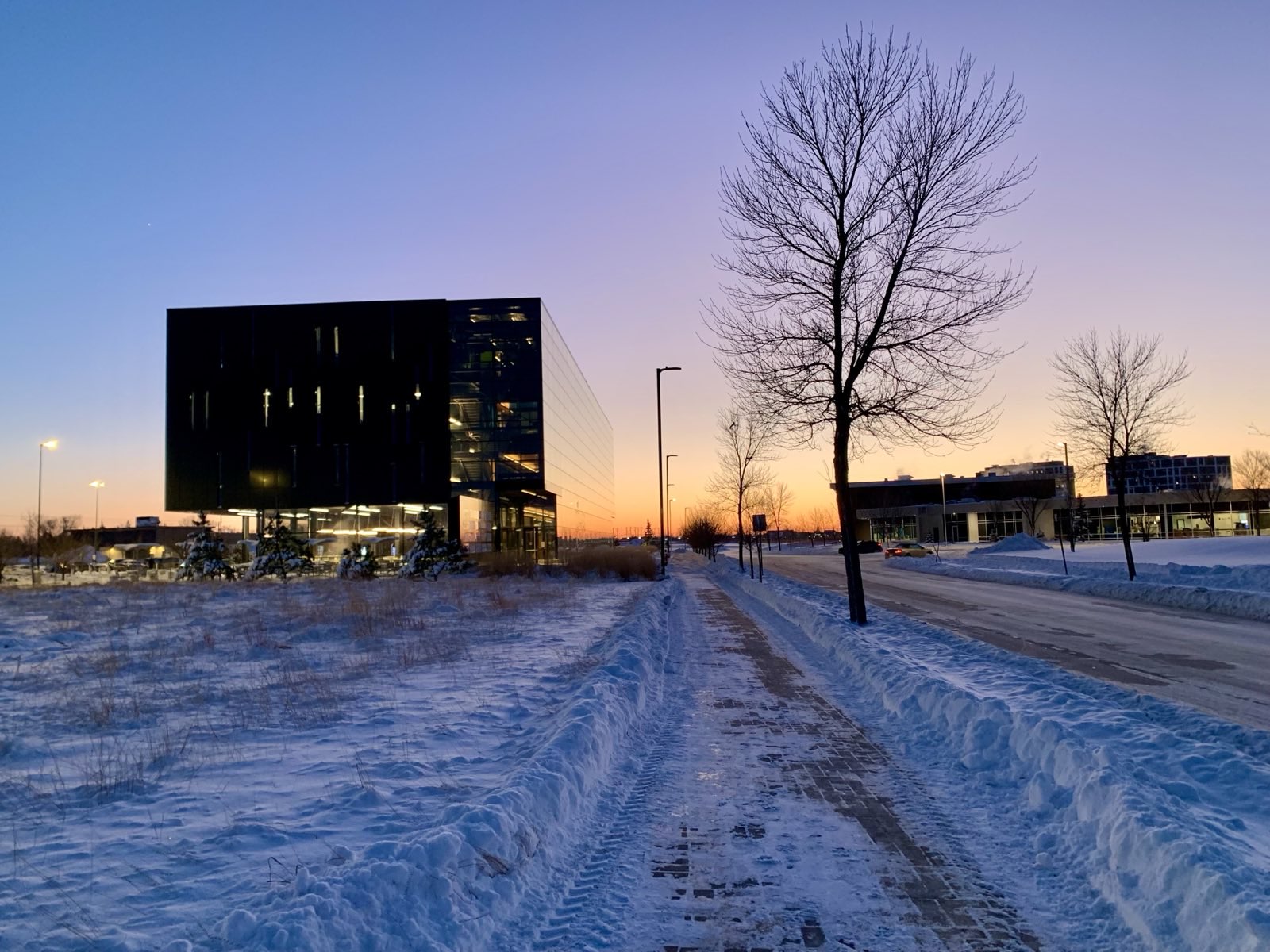
In 1999, the university launched Smartpark, Manitoba's primary research and technology park. By 2019, it had grown to at least nine buildings, anchored by the 75,000-square-foot Smartpark Innovation Hub with its 4K video walls, lab spaces, and a ground-floor atrium. Tenants range from agricultural biotech firms like Bayer Crop Science to tech startups incubated at the North Forge Technology Exchange. The academic journal Mosaic, dedicated to the comparative study of literature and ideas, has been published here since its first issue in the fall of 1967. The Faculty of Human Ecology, which began in 1910 as a mere diploma in Household Sciences at the Manitoba Agricultural College, grew through decades of transformation -- School of Home Economics in 1943, official faculty status in 1970, renamed Human Ecology in 1981 -- before being dissolved in 2015, its departments absorbed into other faculties. That arc from household science to interdisciplinary research mirrors the university's own evolution from a frontier examining board to a research-intensive institution.
Bisons, Boulders, and a World Record
The Manitoba Bisons compete in U Sports, Canada's national university athletics league. Their facilities include Princess Auto Stadium, which opened in 2013 to replace the old University Stadium, and the Frank Kennedy Centre with its indoor tracks, ice hockey rink, tennis courts, and gymnastics rooms. The university's athletics tradition dates back to the fall of 1914, when a track meet against the University of North Dakota at the Winnipeg Exhibition Grounds was judged successful enough to become an annual event. In 1979, U of M student Jan Madden equaled the world record in the 300-yard event. That same competitive spirit runs through campus life. The student newspaper, The Manitoban, prints 10,000 copies weekly during the academic year and distributes them across both campuses and throughout Winnipeg. For a university built on the open prairie, the U of M has always punched above its weight.
From the Air
Located at 49.81N, 97.13W on the southern edge of Winnipeg, Manitoba. The Fort Garry campus is identifiable from the air as a large institutional complex south of the Assiniboine River. Winnipeg James Armstrong Richardson International Airport (CYWG) lies approximately 8 km to the west-northwest. The Red River flows north through the city to the east of campus. Linden Woods and Waverley Heights residential areas surround the campus to the south and west. The Bannatyne medical campus is visible 13 km north near the Health Sciences Centre in central Winnipeg. Best viewed at 3,000-5,000 feet for campus detail, or 8,000-10,000 feet for context with downtown Winnipeg and the river confluence.