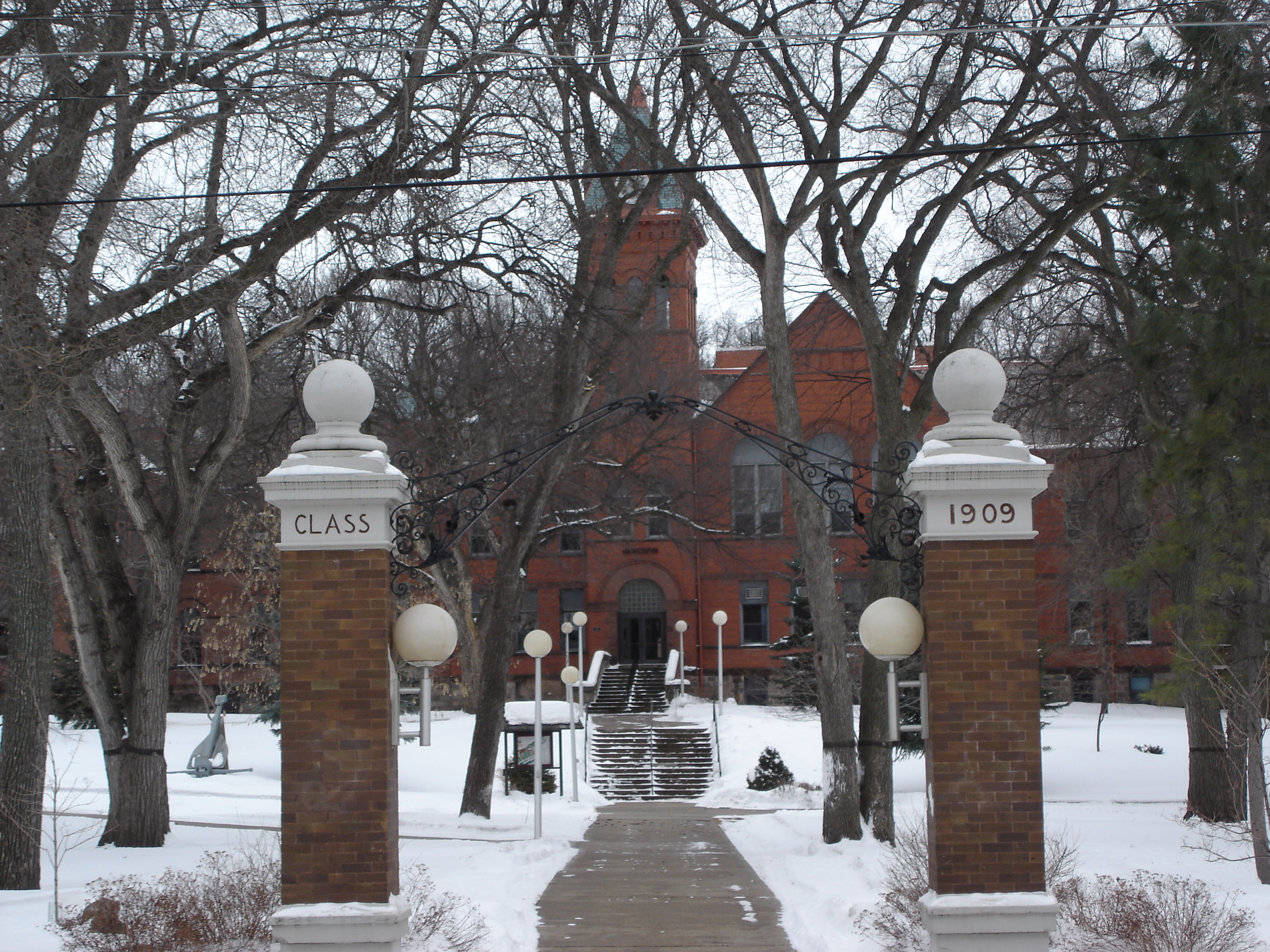
University of North Dakota
In 1883, when the bill establishing a university in Grand Forks passed the Dakota Territorial Legislature, North Dakota did not yet exist as a state. The campus amounted to a few acres of property surrounded by farms and fields, nearly two miles west of town. Students living off campus rode the "Black Maria" -- a horse and carriage bus -- from downtown to class. Today the University of North Dakota sprawls across 240 buildings and 6.4 million square feet, holds R1 research classification, and serves as the state's only home for schools of law and medicine. It predates the state it serves, and that head start has shaped everything about it.
The Flu, the Flood, and the Fires Between
UND's history reads like a stress test. In 1918, the campus became the hardest-hit single institution in the country during the influenza epidemic that killed 1,400 North Dakotans. That same year, classes were suspended so the grounds could serve as an army base during World War I, with male students crammed eight to a railroad caboose in makeshift housing known as Camp Depression. In May 1970, over 1,500 students marched in protest of the Kent State shootings, the largest demonstration in university history. Then came 1997: the Red River of the North burst its banks in one of the worst floods in American history, inundating campus buildings and forcing the cancellation of the rest of the school year. Each crisis reshaped the institution. New housing, new buildings, and a trolley connecting campus to downtown all emerged from earlier upheavals.
Where Pilots Learn to Fly Without Seeing the Plane
The John D. Odegard School of Aerospace Sciences was the first program in the country to offer a degree in unmanned aircraft systems operation. That distinction alone would mark UND as unusual, but aviation runs deeper here than drones. Pioneer aviator Carl Ben Eielson, who made the first flight over the Arctic in 1928, was a UND alumnus. NASA astronaut Karen L. Nyberg earned her degree here. Pearl I. Young, a 1919 UND graduate, became NASA's first female technical employee in 1922, back when the agency was still called NACA. In August 2021, UND became the first university to join the United States Space Force's University Partnership program. From horse-drawn carriages to Space Force partnerships in 138 years -- Grand Forks has covered a lot of ground.
Ice, Courts, and Eleven Championships
The men's ice hockey team has won eight national championships and plays in the Ralph Engelstad Arena, which opened in 2001 and was funded by former Las Vegas casino owner and UND alumnus Ralph Engelstad. The women's basketball team captured three consecutive national titles in 1997, 1998, and 1999. The football squad won the Division II championship in 2001, the same year the Alerus Center opened as their home field. UND's athletic colors are green and white, adopted in the 1920s, though the school's official ceremonial colors are green and pink -- representing the Wild Prairie Rose, North Dakota's state flower. On November 18, 2015, the university retired a decades-long nickname controversy by adopting "Fighting Hawks" as its new identity.
The Phil Jackson Pipeline
Phil Jackson, widely regarded as one of the greatest coaches in NBA history with 11 championships, played college basketball at UND. He is far from the only notable alumnus. Nine governors of North Dakota attended the university. Federal judge Ronald Davies, a UND graduate, ordered the integration of Little Rock Central High School during the Civil Rights Movement. Harry Nyquist, whose work in information theory became foundational to modern telecommunications, studied here. Pulitzer Prize-winning playwright Maxwell Anderson, essayist Chuck Klosterman, and Ebony editor Era Bell Thompson all passed through Grand Forks. More than 100 former UND players have skated in the NHL, including Jonathan Toews, Ed Belfour, T. J. Oshie, and Dave Christian of the 1980 Miracle on Ice team.
Research on the Northern Edge
The Energy and Environmental Research Center, located on the eastern fringes of campus, has established itself as a leader in researching cleaner energy technologies and operates the National Center for Hydrogen Technology. The Chester Fritz Library anchors the largest research library system in North Dakota, housing 1.6 million volumes and serving as both a U.S. patent depository and government document depository. In 2015, UND's economic impact on the state was estimated at more than $1.4 billion annually, making it the fourth-largest employer in North Dakota after the Air Force. A $124-million Medicine and Health Services building opened on the north end of campus in 2016, reinforcing UND's role as the state's sole provider of medical and legal education.
From the Air
Located at 47.922°N, 97.073°W in Grand Forks, North Dakota, at approximately 830 feet MSL. The UND campus is clearly visible along University Avenue in the western-central portion of Grand Forks. The Red River of the North, forming the North Dakota-Minnesota border, is the prominent waterway on the east side of town. Grand Forks International Airport (KGFK) lies just west of the city. Grand Forks Air Force Base (KRDR) is approximately 15 miles west. The Ralph Engelstad Arena and Alerus Center are large, distinctive structures visible on or near campus. UND's aerospace facilities on the western campus are identifiable from altitude. Approach from the south along the Red River for the best overview of both the campus and the city.